

FORGETTING RABIN
"Unrealistic expectations of statehood."
cords' obligations, such as disciplining
Hamas, changing the PLO Covenant or
extraditing terrorists to Israel.
In addition, Mr. Arafat consistently vi-
olated the Accords by inciting violence and
by building a 30,000-50,000 member army
when the Accords call for a 18,000-man
police force. Curiously, both Mr. Rabin and
Mr. Peres could have, but did not, refuse
to continue the Israeli withdrawals until
Mr. Arafat began implementing his re-
sponsibilities. Mr. Peres went so far as
to cover up the fact that the PLO pre-
tended to change its Covenant and only
met to discuss it rather than actually al-
ter it. In order to understand the reluc-
tance of Israel to react to PLO violations,
the period which led up to the 1993 sign-
ing must be examined.
Israel was founded on the premise that
the European Enlightenment had failed
to erase political anti-Semitism because,
according to classical Zionist theory, the
Jews, unlike all other peoples, were state-
less. Thus the solution of 19th-century
Jewish intellectuals was that a Jewish
state would fulfill the Enlightenment
promise of an end to anti-Semitism. After
48 years of statehood, this dream has still
not materialized.
As a result, the architects of the Oslo
Accords believed that once Israel ceased
"occupying Arab land" or "oppressing
Arabs," Israeli normalcy would achieve
.
the international recognition and goodwill
Israelis felt they deserved.
However, for many Israelis, their post-
Oslo life had become intolerable to such a
degree that people were scared to ride the
buses to and from work. Unfortunately,
the recognition of this reality was subor-
dinated to the hope of fulfilling a century-
old dream of an end to hatred.
Educated to believe anti-Semitism/anti-
Zionism would one day end, a "crisis of
confidence" had settled over Israel when
Israel's pariah status seemed permanent.
U.N. condemnations, negative publicity
of Israel's handling of the 1989-1991 in-
tifada and government actions which
made Israelis feel insecure — such as the
outdated reliance on U.S. foreign aid, the
1987 canceling of the Lavi fighter-plane
project, Rabin's 1989 release of 1,500 con-
victed PLO terrorists, which led to the in-
tifada, and Israel's 1991 failure to defend
itself and retaliate against Iraqi Scuds —
added to this crisis.
Add to these events a relentless terror
campaign waged over a period of decades
intended to weaken the Israeli resolve to
defend herself and a concurrent propa-
ganda campaign intended to delegitirnize
Israel's right to a state and the result is
a people ready to do anything to solve their
seemingly insurmountable problems.
The reason Israel was not able to re-
spond appropriately to these threats was
due to the nature of her political system
which was unresponsive to the concerns
of her citizens.
Israel was founded primarily to eradi-
cate anti-Semitism. This was to be
achieved by creating a morally superior
society in order to prove her worthiness of
international acceptance. As a conse-
quence, it was not deemed necessary by
her founders to allow the individual a po-
litical voice.
For example, Mr. Rabin's refusal to
learn from his mistakes was reflected in
his insensitivity to the death and st iffer-
ing resulting from his continuation of the
Accords despite flagrant PLO violations.
According to the thought process which
precipitated Oslo, since Mr. Arafat had
pledged peace, the post-Oslo terrorist at-
tacks were "enemies of peace" andthere-
fore the Israeli casualties did not signal to
the Labor elite that the Accords were not
achieving peace. Thus the inability of the
Israeli voter to influence the course of
these events led to a climate of despera-
tion which in turn led to Mr. Rabin's as-
sassination.
The prime error of the Accords was that
the Laborites and their supporters see Is-
raeli appeasement of Mr. Arafat as a
means of facilitating Israel's internation-
al acceptance and fulfilling secularized
messianic promises of global peace via
"tikkun olam" or "repairing/perfecting the
world." This validates their unre-
sponsiveness to PLO violations as
a means to a higher goal.
Mr. Arafat and his supporters
clearly understand the Israeli
mantra-like desire for peace and
see the Accords as a continuation
of their terrorist war to destabilize
and delegitimize Israel via a
"Phased Plan" to destroy the Is-
raeli state (Netanyahu, A Place
Among the Nations, pages 219-
225).
According to the Egyptian in-
troduction. to The New Middle
East, Mr. Peres' book illustrates
the Israeli plan for the "economic
domination of the Middle East."
Significantly after the Sinai with-
drawal and 17 years of peace,
trade with Egypt remains in-
significant and its government
press is virulently anti-Israel.
The bright light on the Israeli
horizon was the 1996 direct elec-
tion of Binyamin Netanyahu. Af-
ter Mr. Rabin's assassination, it
was thought that a Labor victory
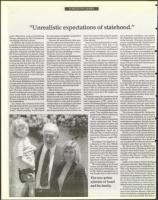
The new prime
minister of Israel
and his family.
was a foregone conclusion. As a result,
Mr. Netanyahu toned down his opposition
to the Accords. However, the power of
events overshadowed Mr. Rabin's death,
leading to Mr. Netanyahu's victory.
For the first time in Israeli history the
prime minister was elected by a majori-
ty of citizens and he is accountable, as a cJ=),
result, to the voters. It is precisely this
quid pro quo relationship between rep-
resentative and voter which has been sore-
ly lacking since Israel's birth and is the
cause of many of the self-inflicted prob-
lems Israel faces today.
That Mr. Netanyahu understands the
consequences of his election is evident by
his reluctance to proceed with the Accords
and his disciplining of Foreign Minister
David Levy after Mr. Levy met privately
with Arafat.
Explaining why he, not Mr. Levy, would
be responsible for foreign policy in the fu-
ture, Mr. Netanyahu explained, "I, not
Levy, was elected by the voters..." Ap-
parently Mr. Netanyahu acknowledges
his responsibility to the voters' concerns
and is determined to allow their senti-
ments to guide his actions. (-
In addition to being the proper course,
this will help his re-election if he is suc-
cessful. However, there are many insti-
tutional obstacles that Mr. Netanyahu
must overcome if he is to implement the
security he envisions for Israel.
The primary obstacle Mr. Netanyahu
faces is the precedents successive gov-
ernments have established. As a result of
these precedents, Israel must make un-
reciprocated concessions, formally known
as "confidence building measures," and Is-
rael is inordinately susceptible to inter-
national pressure. Both of these conditions
area result of Israel's pre-Netanyahu era.
. Firstly, Israel's early Zionist thinkers
set the pattern of unrealistic expectations
of statehood, in and of itself, solving all
Jewish/Israeli problems. As a result, Is-
rael's leaders believe they are always one -
concession away from an end to war.
Mr. Peres' book The New Middle East,
an Israeli version of Presidents Bush and
Clinton's "New World Order," is a perfect
example of the genre of unrealizable utopi-
an fiction like, Moore's Utopia, Marx's
Communist Manifesto and Herzl's Alt-
neuland.
Lastly, in the absence of direct elections, '
past prime ministers, like Menachem Be-
gin at Camp David and Yitzhak Rabin at
Oslo, were deprived of constituent influ-
ence to offset the international pressure ,
they faced. Mr. Netanyahu's ability to
withstand the pressure to close the Tem-
ple Mount tunnel reflects the positive ef-
fect of direct elections and the greater
latitude and confidence it allows him to
defend Israel's interests in word and deed.
Compare the fear-ridden op-editorials
in the Israeli daily Ma'ariv on the eve of
then-Prime Minister Shamir's 1989 trip
to the United States, anticipating the pres-
sure he would unsuccessfully face if an in-