

•
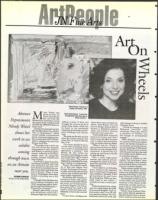
Mindy Weisel: Flowers fora
Country, silk-screen, 1991.
indy Weisel was
Right: Mindy Weisel: "I come from
Abstract
about to leave for
a background where there was no
Israel when she got
artistic ambition."
•
the call from the
Smithsonian Institution: Could
Expressionist she
please create a stylized work reflects a sense of hope and
of art for the 1996-98 Artrain na- struggle for survival as do so
many of her works, which can
tour?
Mindy Weisel tional
be
found in the permanent
During her personal travels,
she thought about the exhibit, collections of museums, govern-
"Art in Celebration!," which ment buildings and corpora-
shows her would
include commissioned tions.
The piece can be seen up-close
pieces commemorating impor-
when the Artrain stops in Ann
tant
events
since
1972.
She
de-
work in an cided to celebrate the end of the Arbor Nov. 2-3 and in Warren
Nov. 9-10.
Persian Gulf War.
"I'm always thrilled to be in-
project was a great ego
exhibit trip "The
with all the fine company volved with something that's
represented on this Artrain," very current or something that
said Weisel, an abstract expres- represents a memory," said
coming sionist,
referring to 33 fellow Weisel, 49, who writes her
artists such as Alexander thoughts and feelings on each
Calder, Georgia O'Keeffe and canvas that later will be covered
through town Dale
over with paint. "The work is
Chihuly.
"I arrived in Israel just after triggered by something I'm read-
the Persian Gulf War, and I was ing, or feeling or remembering."
Weisel, who earned a bache-
on an Artrain very
pleased at the time with
how America handled the con- lor of fine arts degree from
flict. It was April, and Israel was George Washington Universi-
near you. full
of flowers. When I came ty after marrying and starting
a family, has accepted other dra-
SUZANNE CHESSLER
SPECIAL TO THE JEWISH NEWS
back to Washington that same
month, everything was in full
bloom.
"I thought of the Smithsonian
as an American institution, and
I felt I was giving a gift to Amer-
ica through the Smithsonian —
'Flowers for a Country.' "
Weisel's silk-screen, printed
with 48 brilliant colors and a
feeling of light and movement,
where there was no artistic am-
bition," said Weisel, who was
born in Bergen-Belsen after it
became a displaced persons
camp, and moved to America
when she was 3 years old.
"I don't think there was an art
book in the house, and I don't
think I was ever taken to muse-
ums. I suspect that genetically
I got my artistry from my father.
"When I was 14, I found a
pencil drawing that my father
did after he was released from
Auschwitz. It showed the sun
coming up, and I was so moved
by that drawing."
With a junior high-school
teacher who noticed and en-
couraged her talent and a hus-
band who believed in it, Weisel
forged ahead.
"I was raised in an Orthodox
home, where it was expected
that I would marry young and
raise children," she said. "I did -
matic public commissions.
get married at 18, and I have
She did the 1987 Amnesty In- three daughters. While my hus-
ternational Poster and a paint- band went to law school, I
ing commemorating Eli Wiesel, worked and went to school part
her cousin, for the Internation- time.
al Human Rights Law Group.
"I didn't graduate from college
The painting was a gift to the until two weeks before the birth
relative whose last name coin- of my second daughter. I got my
cidentally is close to her married first studio when I was 28 and
name.
just started working. I'm very
"I come from a background ambitious about my work and
still manage to keep a modern
Orthodox home.
"I think my energy is a real
Holocaust survivors' child
syndrome. Every day, there's
a question of whether you
did enough or accomplished
enough."
When Weisel's work reflects
her parents' Holocaust experi-
ences, she thinks of projects as
her parents' personal history,
not as renderings of Holocaust
themes. Trying to come to terms
with the pain and loss, she used
the number on her father's arm
as a graphic element.
A series in tribute to her
mother, "T Ai, Let's Dance," came
after the death of her mother
and included fabric remnants
from her mother's dresses.
Other artistic paths include
her "Touching Quiet" series,
which was completed during a
painting fellowship at the Vir-
ginia Center for Creative Arts.
Surrounded by 600 acres of
country fields, she painted her
reactions to the silence of the
rural area, and the results in-
clude A Storm of Solitude, The
Fields and The Lake.
Weisel, whose husband, Shel-
don, is from Detroit, spends con
siderable family time in Israel,
where relatives from her hus-