

Eyes
h
From
THE Ann Weiss preserves
the past with her camera.
.es LYNNE KONSTANTIN SPECIAL TO THE JEWISH NEWS
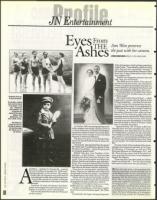
Clockwise from top:
A day at the beach.
An old man, viewing
Eyes from the Ashes
in Jerusalem, cried
out, "I danced at
that wedding!" He
recognized the
portrait of his older
brother, Emil
Wertzberger, and
Emil's bride, Jenny.
This photo of a
young boy after his
first day at cheder is
the one that made
Ms. Weiss pull out
her camera.
C/)
LU
C/)
1-
C)
CC
1-
U-1
LU
1--
88
small boy — perhaps 7 or 8 years old — poses in
his school clothes in the garb of a "little man,"
staring solemnly at the camera. His creamy
cheeks belie the innocence and youth that his
pose attempts to hide, that and the bag of can-
dy
y he holds, passed out at cheder so that the
children's association with school would be
sweet.
Somehow, by some real person, this photo-
graph was brought from someone's home on a
journey to Auschwitz. And it was left there.
This was the photo that made Aim Weiss pull
out her camera.
In October 1986, the photographer/journal-
ist/law student was among a group of Jews on
a Jewish Federation of Greater Philadelphia-
sponsored mission to then-Communist East-
ern Europe, which included a visit to the State
Museum of Auschwitz-Birkenau.
The group was given a more detailed-than-
usnal tour and permitted access to areas usu-
ally denied.
"At one point, I got separated from the group,"
Ms. Weiss said. "I needed some silence to hear
the facts I was feeling ... I found the group just
as our guide opened a door."
Behind that door were bunches of pho-
tographs — 2,400 of them — that Jews had
brought with them from their homes to the
camps. They were the photos of mothers and
fathers, friends and teachers, pets and store-
fronts. They were the photos of the lives they
led, their accomplishments, their celebrations,
their days at the beach and their milestones.
These are the photographs, explained Ms.
Weiss, "that give an intimate view of the lives
of real people, not from the outside — but life from
the deepest place, the inside, the core: the soul.
"These were the photos that people grabbed
when forced out of their homes; the one precious
photograph that they couldn't live without."
And these are the photos that lay in a room,
hidden from the world for over 40 years.
"I looked at this little boy, and I knew I couldn't
let him be covered in darkness again," Ms. Weiss
said.
Immediately, she began taking photographs
of the photographs, which had been pasted into
ledger books. "I was literally pulled out of the
room; the [tour] bus was leaving," she said. "I
felt myself quite immobilized, because I didn't
know how to leave these photos there, these
last vestiges of life."
Finally, her companion turned to her and
said, "Ann, you will be back."
She didn't go to law school. Two years af-
ter discovering the photos, she returned to
Poland, was granted permission from the mu-
seum's director to photograph the photos, and
began painstakingly doing that, one by one.
"It was grueling, yet I couldn't stop. I knew
I would never have another chance to uncov-
er these people."
The result of this trip to Poland — which
happened to coincide with the March of the
Living at Auschwitz — was Eyes from the Ash-
es, a 15-minute film documenting the pho-
tographs and the march. It was premiered in
1988 at the first-ever International Conference
of Children of Holocaust Survivors in
Jerusalem. Excerpts of the video had been
shown on TV in Israel the night before the
screening, and the next day Ms. Weiss received
calls from all over the country, from people
wanting to see more photographs. It was then
that she decided to return to Poland a third
time, to complete the project.
Approximately 125 of these 2,400 pho-
tographs have now been compiled into a travel-
ing exhibition, also titled Eyes from the Ashes.
Dr. Charles Silow, president of C.H.A.I.M.-Chil-
dren of Holocaust-Survivors Association In Michi-
gan, which is co-sponsoring the exhibition's visit
to Detroit, says the photographs show that 'these
are real people who lived, breathed and loved
life."
One copy of each of the hundreds of found pho-
tographs are housed permanently at Los Ange-
les' Museum of Tolerance, as well as at the
Holocaust Museum in Washington, D.C., and
Ms. Weiss brings copies of all of the photos to
show to groups of survivors, in her attempt to
identify the subjects.
`These eyes from the ashes speak not of their
death, but of their life ... It is my hope to bring
back names to the many who are nameless."
V Eyes from the Ashes, a photography exhi-
bition by Ann Weiss, will run through Oct. 31
at the Maple-Drake Jewish Community Cen-
ter. An opening reception will be held 8 p.m.
Saturday, Oct. 26, followed by a lecture by Ms.
Weiss. She encourages attendance by friends,
family and neighbors of survivors — and sur-
vivors themselves — particularly from the re-
gions of Bendin and Sosniwiecz, Poland, as it
was mainly from these sister cities, and their
surrounding areas, that the photographs were
taken. For more information, or to arrange a
private viewing, contact Dr. Charles Silow,
r