

STN Entertainment
Kindertransport: The Director
S fitting in Caribou Coffee in West
Bloomfield on a Sunday evening,
Rivi Yaron seems, at 37, not much
older than the crowd of 20-some-
things drinking coffee in this suburban
hangout. In her Israeli-inflected accent
she is voluble — and open — about
Kindertransport, a play by Diane
Samuels that she is directing at Jew-
ish Ensemble Theatre.
She graduated as a theater major from
the University of Tel Aviv in 1984 and
has since worked as a freelance director
in Israel and in England.
In 1993, when in England, she was
given the script of Kindertransport pri-
or to its first production, but she didn't
read it. When, this year, she accompa-
nied her husband to Detroit for his three-
year residency in obstetrics and
gynecology, she got in touch with the
Jewish Ensemble Theatre.
Evelyn Orbach, JET artistic director,
put her on a play-reading committee.
"Evie and I had the same opinions on
the plays," said Yaron, the mother of 2-
year-old Noa (named after "the first fem-
inist in the Bible"). She has deep respect
for Orbach and feels "I owe her a lot," for inger, said Yaron, is "the naive
Orbach gave her the opportunity, this child and cold adult." Eva attempts
to deny the past and changes her
spring, to direct two staged readings.
"It was challenging," Yaron said, not- name to Evelyn. "She lied, lots of
ing that play directing here is less in de- curtains drawn against the truth,"
mand than in her native Israel. "Here Yaron said of Eva/Evelyn.
At first, Yaron was not sympa-
everyone goes to movies; in Israel, play
going is more 'in.' " Orbach liked her thetic to the character. "OK, you
work and when this season's repertory had a difficult childhood, but at a
was up for assignment, Orbach offered certain point you have to commu-
her two works to choose from: One was nicate with others, share your
thoughts." But as Yaron began
Kindertransport.
"In Israel, I grew up with the Holo- work on the play with the actors,
caust. In many ways I find it difficult "eventually I understood her," she
to cope with it as dramatic material. I said. Reconciliation with the.past
read it because [Orbach] wanted to know and "confronting demons from the
past are the themes." For Yaron,
what I thought about it."
"The second reading was really mag- too, there seems to be some recon-
ic," said Yaron. "It's been a long time ciliation with her own feelings
since I met someone with such deep, in- about the Holocaust.
Kindertransport caught Yaron's
telligent and dramatic writing [as Diane
Samuels]. It's very human," she added, sympathies, this struggle of a
becoming reflective. "My mother-in-law woman to put her past and her
went through something similar and I daughter's future into a seamless
dedicate the show to her." She and Or- whole. Yes, it is a play about Holo-
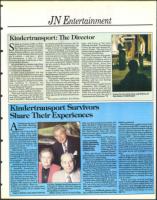
bach agreed she'd direct Kindertrans- caust survivors, but, she said, it Director Rivi Yaron directs Cheryl Leigh Williams and
Dana Acheson in Kindertransport.
"transcends the Holocaust." ❑
port.
The central character, Eva Schles-
Kindertransport Survivors
Share Their Experiences
11 stories are the same,"
Af
said Edith Maniker,
"and each story is dif-
erent."
Maniker was 8 when she fol-
lowed her older sister from
Leipzig to London in July 1939.
She was one of 9,354 children
who were transported out of Ger-
many by train and boat to Eng-
land, America or Paraguay. The
oldest transport was 17, the
youngest 2 months.
Rosie Baum, whose husband
Henry was also a Transportkind,
was a young teen when she came
to England from Bavaria. She
speaks of "the supreme sacrifice
of my parents — the ability to let
go of a child — their selflessness."
Assimilation of the children
spirited away from their parents
— forcefully dramatized in
is a way of
Kindertransport
dealing with the losses, loneli-
ness and fears. "I never told peo-
ple I was born in Germany. The
kids' fathers might be soldiers,"
Baum recalled of her time in
England. She learned to speak
English successfully. When, at
16 she had to register as an enemy alien,
"it was devastating. All of a sudden I was
an enemy."
Later, in Detroit, when asked where she
—
was from, Maniker would say she grew up
in England. "Really and truly, because
when I meet survivors of camps I (do) not
see myself as a survivor."
Jeffrey Garton, who at 16 went to Eng-
land, was later joined by his brother and
sister. His father, a Polish expatriate, saw
the handwriting on the wall and began
planning for the family's escape even be-
fore Kristallnacht. They, like others,
planned to meet again, to reunite. For him,
it was a happy ending.
Garton, now a docent at West Bloom-
field's Holocaust
Cantor Harold Orbach,
Center, stayed in
standing, Edith Maniker hostels in England
and Hans Weinmann: As and Scotland, liv-
children, they were
ing a "kibbutz life
transported out of
consistent with my
Germany to safety.
personal Zionism."
When, after the war, he found his par-
ents in Belgium, all but one sister had em-
igrated to the United States.
"We lost our childhood," Garton says.
Cantor Harold Orbach of Temple Israel
was also just 8 when he joined his broth-
er in an English home from his native Dus-
seldorf He doesn't remember much about
the years away from his parents.
"I don't remember how long (we were)
separated," said Orbach. "I haven't chron-
icled it. I stayed away from that. We have
a tremendous feeling of guile' for having
survived when others did not, he said.
It was not until the 1960s that he read
The Last of the Just by Andre Schwarz
Bart, and it unlocked a "lot of painful ex-
periences."
Giving up a childhood, parents, fami-
lies, a whole culture were the losses these
children sustained.
Hans Weinmann, another survivor and
also a docent at the HMC, stated that the
"statistics about Kindertransport indicate
that the children between the ages of 7
and 12 suffered psychological problems,
some turning to crime or suicide. For the
younger child — like the play's central
character — there was great trauma in
surviving. The word 'survivor' is a ques-
tion of definition," said Weinmann. "The
accepted definition is anyone who lived be-
tween 1933 and 1945 on German or Ger-
man-occupied land and was a member of
the target group and managed to stay
alive."
Even those who remained in relative
safety in England were subjected to bomb-
ings and rocket attacks. Their tenuous ad-
justment was further upset when they
were evacuated to the countryside with
other English children during the Blitz.
This happened to Maniker, but she re-
members most vividly watching her sis-
ter leave on a train in Germany bound for
England before her. It was the first time
she saw her father cry. Neither of her par-
ents survived.
Orbach said that until he read that
book, "I had avoided the whole issue. Still
my brother and I have talked about it a
great deal," and although their parents
are alive and living in Southfield, the Holo-
caust "cheated many things out of my
life." ❑