
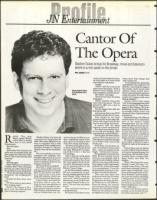

Cantor Of
The Opera
Stephen Dubov brings his Broadway, movie and television
talents to a rich career on the bimah.
PHIL JACOBS EDITOR
Cantor Stephen Dubov:
From Broadway to the
bimah.
uncle and aunt's Queens home,
as if the sight of it would make
the telephone ring faster.
It rang.
"Hello," said the man on the
other end of the phone. "This is
Hebrew Union College. You've
been accepted to cantorial school."
Mr. Dubov was happy.
About an hour later, the phone
rang again.
"Hello," said the voice on the
other end of the phone. "We are
pleased to offer you a part in
Shenandoah."
ewind. Now stop.
Scene: A giant "Marsh-
mallow Man" is chasing
man in the movie
Ra
Ghostbusters.
LU
Rewind again.
Stop.
Remember John Travolta, the
white suit, the colorful floor, the
disco music and "Saturday Night
Fever"? Who is that dancing near
Travolta?
Stop.
Rewind again.
Robin Williams, Tim Robbins,
"Cadillac Man"? Who's that guy
playing one of the detectives in
the standoff at the car dealership?
`This is the dawning of the age
of Aquarius." Are we talking Hair
here?
Broadway? Been there, done
that.
TV? How about a soap opera,
"The Guiding Light."
Opera? The Pirates of Pen-
zance and the Metropolitan
Opera Training Program.
Stephen Dubov sits down for
a second in his Temple Beth El
office. How many offices have you
been in equipped with a baby
grand piano? In the middle of con-
versation, he belts out, "Moriah,
Moriah, they call the wind Mori-
His voice explodes out of con-
versation into perfectly rich,
beautiful, deep sounds. It was too
bad he couldn't sing all the an-
swers to questions posed to him
during an interview.
The most obvious question?
How does a singer and actor
end up on the bimah at Temple
Beth El? The temple, once divid-
ed in controversy, is now hum-
ming with harmony. And it's not
just in the personnel department.
Cantor Dubov was meant for
the bimah. Here's a guy who,
when he was a teen growing up
in Miami, was brought in as a
high-school student to conduct
High Holiday and Shabbat ser-
vices at Temple Beth Am. For
Was he happier than after the
first phone call?
Let's just say that he put HUC
on hold for awhile, like 17 years.
Even though he was busy
enough on film and on stage, Mr.
Dubov still missed what he felt
was his real calling, the bimah.
It wasn't, after all, being
chased by a giant marshmallow.
But there was another impe-
tus as well: the changing, often
unpredictable world of theater.
Case in point. He didn't receive
years and years, he filled in as ei- a part as "Gus, the opera cat," in
ther a substitute cantor or stu- Cats because a costumer thought
dent cantor at temples in New he, at 6-feet-1-inch, was too tall
York, New Jersey and Florida.
for the part.
Sometime during those years,
Then there was the time, he
he dreamed about the bimah and said, when Robert Goulet nixed
the stage. Mixing the two, figur- him — again, he suspects, for his
ing out how to do it — that was. height — for the show Camelot.
his challenge.
The application went back into
After a stint as a sixth-grade HUC. He was accepted, but not
teacher in Florida, he rented a before he was rejected. And it
truck and moved to New York. wasn't for lack of ability. School
He would audition for the Broad- officials were concerned he'd nix
way show Shenandoah, and ap- them again if a Met opportunity
ply for cantorial school at the surfaced. Mr. Dubov demanded
Hebrew Union College.
to be reconsidered. It was his
At the Shenandoah audition, staunch desire to become a can-
850 men competed for six posi- tor that reversed the decision.
tions by singing eight bars of the
"They saw that there was
song "Moriah." After "thank you nothing on Earth that I'd rather
very much," which he heard the do than be a cantor," he said.
directors say to many before him, "Singing from the stage and from
they asked Stephen Dubov to re- the bimah are so very different.
main. "Can you stay and dance From the bimah, you express
for us?"
your true inner self as a message
They said they'd call him on of prayer from the people to God.
a designated day.
When you are putting a charac-
He stayed by the phone at his ter together for a show, you some-
times draw from things that
aren't really real.
"I was looking for a spiritually
centered life," he continued. "At
Beth El, I can bring the stage to
the temple. And I can do roles
without being turned down.
Show business doesn't present a
sense of security. It's a life where
people don't always walk away
feeling satisfied."
Cantor Dubov's first major
"Dole" in the congregational world
came as cantor for Touro Syna-
gogue in New Orleans. This is an
800-family temple. While there,
he brought Jewish music and
klezmer to New Orlean's annual
jazz festival.
Experimenting with different
musical forms is an important
part of the cantor's Judaic
arrangements. On one of his
tapes, the listener hears the tra-
ditional, deep, almost crying in-
tonations of "Shalom Aleichem."
It isn't long before the beat is
picked up and the traditional
prayer and poem moves much
faster and more contemporary.
The cantor is planning to have
a jazz night on March 14 and a
Broadway night at the temple as
well.
Cantor Dubov came to Detroit
as part of Rabbi Daniel Syme's
new clerical leadership team. He
moved here with his wife, Chris-
tine Saloc Dubov, a writer of chil-
dren's books, and their two
children.
"When I first heard the word,
`Detroit,' I said, 'No way,' " re-
counted Cantor Dubov. 'Td done
road shows through Detroit. I
knew what it looked like. I was
there performing Pirates of Pen-
zance. But then I met the people.
And I saw the need for something
I could provide. It was an oppor-
tunity for me to reach out to Jew-
ish children and adults. I could
bring something here, and I could
make a difference.
"I want to be the best cantor I
possibly can be for Beth El and
serve this community well." El