

GOD'S MASTERPIECE THEATER
tion; and when neighbor still kills
neighbor over religious and eth-
nic differences, Mr. Moyers hopes
his series will serve as a differ-
ent model of discourse.
"Will people continue to watch
even though it's not 'Crossfire?"
Mr. Moyers asked rhetorically.
"Part of my problem with Amer-
ica is that too much of it is 'Cross-
fire."
Crazy For Midrash
D ETRO IT J EWIS H NEW S
I
1--
LL1
5
0
f that political talk show has
become the poster child for
empty, inflamed rhetoric,
Burt Visotzky's study group that
inspired the TV series was just
the opposite. It was an oddly
matched collection of writers,
artists and others that met one
weekday evening a month in a
dining room off the cafeteria at
the Jewish Theological Seminary
in New York.
Raised in a Conservative Jew-
ish home in Chicago, Rabbi Vi-
sotzky remembers attending
Hebrew school, Hebrew high
school, and even the Jewish
Camp Ramah in Wisconsin. He
read the Bible, listened to the sto-
ries, "and basically had a child's
view of the Torah."
After the University of Illinois
in Chicago, he sent himself to the
JTS "to give myself the benefit of
a Jewish education." It was there that he fell in love with
Midrash, the Jewish tradition of interpreting the Bible.
He came to focus on the distinction betweenp'shat, the
simple reading of the text, and d'rash, the more ideolog-
ical interpretation that drags the story into a modern
context.
In 1987, Rabbi Visotzky set up his first discussion
group, mostly of writers, in an effort to learn something
about how the rabbis of old conducted Midrash. "To say,
`I'm going to invent dialogue for Abraham, or rm going
to invent dialogue for God,' is extraordinary irreverence,"
he asserted.
"In the end ... I didn't learn a lot about how the rabbis
developed Midrash," he concluded. "I learned a lot about
p'shat."
In his new book, The Genesis of Ethics, Rabbi Visotzky
maintains that the leap from p'shat to d'rash is what
makes the discussion of the Bible so exciting. From the
literal text of Genesis — what he calls "an ugly little soap
opera about a dysfunctional family" — untold millions
of people have made the Bible, and Genesis especially,
Western culture's pinnacle of holy moral literature.
"In short, then, it is not the narrative of Genesis that
makes the work sacred," Rabbi Visotzky writes. "Rather,
it is in the process of studying Genesis that the trans-
formation takes place." That was the attraction that drew
these writers and artists, and then a separate group of
Wall Street lawyers and CEOs, to that little dining room
in Manhattan month after month, year after year.
But it was also Rabbi Visotzky's funny, provocative way
of leading a discussion of the texts. He simply won't let
respect for the book prevent his group members from get-
ting down and dirty in their talks. 'When you have a lover
you can't be unduly reverent, or [else] you can't make
love," he insisted. "You have to get undressed, you have
to be irreverent, you have to tickle and get a little wet."
When the New York Times declared the discussions
"the best conversations in New York City" in 1991, Bill
Moyers decided he had to check it out. "I saw the piece,
High Culture, Low Art
I.
et there be no mistake: Great ---\
television this is not. Mr.
Moyers blanches at any com-
parisons with documentarist Ken
Burns, who so engagingly pre-
sented America with his rendi-
tions of the U.S. Civil War, the
history of baseball, and the West.
"He's using the best techniques
of cinematography, the best tech-
niques of the medium to bring his-
tory alive," Mr. Moyers explained.
"I'm trying to bring minds alive."
In fact, some are blunt about
the show's commercial appeal.
One person affiliated with the pro-
ject simply called it "dull." Christo-
pher M. Leighton, who heads the
Baltimore-based Institute for
Christian and Jewish Studies, was „7-/
more circumspect. He said the
show might have been more ef-
fective if Mr. Moyers had varied
the format a bit, and maybe kept
each episode to a half-hour.
When Mr. Leighton brought a
group of 27 clergy together this
spring to view some of the tapes
and start talking about them, they
quickly gave up on watching an
entire hour, and cut back to 20
minutes or so per viewing. Grant-
ed, that was partly because they
were chomping at the bit to have
a go at the issues themselves.
Phillip C. Lucas, an assistant
professor of religious studies at
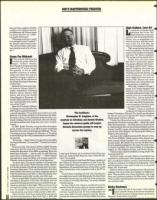
The facilitator:
Stetson University in DeLand, Fla., hasn't seen the shows
yet.
But he warns not to discount Mr. Moyers' ability to
Christopher M. Leighton, of the
attract people to heavy subjects.
Institute for Christian and Jewish Studies,
"I think that Moyers has been very successful ... at
drawing the American viewing public — those who watch
hopes his resource guide will inspire
PBS, thinking people — drawing them into these broad-
- er religious issues that cut across denominations and tra-
Genesis discussion groups to crop up
ditions," said Mr. Lucas, who has just completed a book
across the country.
called Prime Time Religion: An Encyclopedic History of
Religious Broadcasting.
Just look at the unlikely success of Mr. Moyers' series,
`The Power of Myth," which turned a then-obscure aca-
demic named Joseph Campbell into a national guru on c'\
ancient myths. Mr. Moyers has lent his soft East Texas
drawl to projects ranging from the song "Amazing Grace,"
to religion in politics, and most recently to comparative
religion, in "The Wisdom of Faith, with Huston Smith."
"I think he has a kind of credibility among people," Mr.
I went up to Visotzky, sat in on three or four of the sem- Lucas pointed out.
inars, got really excited about the value of this for tele-
And don't forget, he said, religious consumption has
vision," he recalled.
exploded in recent years. More people care about reli-
In a private letter to his friend Eli Evans, president of gion, according to national surveys, and certainly more
the Charles H. Revson Foundation in New York, Mr. people are tuning in to religious broadcasting. "It's a
Moyers described what got him so revved up about the growth industry, if you want to look at it in economic
discussions. He paraphrased some of the letter as part terms," Mr. Lucas said.
of the introduction to his companion book to the TV se-
While he believes that Americans have always been
ries.
religious, they have rarely come together on religious is-
"I heard them wrestling not only with what the sto- sues. 'That would be new, if you could find a way to get
ries might have meant to the first people who heard them Jews and Christians together for Bible study," he said.
thousands of years ago, but with how those ancient sto- `That would be something that's never been done before"
ries connect to everyday life today," he writes of Rabbi on a national scale.
Visotzky's group.
"As they talked, this ordinary, unadorned room be-
came for these few hours a place of creative incubation."
But the group decided it didn't want the intrusion of 66 've always felt Bill is the master of the talking
head," said Mr. Evans, of the Revson foundation.
television to spoil the mood. So when it disbanded a few
"I think he's given talking heads a good name,
years later, Rabbi Visotzky agreed to help Mr. Moyers
recreate the experience for his Public Affairs Television because it doesn't have to be dull."
But the series was not without _ its risks. he maintained._/
Inc.
Risky Business
1