

ing Minister Ariel Sharon that Is-
raeli settlers and IDF soldiers be-
gan firing indiscriminately while
battalion commander, Col. Assaf
Shavit, was standing exposed on an
embankment, trying to calm the
Palestinian demonstrators down.
Col. Shavit was seriously wounded.
There were remarkable tinges of
cooperation, despite the bloody out-
come. In Nablus, Mayor Ghassan
Sha'aka and PLO official Sa'id Ke-
nan responded to a call from a se-
nior Israeli officer by accompanying
the Palestinian ambulance that
evacuated wounded Israelis from
the Tomb of Joseph.
But these were the exceptions. In
other cases, the policemen were ill-
equipped to make politically pru-
dent decisions. High ranking offi-
cers were nowhere and junior
officers were helpless to stop the
rank and file of the 30,000-strong
Palestinian police force.
Most are veteran PLO troops who
spent the years between the 1982
war in Lebanon and the 1994 "Gaza
First" treaty sequestered in the re-
mote camps of Egypt, Iraq, Yemen,
and Libya. More recently, they've
been joined by young "graduates" of
the intifadaMr. Arafat prefers them
in his pay and control rather than
unemployed and disgruntled.
Most of the policemen, insists po-
litical scientist and PNA council
member Abu Amer, simply reacted
emotionally to other Palestinians
being attacked.
"They are Palestinian national-
ists," he said. "One could hardly
have expected them to turn and
open fire on the same people the Is-
raelis were shooting at."
Still, if they lack prestige and ma-
ture political judgment, the Pales-
tinian forces are endowed with
thousands of machine guns, rocket
launchers, explosives, land mines,
and even light mortars.
Only a small portion of this ar-
senal (8,213 rifles, 2,277 revolvers,
216 submachine guns, and 45 ar-
mored cars in Gaza only) has been
approved and registered — by Is-
rael (as called for in Oslo agree-
ments). Heavier weapons have been
smuggled in from
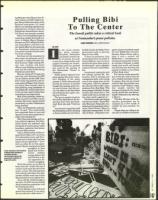
Israeli protesters collect posters Egypt and Jordan.
at Mount Herz! Cemetery in
Israeli military
Jerusalem during a
sources believe that
demonstration against the
the PNA has a spe-
government's decision to
cial apparatus de-
reopen the tunnel.
voted to smuggling.
If for this alone, no one knows
better than Mr. Arafat that loss of
control could mean the end of his
career, at best. The disintegration
of an orderly police force into inde-
pendent militias could urge civilian
demonstrators to turn against him.
Even with Mr. Arafat strongly at
the helm, the IDF remains skittish
about resuming cooperation with
the Palestinian police.
Yet, by Monday, many of the joint
patrols had resumed. In one sense,
the two sides have little choice. LI
Pulling Bibi
To The Center
The Israeli public takes a critical look
at Netanyahu's peace policies.
LARRY DERFNER ISRAEL CORRESPONDENT
TEL AVIV
n the recent election
for prime minister,
Binyamin Netanyahu
won Israel's Jewish vote
by 11 percent. It is safe
to say he no longer holds such
support following the Israeli-
Palestinian mini-war sparked
last week by the opening of
the Hasmonean Tunnel in
Jerusalem.
Public opinion appears to be
going against the prime minis-
ter's handling of the peace
process. A Yediot Aharonot poll
showed 54 percent of Israelis
thought the opening of the tun-
nel was ill-timed. And this sur-
vey was taken on the day before
the territories blew apart, cost-
ing over 70 lives.
The key to people's stand on
the conflict depended on the les-
son they drew from the blood-
shed. Each side said, "I told you
so."
Government supporters said
the Palestinian police's shooting
at Israeli soldiers proved what a
terrible blunder the Rabin-Peres
government made in allowing
them to carry rifles.
"If they are policemen, they
should police their own people. If
they're fighters, then we never
should have given them guns in
the first place," said a vegetable
vendor in Tel Aviv's Carmel Mar-
ket.
Government opponents said
the killings proved Mr. Ne-
tanyahu, both in ideology and
management style, is the wrong
man in the wrong place at the
wrong time. "This is a catastro-
phe, the end of the world," said a
pensioner from Bnei Brak. "The
peace process is finished. In three
months Bibi destroyed it. The
whole world was on our side, now
the whole world is against us."
The Israeli media were laying
into the new leader. "Prime Min-
ister Binyamin Netanyahu sur-
prised even his harshest critics,"
wrote Chemi Shalev, Maariv's
diplomatic correspondent. "In 100
days of `grace'... Netanyahu man-
aged to almost completely topple
the 'new' Middle East of his pre-
decessor, Shimon Peres, and re-
place it with a revived 'old'
Middle East — including an in-
ternational community united in
its criticism [of Israel], a solidly
hostile Arab world, and Israelis
and Palestinians shooting one
another to death on the streets
of West Bank cities."
The Israeli media generally
lean to the left, and as such are
not a reliable barometer of pub-
lic opinion. But even an avowed
centrist like the popular com-
mentator Yosef "Tommy" Lapid,
who usually reserves his
sharpest attacks for the Arabs
and the Israeli left, was skewer-
ing Mr. Netanyahu day after day
in Maariv.
"The first 100 days of the Ne-
tanyahu government can be
summed up in five words: It
couldn't be more terrible," he
wrote.
"People today are willing to ad-
mit only on condition of anonymi-