
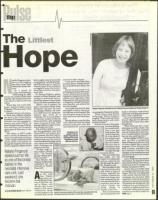

PHOTO BY GLENN TRI EST
The
S2
MMEIMMONP,§0=120.0SMOMMOMPACWZAMONOW2MIOANSWOMO
::,IMP.WaMSSZSOV2K a MM2P2:,'WOOM
XVMSNMOMM",i'MOM.WESMM.Z OMM MS.W o iSSIM:40
O
atalie Fingeroot start-
ed out in life weighing
less than most Rosh
Hashanah chicken din-
ners.
At 1 pound 12
ounces, she entered the
world on Aug. 31, 1983,
, exactly two months earlier than
expected. Her chances of survival
were about as slim as her tiny
wrists.
"Every day was a new chal-
lenge," said her mother, Laura
Fingeroot. "We never knew what
to expect."
Natalie's story is not unusu-
al. Each year, millions of babies
are born in the United States,
hundreds of thousands of whom
find their way into neonatal in-
tensive care units (NICU). In
Sinai Hospital last year, 3,300 ba-
bies were born, and 10 percent
spent part of their stay in the
NICU.
The babies in NICU suffer
from a variety of ailments, but
many are premature and have
a birth weight well below 2,500
grams, about 5 1/2 pounds. Al-
though the majority will not suf-
fer from long-term effects of a low
Natalie Fingeroot
started out her life
as one of the tiniest
babies in the
neonatal intensive
care unit. Last
weekend, she
became bat
mitzvah.
JILL DAVIDSON SKLAR STAFF WRITER
birth weight, some do encounter not want to take a chance.
"I was sure it was false labor,
complications, including breath-
ing difficulties due to underde- but after dinner, dessert and cof-
veloped lungs. Even sucking is fee, we decided to go to Sinai," she
a struggle for some who must re- said.
But the doctors found it was
ceive their nutrition through a
something more than false labor.
small tube.
Dr. Samina Furhad, a neona- Laura's blood pressure had sky-
tologist at Sinai Hospital, said rocketed to dangerous levels; her
changes in technology have al- reflexes were hyperactive. They
lowed the doctors to save babies diagnosed her with preeclampsi ,
born at 23 weeks gestational age. a pregnancy-related blood-pres-
"When I was a resident, we sure disorder, and ordered her
didn't resuscitate babies under into the hospital.
Laura spent the next four days
600 grams," she said. "So much
has changed. Before, a 31-week- and nights in bed in almost to-
er (a child born at 31 weeks ges- tal darkness in the hospital. She
tational age) would be a was also given drugs to stop the
challenge; now it is no problem." labor and lower her blood pres-
Last year, medical workers at sure.
But the efforts to stop the labor
Sinai cared for a girl weighing
about 15 ounces at birth. After were called off when her blood
gaining sufficient weight, her par- pressure continued to rise. She
was rushed in for
ents brought her home.
Not all of the children survive,
but the graduation rate from
Weighing in at 4
Sinai's NICU is 97 percent, leav-
pounds 4 ounces,
ing 3 percent who don't make it.
Natalie Fingeroot was
Some have chromosomal abnor- discharged from Sinai
malities that even the most ad-
Hospital two months
after she was born.
vanced medical technology cannot
cure; others have deformities or
other challenges too
great to surmount.
"If they make it,
they make it. If they
don't ..." Dr. Furhad
paused. "If they don't,
that is too bad."
But Natalie did.
This past weekend she
celebrated her bat
mitzvah at Temple
Emanu-El.
A
t the beginning
of the week
that Natalie
was born, Lau-
ra and Martin Finge-
root of Oak Park were
out to dinner with
friends when Laura
began to feel erratic
contractions. Seven
months pregnant with
her third child, she did
Natalie Fingeroot celebrated her bat mitzvah this past weekend at Temple Emanu El.
an emergency Caesarean section.
"There were so many doctors
in the room," Martin Fingeroot
recalled. 'There must have been
half a dozen doctors and nurses
for both of them."
Natalie arrived on the scene,
her arms flailing,
her mouth emit-
ting a loud and
long scream. Her
14-inch-long body
fit in the hand of
the surgeon and
her head was the
size of a lemon.
Her skin was so
translucent that
her parents could
see right through
it in some places.
"She was so little that
her pinky was the
length of my fingernail
and you could see her
ribs through the skin,"
Mr. Fingeroot said.
She was taken to the
neonatal intensive care
unit where a team of
doctors assessed her
condition. Because her
heart and lungs were
fully developed, the doc-
tors determined that a
respirator was not nec-
essary; Natalie was
strong enough to
breathe on her own.
But an intravenous
Natalie Fingeroot weighed a little more than 2 pounds at the time
line was attached to her
this photo was taken less than a month after she was born.
-
head to introduce medications
and fluids; a feeding tube provid-
ed her with needed food.
Laura was astonished by what
she saw when she was allowed to
visit the NICU three days after
the delivery.
"When I first saw her, I want-
ed to jump out of the window," she
said. "She was so little, and there
were all of these lines and moni-
tors. I couldn't believe I brought
her into this world like this."
In the brightly lit NICU, mon-
itors provided a background
drone of beeps and whirs as a host
of wires tangled like a mess of
spaghetti above Natalie's frail
body. A sensor, attached to her
foot, informed a computer of the
changes in her temperature and
adjusted the heat in her incuba-
tor accordingly.
Laura Fingeroot remained in
the hospital, her high blood pres-
sure slowly ebbing. She was al-
lowed to go home in 10 days, but
Natalie remained in NICU.
As the days and weeks went
on, Natalie continued to face chal-
lenges. First she was diagnosed
with a hernia, then she had a he-
morrhage near her brain. Both
conditions resolved themselves
without any permanent damage.
The doctors also thought she was
suffering from necrotizing ente-
rocolitis, an inflammatory bow-
el disorder which occurs in some
pre-term or low-birth weight ba-
HOPE page 70
CD
C5)
0")
ti
U_J
CO
2
LU
LU
C„
09