

Joining The
Establishment
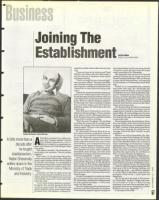
Anatoly Sharansky: Cabinet Minister.
A little more than a
decade after
he fought
totalitarianism,
Natan Sharansky
settles down in the
Ministry of Trade
and Industry.
Beersheba courtyard on a sultry sum-
mer's day: "Anatoly, Anatoly," cries the
frail, shabbily-dressed man, and in a
Afl ash he is locked in an emotional em-
brace with Industry and Trade Minister Natan
Sharansky.
"His name's Levshefer," Mr. Sharansky ex-
plains after a few moments. "We sat in prison
together."
Even today, 10 1/2 years after Natan Sha-
ransky was reunited with his wife, Avital, and
given a hero's welcome at Ben-Gurion Airport
by 250,000 well-wishers, it is remarkable to
think that the diminutive, 48-year-old minis-
ter ever spent a year and a half in solitary con-
finement in Moscow's notorious Lefortovo
Prison.
Ironically, now that he wields power, the
man who has earned world fame as an out-
spoken opponent of totalitarianism must now
meticulously measure his words before talk-
ing to the press.
"I can't enjoy being a dissident anymore,"
he admits. But, already during his first two
months in government, Mr. Sharansky has
clearly stated his views concerning the agen-
da ahead of him: liberalization, wholesale pri-
vatization and the need to reform his own min-
istry.
There are those in the Industry and Trade
Ministry who believe that Mr. Sharansky is
just the visionary to implement those repairs
and improvements.
`There's no doubt the man is open-minded,"
says one senior official. "He knows the differ-
ence between socialism and liberalism, and
also recognizes a middle ground between them.
I think his is a vision that could bring origi-
nality."
Indeed, the communist-raised minister ap-
pears to have refreshingly honest views about
the oft-discussed structural reforms which are
at the heart of the new government's economic
policy. While his cabinet colleagues appear to
be dithering over which companies to tackle
first, and which selling, spin-off or flotation
methods to employ, Mr. Sharansky is far more
forthcoming.
Take Binyamin Netanyahu's much-her-
alded privatization designs. Of any minister
in the cabinet, only Mr. Sharansky openly con-
firms the government has a problem putting
into practice its election promises.
`That's for sure," he agrees. "It's one thing
to criticize the system, but it's another to im-
plement the changes. The need to sell off state
assets is urgent. We have a very conservative,
centralized economy."
Mr. Sharansky believes there is an un-
holy alliance between proletarian blue-col-
lar workers and capitalist businessmen in
Israel. Mr. Sharansky argues that business
leaders are often monopolists who control
entire industrial sectors and vast invest-
ment fiefdoms, and consequently fear such
schemes as the "exposure program," which
aims to reduce duties on imported goods.
The Histadrut-led, public-sector workforce,
meanwhile, fears change, and with it the
possibility of losing its perceived power base,
and more importantly — its jobs.
Giving in to this unwritten employer-em-
ployee pact would be a "strategic mistake,"
concludes Mr. Sharansky. If only allowed to
fully emerge, the free-market, decentralized,
demonopolized economy which Mr. Sharan-
sky seeks would not only generate more com-
petition in the high street, but ultimatelyit is
also bound to result in reduced prices and in-
creased wages.
In order for prospective investors to realize
this is the type of future Israel wants to see,
Mr. Sharansky is insisting his colleagues send
out clear, positive messages — not by their
words, but their deeds.
The ever-thickening plot surrounding the
attempts to sell Bank Hapoalim, for instance,
is transmitting negative signals throughout
DAVID HARRIS
SPECIAL TO THE JEWISH NEWS
the industrialized world concerning Israel's
inclination to join the financially developed
world, according to Mr. Sharansky.
The Hapoalim saga showed him that local
political elements are too closely involved in
Israel's business landscape. Still, he does see
a major role for the government, and especially
for his ministry, in international trade deal-
ings.
Indeed, at an unspecified date, probably
some time next year, Mr. Sharansky has
agreed to return to Russia, not as a blacklist-
ed dissident, but as a visiting dignitary seek-
ing new markets for Israeli companies. So far,
he says, he hasn't thought much about the
trip's personal significance; he has other more
pressing affairs of state to attend to, including
economic links between Israel and the Pales-
tinian autonomous areas.
For the time being, he will not reveal exact
plans, and he has denied newspaper reports
suggesting he intends to close down four re-
gional offices. He acknowledges that the min-
istry's significance has diminished dramatically
over the last 10 years, a development which
he generally hails.
Some bureaucratic downsizing is, there-
fore, inevitable, while the newly trimmed
ministry should focus on increased support
for R&D, creation of free trade agreements
and forming a strategy for taking best ad-
vantage of what he calls "Israel's unique
workforce."
While on his visit to Beersheba, Mr. Sha-
ransky saw some of the Industry and Trade's
incubator start-up programs first hand, like
that of the Russian doctor who is about to
begin marketing a revolutionary surgical
stapling device. Through such schemes, Mr.
Sharansky sees a way of not only absorbing
highly-educated immigrants, but also giv-
ing them the opportunity to contribute in
full to Israel's economic development.
After visiting a plethora of high-tech in-
cubators and low-tech factories, and between
chatting with Bedouins and squeezing an
unscheduled visit in to immigrant volun-
teers at the Zionist Forum, Mr. Sharansky
— with his well-worn, green peaked cap still
resting at a tilt on his famous balding, and
now graying, head — can afford a moment
or two to reflect on his future, and more -im-
portantly, those of his 7- and 9-year-old
daughters.
"I'm trying not to get used to this routine
of 17-hour days," he says. "I hope, with time,
I'll cut it down to 12 or 11. I feel it is a big
drawback of my new life as minister that I
practically don't see my daughters. It makes
Shabbat even more important." ❑
(c) Jerusalem Post 1996
CO
0)
0,
r--
CNJ
CC
LU
CO
LL,
H-
Cl-
LU
(/)
57