

iday services, by listening to the
"old-time chazzanim, like Moyshe
Oysher. I prepare by contemplat-
ing what each song means, and
read about the historical mean-
ing
gation T'Chiyah, describes how
his congregation provides for the
congregants' needs:
"We have returning to us Toba
Spitzer, who is a student at the
Reconstructionist Rabbinical Col-
lege (in Philadelphia), and serves
as a High Holiday resource."
Though it has no cantor,
T'Chiyah has several members
who serve that function.
Barbara Cash is one. A lawyer
by profession, she has read music
since she was 5, and started teach-
ing Jewish music at age 14:
"We have total eqiislity between
men and women. The service is
distributed less by gender, but
more by capability, so everyone
can participate."
Ms. Cash says she is just one in-
dividual within the group who
makes the service.
Another Congregation T'Chiyah
member, Eugene Perrin, agrees
with this concept. "The service is
run by ourselves," allowing each
congregant to feel vital and nec-
essary to the whole.
A professor at Wayne State Uni-
versity School of Medicine, Mr.
Perrin prepares for the High Hol-
Birmingham Temple also en-
courages an "interactive holiday
experience," and then takes it a
few steps beyond.
Everything at Birmingham
Temple, according to music direc-
tor Maria Cimarelli, is approached
from the cultural and historical
perspective, rather than theolog-
ical, and that includes music.
"We use no God-type music,"
she says, "but we do use familiar
tunes with some of the words
changed." For example, one song
is sung in English to the tune of
"Avinu Malkeinu," and "Oseh
Shalom," or "He Who Makes
Peace," becomes "Oseh Ha'Olam,"
with the stress on olam, or
"world," rather than any deity.
Ms. Cimarelli explains that
Birmingham Temple's weekly ser-
vices and High Holiday services
focus on a different daily theme,
which is reflected in the musical
selections.
"For the children's services, we
bring out the shofar, to give them
the history
"We also have two Detroit Sym-
phony Orchestra players who are
temple members: One's a klezmer-
style clarinetist, and there's a cou-
ple from the Metropolitan Opera
Theatre orchestra."
Ms. Cimarelli herself is a singer
with MOT.
She says that "people don't
mind that I'm not Jewish, as long
as I perform my duties."
One of Ms. Cimarelli's temple
duties is hiring other musicians
for the holiday services. All she
asks is that they have a working
knowledge of Jewish music. And
if they don't have that, she will
work with them.
"We are a combination of old
Jewish traditions, newly created
to fit our brand of thinking," she
says.
And part of those traditions is
a dose of some of the most beau-
tiful music in the world, albeit
sampled and reassembled.
Explains Ms. Cash, "I have a
tendency to like the songs that are
up-tempo, that make you smile.
That's what suits our atmos-
phere." El
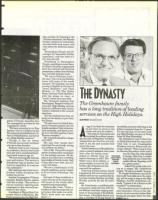
THE DYNASTY
The Greenbaum family
has a long tradition of leading
services on the High Holidays.
ALAN HITSKY ASSOCIATE EDITOR
t age 5, he liked the attention Southfield, has been following in his
he got when he stood on the father's cantorial steps for 11 years.
corner and sang for soldiers.
For the last four, he has been lead-
But when he went home and ing High Holiday services at Young
mimicked the soldiers' gooses- Israel of West Bloomfield.
tep and cries of "Sieg Heil," his father
Mr. Greenbaum was 8 when Can-
slapped him for the first and only tor Schkolnik heard him sing and in-
time in his life and knocked him vited him to join Congregation
across the room.
Mishkan Israel on Blaine and Lin-
David Greenbaum of Southfield be- wood in Detroit. "Then I sang in Can-
came a cantor's assistant a few years tor Reuven Boyarsky's choir until I
later after his family immi-
was 12, when my voice started
grated to Detroit from his Young Israel to change. After that, I couldn't
leaders
native Germany in 1937. His prayer
sing anymore, but Cantor Bo-
David and
father was a ba'al tefillah, a
yarsky
told me, 'Someday you'll
Joseph
prayer leader, as were his late Greenbaum. be a great cantor."
brother, Mr. Greenbaum's two
Asked if he could make a liv-
sons and his nephews.
ing as a singer, Mr. Greenbaum
Following Jewish custom, David laughs. "I'd starve to death," he says.
Greenbaum did not become a ba'al
Dr. Joseph Greenbaum says his fa-
tefillah until he was married. But he ther could 'lust wake up in the morn-
has been leading Shabbat and High ing" and be ready to sing on the High c)
Holiday prayers for the 40 years Holidays. And Mr. Greenbaum con-
since.
tends, "I spend a lot of hours on the
Mr. Greenbaum, a certified public treadmill" in preparation.
accountant, leads services with his
The Greenbaums join hundreds of
son Michael and other singing assis- other Detroiters who go to the inik-
tants at Young Israel of Southfield. Tah for ritual immersion before Rosh
Son Joseph, a Southfield dentist and Hashanah and again before Yom Kip-
also a member of Young Israel of DYNASTY page 70
A
CO
0,
CC
U-1
CO
LU
0-
LU
C.f)