

srae
Brigilitorizon
D
On the eve of a
new year, Israel's
prime minister
discards the
headlines and
offers a confident
interview to
the Diaspora
Jewish media.
INA FRIEDMAN AND LARRY DERFNER
ISRAEL CORRESPONDENTS
espite what the headlines might sug-
gest, early this week things were
looking good to Prime Minister
Binyamin Netanyahu.
Speaking with representatives of the
Jewish media in the Diaspora, he drew an
encouraging picture of the unity of Israeli
society, his handling of the peace process,
and the basic resilience of the religious "sta-
tus quo."
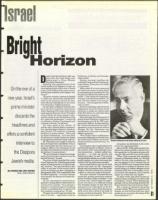
The prime minister, customarily dressed
in a black suit, seemed fully relaxed and fo-
cused on the questions at hand. He start-
ed by offering a friendly jibe at the media,
even dropping a Yiddish expression.
He also spoke confidently of Israel's abil-
ity to prevail over political violence from
within. Speaking of the recent death threats
made against Supreme Court President
Aharon Barak, the prime minister reiter-
ated his resolve to use "the full force of the
law" against the perpetrators. "I simply will
not tolerate a climate of lawlessness and
a climate of threats," he declared.
But when asked if this climate, 10
months after Yitzhak Rabin's assassina-
tion, signaled deeper distress in Israeli so-
ciety, he said: "It's overblown to describe
[Israel] as a violent culture ... We've had
our share of aberrations ... but I don't think
the divisions in Israeli society are deeper
or stronger than the forces which unite us."
Mr. Netanyahu also sought to allay the
fears of Conservative and Reform Jews in
the United States that the "status quo" on
religious affairs was eroding due to the
strength of the Haredi and modern-Ortho-
dox parties in his government.
'We are not going to change the arrange-
ments that have been arrived at over the
last half century," he said.
The prime minister described the modus
vivendi between the Orthodox and secular
sectors of Israel's society as a "slowly evolv-
ing" construct. "You can have films on Sat-
urday in one part of the country and a
closure of a street in another, depending on
demographic shifts. That is essentially what
has been happening — an ad hoc arrange-
ment between the secular and haredi com-
munities."
He also reiterated the position he ex-
plained to visiting Reform rabbis before be-
coming prime minister. "Any attempt to
impose an overall principle of reordering
society is something that we agreed will
have explosive consequences," he said.
Of course, he could not get away from the
issue of the day — negotiations with the
Palestinian Authority and its leader,
Yassir Arafat.
Monday morning's headlines de-
scribed the long-awaited meeting be-
tween Messrs. Netanyahu and Arafat
as "imminent."
When asked if he were pressuring
the Palestinian leader too hard, there-
by endangering his standing, Mr. Ne-
tanyahu turned the focus back on Mr.
Arafat. "I don't think the Israeli gov-
ernment is Arafat's first problem," he
said. "His first problem is his own gov-
ernment ... the management of Pales-
tinian society."
Economic hardships endured by the
Palestinians due to the closure on the
territories, he added, are a direct result
of the PA's failure to undertake deep
commitments on security.
Early this week, the sticking point in
getting Israeli-Palestinian negotiations
moving again was still the IDF's rede-
ployment in Hebron. In Gaza that day,
Mr. Arafat reiterated that the Oslo II
agreement must be honored without
changes. But Mr. Netanyahu was
equally firm on the need to revise the
Hebron agreement.
"We've talked about modifications
of security safeguards so that the Jew-
ish community in Hebron can live rel- Binyamin Netanyahu finds things looking up in Israel.
atively normal and secure lives," he
explained.
Jerusalem, he reiterated, is not a mat-
"Just imagine what would happen if we ter for the negotiating table.
had terrorist attacks in Hebron, which is
Above all, Mr. Netanyahu seemed con-
the juncture of the most politically sensi- fident that despite steady criticism from
tive communities — indeed, radical com- the opposition on his peace process poli-
munities — on both the Jewish and cies, the right and left were not far apart.
Palestinians sides," he said. "If we started
"When I talk to groups that ostensibly
having terrorist attacks on one side, it could support a Palestinian state, as I did last
quickly escalate into violent exchanges that week in Tel Aviv, they invariably say: 'Oh
could scuttle the entire peace process."
yes, we support it, but it cannot have an
Syrian negotiations were on the back army of 150,000 men; it cannot have tanks
burner this week, but Mr. Netanyahu and planes or rockets to threaten us; it
delved into his thoughts about the Golan cannot bring in 2 million refugees on the
Heights. Would he relinquish no territo- outskirts of Tel Aviv or Jerusalem; it can-
ry there in return for peace with-Syria?
not control the airspace; and it cannot
The prime minister indicated that his siphon our water from our aquifer.'
maximalist position essentially matched
"In other words, they [favor] severe in-
Syrian President.Hafez el-Assad's. "I see hibitions that normally do not cohere with
no reason why I should enter the negoti- sovereignty," he said. "We're dealing here,
ations with Syria on a different footing perhaps, with an interesting semantic dif-
from President Assad," he said. "But I am ference between the rival camps in Israel."
prepared to have discussion on the full
But in terms of substance, the prime
range of matters, and in those discussions minister added, "When you speak to most
Syria will be able to bring to the table its Israelis, you will find that they have views
various territorial demands. This is not similar to my own about the shape of the
something we have ruled out."
final settlement:" ❑
LO
CT)
T
-
CD
CC
w
LU
LU
CO
81