
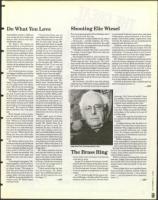

Shooting Elie Wiesel
Aubie Baltin retired in 1988 and
now, at age 54, he is ready to go
back to work. But he won't be a
stockbroker again.
Mr. Baltin, who began his
working life as a 13-year-old in
the construction business, says
he has learned things in retire-
ment he never understood when
he sat behind a desk. He admits
his views may not be entirely
kosher according to traditional
Jewish views, but he insists the
wisdom he has gleaned about the
nature of labor is firmly rooted
in Torah.
As a working person, he says,
his biggest mistake was that he
spent all his time "doing things
for money."
"If you do something you don't
enjoy, if you work just for mon-
ey, it is called work," Mr. Baltin
says. "But if you do something
you enjoy, it is called play, right?"
Mr. Baltin was born in Cana-
da, and 15 years ago he moved
to New York, where he spent a
decade "pursuing money, which
was stupid: I should have just
done what I wanted, and I would
have made a ton more money in
the end." He moved to Palm
Beach Gardens, Fla., five years
ago.
Even though work is neces-
sary, he says, no one should la-
bor at something they do not
love. "There is no rule in Torah
that says you have to be an elec-
trician or a plumber or a physi-
cist. There is no rule that says
you can't do something you en-
joy," he says. "When you do the
thing you love you will make
money, because you will be good
at it."
Mr. Baltin used to work 12 to
18 hours a day at a job he did not
love. "I was always prospecting,
I never stopped reading, and you
know what it did for me?" he
asks. "It made me enemies. You
could never do what's right, and
the clients turn you into a pros-
titute.
"I was taught improperly," Mr.
Baltin explains, "and I had to re-
tire before I had time to reflect
on these things." He began to
find that time when his father
died, and he returned to the syn-
agogue after a 40-year absence.
In addition to saying kaddish for
nearly a year, Mr. Baltin began
reading Torah.
Free-lance photographer Dina Goldstein didn't
want to go to work that day.
A close friend had been killed the day before
— hit by a car — and Ms. Goldstein, 26, of Van-
couver, British Columbia, had spent the night
crying. Now she was supposed to spend the day
taking pictures of Elie Wiesel.
"I thought to myself, 'My God, I can't do this!
I'm a mess, I haven't slept.' But I knew this was
a special assignment."
, She dragged herself out, and had been tak-
ing pictures for a while when "suddenly Elie
Wiesel asks me why I look so sad," Ms. Gold-
stein recalls. She shared a little of her suffering
with the famous chronicler of suffering, and
found that his attentions helped to ease her pain.
"I was so glad I got up and went into work.
Being around him made me feel a lot better,"
says Ms. Goldstein, who came with her parents
from her native Israel to Vancouver when she
was 8 years old.
Ms. Goldstein, who fell in love with photog-
raphy during a 1990 trip to Israel, explains that
her work in the Jewish community is especial-
"I found that there was not
one single story where I have the
same interpretation as the rab-
bis," he says with a laugh. Mr.
Baltin says that Torah is a guide
to enlightened self-interest, that
"all the laws of Torah are in-
tended for our own immediate
benefit, and they should be fol-
lowed for our immediate benefit,
not out of fear or love of God."
Where Torah teaches humili-
ty, for example, Mr. Baltin un-
derstands that "if you are not
humble, you lose — and it
doesn't matter if you are right or
not. If you are an arrogant [jerk],
nobody cares if you are right."
Torah says we should be hon-
est with everyone, "and that's
how Rothschild got rich," Mr.
Baltin says, "because the king
could trust him never to cheat."
Likewise Torah says that
"everything you do has to be mit-
igated by a sense of justice and
fairness," and Mr. Baltin, look-
ing back on his own career as a
stockbroker, finds that "even if
my intentions were good, or I
could lie to myself that my in-
tentions were good, I did things
strictly out of my own short-term
self-interest, which inevitably
turned out not even to be in my
interests."
After eight years of retire-
ment, studying Torah and pon-
dering his deepest wants and
needs, Mr. Baltin finds he is
ready to go back to work. Re-
tirement, he says, "will kill you.
Look what happens when you
take a mentally deficient person,
for instance, and give them a job:
they come alive. Before that, you
can give them everything, food
and shelter and comfort, but they
are dead. What work does is, it
gives a person the satisfaction of
being alive."
Mr. Baltin explains that he
now has the luxury to look for
work "where I can help some-
body more than I help myself."
But he adds that, by his reading
of Torah, "all jobs are necessary;
it is not for us to judge what is
a low job or a high job.
"If each person does his best
at a job he enjoys," Mr. Baltin
says, "he is fulfilling God's pur-
pose. All God wants is for us to
be happy." E
—AKS
PHOTO BY DANIEL LI PPITT
Do What You Love
Judge Avern Cohn: Enforcing society's rules.
The Brass Ring
Avern Cohn can't remember ever having
a bad day at work.
At age 72, he figures he has got it made:
a job for life, the respect of his peers, the op-
portunity to be involved in his communi-
ty. But the best part, he says, is that he gets
to use his position to implement his Jewish
values.
As U.S. district judge for the eastern dis-
trict of Michigan, the Bloomfield Township
resident said he could have retired three
ly rewarding "because it gives me a real sense
of belonging, a sense of purpose. A lot of other
people, non-Jewish people, might shoot a bar
mitzvah, for instance, and not understand the
meaning and the essence of it."
Likewise, when she goes to shoot a wedding,
she finds the connection she makes with the
couple almost as rewarding as the final pictures
themselves: "It means so much to me to know
that people trust me. It can be a huge respon-
sibility, and they trust me to handle it."
Ms. Goldstein considers herself Conservative
in her Jewishness, observant of tradition, though
perhaps not of ritual. While she declines to spec-
ulate on the broader "Jewish" understanding of
work, she knows that in her own life, a piece
of work is satisfying when it challenges her.
"Anybody can get a picture, but not anybody
can get a special picture, something that makes
it yours completely, that shows that you saw
it in a way nobody else could see it."
And that is the picture Ms. Goldstein gets up
each morning to pursue. 0
—AKS
years ago, "but I have my health, I have
my intellect, I have an interest in what
I do. I could not imagine that retirement
could be more satisfying than this."
Prior to taking his seat on the bench
in 1979, Judge Cohn was a partner in
a law firm. Today, as one of only 700 fed-
eral judges in the nation, he is part of
an elite corps.
Judge Cohn says he is honored to be
in a position to affect the life of his com-
munity.
A judge's primary role, he said, is to
enforce "the rules that society has es-
tablished." But a judge can have an even
more powerful influence, too. Judge
Cohn, for instance, presided over the
waning days of the Detroit school de-
segregation battles.
Rabbis argue that a Jew can make
work meaningful by integrating the pre-
cepts of Torah into the daily grind, and
this is just what the judge tries to do.
He says that his Jewish heritage has giv-
en him "an understanding of the less for-
tunate, and a certain amount of sympathy
with my fellow person."
When it comes to enforcing the criminal
statutes, Judge Cohn says he feels he has
done his job well "if I can bring a bit of corn-
passion and understanding" to the pro-
ceedings.
"Some judges have an imperfect heart:
they are harsh, vindictive, narrow. I like to
think of myself as having — not a perfect
heart -- but the absence of an imperfect
heart." 0
co
0)
0)
co
—AKS
2
w
0
U-1
U)
59