

Why We Work
efforts. These scholars were, in general,
men of a fairly practical turn of mind, and
they saw that "in the reality of the world,
it is vitally necessary that people work,"
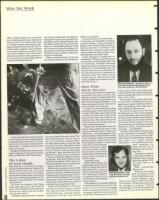
explains Rabbi Michael Broyde. The Or-
thodox rabbi, a professor of law at Emory
University in Atlanta, says that in the
view of the Talmud, "the notion that 'I
will study and others will support me' is
for most people not a good idea, both for
practical and ethical reasons."
said: This one waited tables. He began his
working life in his early teen-age years, serv-
ing holiday meals in Catskills resorts in the
late 1960s and early '70s. It was "hard work,
under the worst possible conditions," recalls
the 48-year-old university professor and
management consultant, who also lists an
Orthodox smicha, or rabbinic ordination,
among his credentials.
"There was this one kid, 8 or 10 years
old, the most obnoxious kid, and the par-
ordinary, paying jobs.
It's true that they saw Torah study —
"not farming, war, handicrafts, commerce,
or statesmanship — as the occupation of
highest honor," Rabbi Waskow explains,
but they also felt it was wrong to "use
Torah as a cow." Better to have an ordi-
nary job, they said; better to earn an hon-
est living with meaningful work.
Psalm 128 seems to confirm this un-
derstanding: "When you eat the labor of
your hands, you will be happy and it will
be well with you." Certainly a little more
upbeat than all that smiting and cursing
of Genesis 3:17. (Interestingly, some rab-
bis have read this as an exhortation to
the Jews to do manual, as opposed to in-
tellectual, labor: The "hands" are for
working, they say, while the seichel and
middot, intellect and character, are re-
served for Torah.)
More Than
Meets The Eye
In fact, the rabbis who said we do have
to work could point to an explicit biblical
commandment in their favor: "Six days
shalt thou do thy work, but stop on the
seventh day ..." (Exodus 23:12). Seems
pretty cut and dry.
All right: So Genesis says work is a curse,
and the rabbis say we have to do it anyway.
So far, so bleak. But wait: There's more.
The Labor
Of Your Hands
David Schnall, a professor of manage-
ment and administration at Yeshiva Uni-
versity in New York, has a lot of good
things to say about work. In his exten-
sive studies of Jewish texts, he has found
that "the overwhelming majority of ref-
erences to work and labor" are actually
"very positive."
He notes, for instance, that "many
great sages, especially in the Talmudic
times, were identified by their professions:
this one was a cobbler, this one a builder,
this one grew wheat."
Of Professor Schnall himself, it might be
ents just indulged his every whim," Pro-
fessor Schnall recalls. "So once I was on
my way to the kitchen, trying to memo-
rize half a dozen orders, and the kid calls
me back to the table. I thought he want-
ed to order something else, and instead
he says, 'Waiter, could you please pass
me the salt — from the other end of the
table?' So I do. Then he turns to his moth-
er and says, 'Mommy, thank you for tak-
ing me here,' and I think, 'Finally, at least
a little bit of gratitude.' And he says, 'I re-
ally like the people who are waiters here
— because they're your slaves.' "
While there is certainly a broad divide
between a Catskills dining room and a
career in academia, Professor Schnall's
is perhaps not a surprising leap in the an-
nals of Jewish scholarship. The ancient
Jewish sages, after all, seemed to under-
stand quite clearly that every kind of
work has its own particular value.
Rabbi Arthur Waskow, in his recent
book Down-to-Earth Judaism, explains
that while the rabbis' "favorite occupa-
tion was their own ... the study and rein-
terpretation of Torah," most still had
Rabbi Everett Ackerman: "The goal of a rabbi is to
teach people to become educated Jews who can
in turn learn on their own, and teach others."
Cream stand, and for a kid with a pock-
So what gives here? First, the rabbis have et full of change he'd earned himself, Sat-
us convinced that labor is a heaven-sent urday mornings after work were "the best
affliction, a painful necessity at best. Now thing in the world."
As a member of the clergy, Rabbi Bal-
they tell us that having a good job is even
better than having good ancestors — and lon still works on Shabbat; he says he is
these were guys who took "the merit of glad if he can "spend a little time with my
wife in the afternoon, take a little nap, or
one's ancestors" very seriously.
It seems we have wandered into that play a little golf' after services.
Even this, he said, is more rest than
in-between space, where Talmud builds
a bridge. The bridge stands with one leg his father got, as a U.S. Army chaplain
on reason, the other leg on faith, and its on the North African circuit, serving every
span reaches from this world to the Jewish-American soldier from Casablan-
world-to-come. The rabbis believed we ca to Jerusalem. As he trudged endless-
could transmute our everyday work into ly from one military outpost to the next,
a kind of spiritual exercise.
he would shlepp an old Army backpack
Despite their initial reservations, the filled with "a tallis, a bottle of scotch, a
ancient sages ultimately came to view good story — and Shabbos."
A rabbi is "the vessel into which all oth-
work as a potential source of "honor and
self-esteem ... not a sad necessity, but a er holy aspirations are poured," Rabbi
joyful possibility," Rabbi Waskow writes. Ballon says, so that even if his own Sab-
At the very least, honest work, profitably bath rest is somewhat fleeting, he still de-
pursued, allows us the leisure to study rives from it a unique spiritual
Torah and give to charity — surely a plus satisfaction — and he still sees an inti-
mate connection be-
in the eyes of the Talmudic
8 tween the holy rest of
teachers. And work enables
Shabbat, and our every-
us to buy challah, candles,
; day work.
prayer shawls: all the items
He points out without
needed to live a full ritual and
"work,"
there could be no
spiritual life, according to
,c2 Sabbath "rest," and sug-
Jewish custom.
E gests that perhaps "with-
And there's more.
out work, there is no
Rabbi Jeffrey Ballon, who
sanctity."
until recently served with the
Work ... and sanctity?
Reform Temple Beth Am in
What gives?
Palm Beach, Fla., points out
Well, just as our Sab-
that the literal goal of every Rabbi Michael Broyde: "In the
bath
rest mirrors God's
Shabbat:
Jew's work week is
reality of the world, it is vitally
Great Coffee Break, some
a cessation of labor that mir- necessary that people work."
Jewish thinkers argue
rors the divine rest during the
that our daily labors reflect the primal
time of creation.
Rabbi Ballon, 54, remembers Sabbaths act of creation. "People are partners with
in which he enjoyed a divine rest of a par- the Almighty in creating," Professor c-\
ticular sort: as a 12-year-old newspaper Schnall argues, "God did not complete the
carrier in suburban Long Island, N.Y. The creating." It is our work that does that.
newspaper distribution center stood be-
tween Ricki's Pizzaria and a Carvel Ice