

C7
Gen. Israel Dille, a longtime
friend of David Wyrick, was an am-
ateur archaeologist and a high-rank-
ing member of Ohio's Episcopal
Church. In Newark, he lived in the
same house with McCarty. The two
would become Wyrick's leading sup-
porters.
Elijah Sutton was an Ohio stone
carver whose son, Joseph Sutton,
accompanied Wyrick on some of his
digs.
The Discovery
T HE DETRO I T JE WI SH NE WS
The story of the "Holy Stones" be-
gins in Newark, Ohio (about 60
miles north of Columbus), which sits
on the edge of a group of mounds
and earthworks that most experts
agree were burial grounds of Indi-
an tribes.
At 4 p.m. on a warm June 29 in
1860, David Wyrick was seen dash-
ing around town, announcing a re-
markable discovery: He had found a
rock, about 6 inches long and 2 1/2
inches wide — what would later
come to be known as the Keystone
— covered with Hebrew writing.
Wyrick and his teen-aged son had been
searching for bones, about 1 mile outside
of town, when they made the find. Wyrick
was eager to bring others to the site — es-
pecially his close friend and former
teacher, Gen. Israel Dille.
Perhaps by sheer coincidence (or per-
haps not, as Bradley Lepper will argue),
Col. Whittlesey, a well-known expert on
ancient relics, happened to be in Newark
that day. Whittlesey and Gen. Dille went
to the dig, where they saw a depression
about 13 inches deep from which the stone
apparently had been retrieved. The rock
was fairly clean and not, as one might ex-
pect, encrusted with elements.
Whittlesey made no immediate pro-
48
Finally, Whittlesey was troubled
by the fact that, at least initially,
Masonic groups recognized the
stone as one of their own artifacts.
Amazingly enough, five months
later Wyrick would stumble upon
yet another relic, now known as the
Decalogue Stone. Conveniently, it
answered all of Whittlesey's ques-
tions.
Wyrick made his first visit to
what was known as the Great Stone
Mound, about 10 miles outside
Newark, on July 25, 1860. Although
now greatly dismantled, the Great
Stone Mound once stood 50 feet
high and was the site of many am-
ateur excavations. Not long before
Wyrick's first visit, farmers had
come across a wooden coffin which
still contained remnants of a skele-
ton.
On Nov. 1, 1860, accompanied by
five other amateur archaeologists
and interested parties, Wyrick re-
turned to the site. He dug under-
neath the skeleton, deep into layer
upon layer of thick, white clay.
Later Wyrick would write of the
discovery in a letter to the Cincin-
nati Daily Commercial, selecting
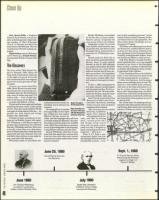
nouncement on the stone's au- Above: The back of
thenticity, but he did have his the Decalogue Stone. words even his most outspoken
supporters find unusual.
concerns.
After throwing out a few spades
He wondered how it was that Right: Columbus is in
the center of the state,
full of clay, I passed my r
the supposedly ancient stone with
both Newark and
was written in a very modern Coshocton to the east. spade down between
what appeared to be two
Hebrew? (In fact, anyone fa-
miliar with the language today will have rocks, and then by bearing
no trouble reading the Keystone.) He point- down, I turned up the rock I
ed out that numerous texts were available had already struck several
in the 1800s that would allow an amateur, times with my spade, and ex-
not at all knowledgeable in the language, posed it to view. I dropped my
spade, and picking up the stone,
to copy Hebrew phrases onto the stone.
Second, Whittlesey asked how it came exclaimed — "Here it is."
to be that this aged stone was less than
"Here it is"? Such a pro-
2 feet into the earth when most ancient nouncement makes "one won-
treasures are buried under layers of set- der if perhaps Wyrick had been
tlement remains?
prompted by someone ... to ex-
June 29, 1860
Sept. 1, 1860
David Wyrick discovers
the Keystone.
D. Francis Bacon's article
denouncing the Keystone
appears on Page 1 of
Harper's Weekly.
June 1860
Col. Charles Whittlesey,
an expert in antiquities,
makes a visit to Newark, Ohio.
pect to find something unusual," writes
retired Denison (Ohio) University Profes-
sor Robert Alrutz in his pamphlet, The
Newark Holy Stones: The History of an Ar-
chaeological Tragedy.
Whittlesey and others may have found
the Keystone's modern Hebrew discon-
certing, but they must certainly have
been perplexed by the Decalogue Stone's
virtually undecipherable letters. Some
are familiar as Hebrew; many are not.
And if the Masons thought the Key-
stone looked familiar, not a one stepped
forward to lay claim to the Decalogue
Stone. In fact, a number of scholars had
no problem identifying the stone as clear-
ly associated with Judaism.
If the Decalogue Stone was indeed a
hoax, it was clear from the start it had
not been perpetrated by an amateur.
Unlike the Keystone, the Decalogue
Stone was an intricate piece of work. En-
cased in a well-crafted stone container,
with slits on the tops and bottom to al-
low for certain closure, it was a dark,
heavy relic whose engraving, an abbre-
viated form of the Ten Commandments,
ran from the front to the back. At the top
are three holes whose purpose has yet to
be determined.
Mr. Alrutz asks: "In studying such pe-
culiarities (the holes and the slots for clos-
ing the box), there must come to mind the
question: If these are a hoax, why would
Rabbi Max Lilienthal,
of Hebrew Union College,
examines the Keystone.