

STN tinter aihmat
THE D ETR OIT J EWISH NEWS
PHOTOS BY DANI EL LIPPITT
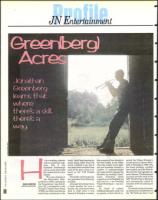
Jonathan
Greer-berg
learre that
where
there's
tiler
wad.
O s
MARA REINSTEIN
JEWISH NEWS INTERN
e is a musician, a farmer
and an electrical engi-
neer. But it was
Jonathan Greenberg's
role as a tutor that made
him realize that he was a
success.
"We were playing in
the Milwaukee Sum-
merFest in 1991, opening for
the Temptations," says the 30-
year old, a trumpeter in the
Trinidad Tripoli Steel Band
(ITSB), one of the most famous
steel drum orchestras in the
world. "And I kept hearing my
name being yelled from the
crowd. I looked to see who it
was and it turns out that it was
some of the guys whom I tu-
tored on the U-M football
team."
Not bad for a former gas-sta-
tion attendant from Farming-
ton Hills.
Although Greenberg's been
a band member for over a
decade, the steel band dates
back to 1942 when it was
formed in Trinidad, a country
that consists of two islands in
the West Indies. In the 1940s,
when the country was in polit-
ical and economic turmoil, a
number of underprivileged
teen-agers tried to appease the
situation by creating "jump"
music. Numerous bands
cropped up out of Trinidad, but
only one act — the Trinidad
Tripoli Steel Band — has sur-
vived.
Its blend of upbeat,
Caribbean-like party music was
so popular, in fact, that it re-
ceived the Prime Minister's
Award given by Queen Eliza-
beth in Trinidad in 1966. Yet,
the band probably wouldn't
have made it out of the West In-
dies if not for the legendary pi-
anist Liberace. The flamboyant
musician met the band at the
1967 World's Fair in Montreal
and subsequently asked its
members to be his opening act
on tour.
The band's string of success-
es continued as it performed on
the "Ed Sullivan Show" and