

1.
The
(/)
LLJ
LU
- 3
CC
LJ_J
w
92
f you've ever want-
ed an entertaining
cultural experience you
could call truly Israeli,
you couldn't do better
than one of the Cameri
Theater's first-rate pro-
ductions.
The only problem
with that, you may
be thinking, is that
its shows are in He-
brew and your proficiency in
the language ranges from
nonexistent to "shalom."
Well, it's time to think again,
since Cameri now has simul-
taneous English translations
every Tuesday night, allowing
you, while in Israel, to discov-
er for yourself what issues con-
cern the discerning Israeli
theater-goer — issues that
some members of the Israeli
establishment would have pre-
ferred to be forgotten or ig-
nored.
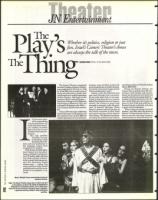
Above: Midnight Prayermeant double hernias for
everyone involved.
Right: The Cameri Theater always puts a modern-day spin
on its classics, as seen in its smash-hit adaptation of
Shakespeare's A Comedy of Errors, set in a town not to
dissimilar to war-torn Beirut. Among the play's highlights:
a govemor wearing a kaffiyeh, belly dancing and
gunshots.
Whether it's politics, religion or just
fin, Israel's Cameri Theater's shows
are always the talk of the town.
g
GIDEON KEREN SPECIAL TO THE JEWISH NEWS
The Cameri Theater, recognized
as Israel's leading repertory theater,
was established in Tel Aviv in 1944
by Yosef Milo and a small group of
actors who believed in a theater that
would stand as an artistic expression
of their Zionism. Although not the
country's official national theater—
that honor belongs to the Habimah,
which began in Moscow in 1917 and
relocated to Palestine in the 1920s —
it is certainly Israel's most success-
ful.
It has a 900-seat main auditorium
that usually plays to full capacity, and
the company must use four different
theater spaces just to house all its pro-
ductions, many of which continue for
several seasons due to public demand.
(Currently, the Cameri stages at least
12 new productions a year.)
Indeed, while the Habimah last
year went through what was proba-
bly its worst crisis when it very near-
ly had to close down due to a massive
deficit (the problem has now been re-
solved), the Cameri is going from
strength to strength under the guid-
ance of General Manager Noam
Semel (a former cultural attache at
the Israeli consulate in New York)
and award-winning artistic director
Omri Nitzan. The theater even boast-
ed ending the last fiscal year with an
operating surplus of 700,000 shekels
(about $235,000).
During its 52-year history, the
Cameri has mounted some 400 pro-
ductions, both Israeli and interna-
tional, has traveled all over Israel and
recently started promoting itself as a
leading international force in the the-
ater world. Each year, the troupe ap-
pears in New York and performs at
theater festivals worldwide, including
a recent visit to Argentina.
'What makes us unique in Israeli
theater," says Miri Alon, the theater's
director of international relations, "is
that we are the only large company
concentrating on and promoting con-
__/