

mous to Sexaholics Anonymous
to Gamblers Anonymous. The
basic 12-Step program founded
by AA in the 1930s is the root
of these programs, as well.
"What I try to do is take the
issue to another level," Rabbi
Shemtov says. "What I try to
do is be a friend to an addict
who needs the enthusiasm to
be helped."
"Enthusiasm to be helped?"
Sounds like a saying from some
sort of slick salesman trying to
sell thigh developers.
But Rabbi Shemtov —
whose friendship circle does
outreach to addicts, visits Jew-
ish inmates incarcerated in
state jails and organizes teen-
age girls to tutor and volunteer
to teach others — isn't mar-
keting anything other than
friendship.
"You have to find a middle
ground," Rabbi Shemtov says.
"I come to the addict as a real
friend, and once he realizes it,
he'll trust me more. I make it
clear to the addict that my
whole life goes up and down
with him. You need a friend to
come over and shake you."
Dennis has been shaken.
"You can't do it yourself,"
Dennis says. "You realize you
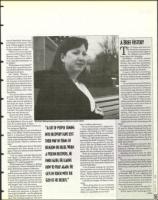
are defenseless. It's you and Kim Friner: Offering counseling and support to Baltimore's Jewish addicts.
God. It's a scary thing. It helps
been a million miles away.
to have someone who doesn't yell at you.
No one is thinking about a higher pow-
I'm trying and fighting.
er when taking drugs or alcohol, Dennis
"Admitting that you are powerless is
explains. The feeling of a "hit" is compa-
Step 1," he added. "And for many people,
rable to an orgasm. For $5, you can have
Step 1 is temporary because they are
another orgasm and then another.
stuck with the same old feelings. You don't
"When an addict gives that up, it's like
really make the feelings disappear; they
mourning the death of someone," he says.
are just buried. That is a common mis-
"It's so hard to say goodbye to your ad-
take."
diction. But the 12 Steps work. It's the
So many addicts quit AA or Narcotics
person, though, who has to make them
Anonymous but then decide to try it
work. The 12 Steps are the training
again. They are welcomed and respected
wheels of a life of sobriety for the addict."
for not giving up.
There are programs that augment 12
"I say my name and start the process
Step programs such as AA. Baltimore's
over again," Dennis says. "It's like a
Jewish Alcoholic and Drug Abuse Service
salmon fighting upstream. But I'm still
(JADAS) is one of them. It is paid for and
fighting. I'm making progress."
sponsored by The Associated, Baltimore's
What breaks the 12 Steps is a feeling
Jewish Federation.
of inadequacy. Dennis described the ad-
"A lot of people coming into recovery
dict's destructive pattern of behavior.
have lost their way in terms of religion or
Desperate for crack money, Dennis
belief," says program coordinator Kim
pulled up to a gas station. He didn't have
Friner. "When a person recovers, he finds
any cash. He went into the station and
faith. He learns how to pray again. He
purchased $100 of cigarettes on his cred-
gets in touch with the God of his beliefs."
it card. He turned around and sold the
JADAS encourages 12-Step involve-
cigarettes for $40 cash. He took the cash
ment.
and bought "hits" with the money.
"We're doing what we can to educate
He returned to a crack house. Dennis
at least the children in our community
remembers thinking how "stupid" he was
about addiction," Ms. Friner says. "Ad-
for selling the cigarettes so cheaply. He
diction is a possibility in our lives."
was angry at himself— not for taking the
drugs, but for losing out financially on the
deal. The 12 Steps might as well have
"A LOT Of PEOPLE COMING
INTO RROVIRY HAVE LOST
THEIR WAY IN TiRMS OF
RELIGION OR NE. WHEN
A PERSON RiCOWRS, HE
fINDS fAITH. HE LEARNS
HOW TO PRAY AGAIN. HE
GETS IN TOUCH WITH THE
GOD Of HIS BELIEFS."
A BRIEF HISTORY
he 12 Steps were born out
ITI of Alcoholics Anonymous.
To understand the origin of
the 12 Steps, one must first
learn about AA's founders.
Bill Wilson — or Bill W., as most
AAers refer to him — was a chronic
drinker who said that alcoholism
gave him a "new sense of freedom."
While working on Wall Street, he
gradually became an alcoholic.
It as in 1934 that a recovering
alcoholic friend of his introduced Bill
W. to he Oxford Group, headed by
Epic pal minister Dr. Samuel Shoe-
maker .
Th e nondenominational Christian
grow P focused on the importance of
taking stock of oneself, confessing
one'sdefects
and showing a willing-
d
ness to
d
What
During his sobering period, Bill W.
said he experienced a "conversion"
feelig. And from the conversion
grew the concept that alcoholism
breed s hopelessness, which can be
helped
e by turning oneself over to a
higher power and interacting with
others.
On a business trip to Akron, Ohio, Bill
W. met Dr. Robert Holbrook Smith, an
alcoholic who was still drinking. They
met because Bill W. wanted to meet and
talk to another alcoholic. It was his the-
ory that, through friendship, the two
might be able to support one another at
their time of need.
Dr. Smith is known in AA as Dr. Bob.
He accepted Bill W.'s belief that alco-
holism is a disease. The two agreed to
form Alcoholics Anonymous.
AA dates its birth to June 10, 1935,
Dr. Bob's first day of "permanent sobri-
ety."
The two men started talking to alco-
holics in Ohio and then New York. These
first followers would split from the Ox-
ford Group, rejecting its evangelistic na-
ture.
In the process of its early growth, AA
co-founder Bill W. put together the
Twelve Steps For Recovery. The Steps
(see related story) requires an admission
of human powerlessness and supports
the concept that a greater power can re-
store the alcoholic to sanity.
Dr. Bob died in 1950 at the age of 71.
He was 56 when he had his last drink.
Bill W. died in 1971 at the age of 76.
P.J.