

ight
veete
Jewish groups find party seats
but squirm without
a firm ideological fit.
JAMES D. BESSER
WASHINGTON CORRESPONDENT
his week's Republican con-
vention wasn't exactly a
gathering of the mish-
pachah, despite Bob Dole's
surprise vice presidential choice
— former congressman and
quarterback Jack Kemp, an
honorary Jew if ever there were
one. But the San Diego extrav-
aganza did highlight an im-
portant political development
for the Jewish community:
Through a variety of mecha-
nisms, Jews have developed
a stronger and much more
visible presence in both ma-
jor parties.
For years, members of the
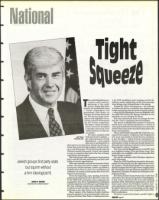
Jack Kemp: National Jewish Coalition —
Honorary Jew. the central group for Jewish
Republicans — have argued
that active participation in
their party is an important element in Jewish po-
litical clout even if a large majority of Jews contin-
ue to vote Democratic. On the Democratic side, the
National Jewish Democratic Council was created,
in part, to maintain that lead in the face of chang-
ing political demographics.
But both groups walk a precarious line between
blind, narrowly focused partisanship and their cred-
ibility as Jewish organizations.
Both were created to promote the interests of their
parties. But they also need to retain a connection
to uniquely Jewish interests; neither can afford to
blithely ignore flaws in their own candidates and
platforms, nor trends in their parties that most Jews
regard as threatening.
From the beginning, many leading Jewish Re-
publicans favored former Sen. Bob Dole in the race
for the 1996 GOP nomination. Jews, in general, are
pragmatists who favor "establishment" politicians
with the experience and influence to get things done;
Mr. Dole, a Senate veteran and a moderate in a par-
ty tilting toward the right, struck most Jewish Re-
publicans as the right choice at the right time.
Many leaders of the National Jewish Coalition
played a significant role in financing Mr. Dole's ear-
ly primary battles; Max Fisher, a leading fund-rais-
er for GOP candidates and a longtime Jewish Re-
publican leader, helped bail out the Dole campaign
when things were looking bleak in the spring.
Despite Mr. Dole's anti-charisma — he continues
to project himself as a candidate who despises the
image engineering that dominates big-time politics
— rank-and-file Republican Jews are delighted with
the 1996 GOP ticket; Mr. Kemp's selection as vice
president was an unhoped-for bonus.
But that enthusiasm does not change the fact
that Mr. Dole is a seriously flawed candidate.
His record on Middle East matters is distinctly
mixed, from a pro-Israel perspective; a variety of
votes and statements over the years have provided
Jewish Democrats with abundant ammunition for
their counterattacks.
This in itself doesn't disqualify Mr. Dole from win-
ning Jewish support. Congress is full of legislators
who were once hostile to Israel but who eventual-
ly saw the light — either because of persistent ef-
forts by pro-Israel lobbyists or out of cold-blooded
self-interest, or both. In the end, Jewish leaders tra-
ditionally have believed, motives are less important
than positive votes in Congress.
But when Jewish Republicans try to sell Mr. Dole
as a longtime booster of the pro-Israel cause, they
erode their own credibility with a Jewish public that
doesn't forget so easily.
Nor can the influence of the Christian right be so
easily dismissed.
Since the 1992 Republican convention that cata-
pulted Pat Buchanan into the nightmares of Jew-
ish leaders, Jewish Republicans have vigorously
denied charges.that far-right forces ranging from
Mr. Buchanan's anti-government populists to Pat
Robertson's Christian Coalition are dominant in Re-
publican politics.
But those blanket reassurances fly in the face
of the facts: The almost one-quarter of the delegates
to this week's convention who were card-carrying
members of Mr. Robertson's organization, the three
dozen states where the Christian Coalition exer-
cises substantial control over the party apparatus,
the right's dominance in hammering out this year's
platform, a document that contains few hints of Mr.
Dole's moderation.
Christian conservatives have a perfect right to
SQUEEZE page 42