

Casting A Net
ometimes great notions start
in the most unlikely places.
Mark Rutenberg's was
hatched in his upstate New
York garage, and he's since
launched it into a multimillion-dol-
lar business.
His did not start as a pipe
dream. As a biomedical engineer
then working in the defense in-
dustry, it occurred to him that the
"neural network" technology used
to distinguish decoys from dead-
ly intercontinental ballistic mis-
siles could be easily adapted to the
area of human health.
"I thought [neural network tech-
nology] was perfect for cytology,"
or the analysis of cells, Mr. Ruten-
berg said. The science evolved out
of military concerns but is ideal for
medical usage, he explained.
Today, Neuromedical Systems
Inc., based in Suffern, N.Y., is list-
ed on the Nasdaq, trading at be-
tween $20 and $25 per share. Last
year's revenues doubled from 1994
to $2.5 million. Mr. Rutenberg es-
tablished the company in 1988.
The PAPNET Testing System,
which Mr. Rutenberg developed in
his garage to analyze Pap smears,
is in use in 16 countries. A whol-
ly owned subsidiary in Rehovot,
Israel, manufactures the center-
piece of the system, scanners that
review slides and translate ab-
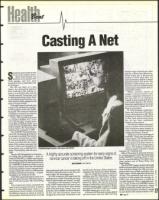
normalities into a digitized for- A cytotechnologist reviews a Pap smear with PAPNET.
mula. That facility was set up in
1993.
Nearly 140 laboratories in 44 states —
including two in Michigan — have in-
vested in PAPNET, a highly accurate sys-
tem of examining Pap smears for cellular
abnormalities that can lead to cervical can-
JULIE EDGAR
cer. PAPNET's detection ability is up to
30 percent keener than the conventional
screening method; neural network tech-
dozen abnormal cells can be lumped with
nology enables the system to differentiate
between cells that are touching — a break- 300,000 to 500,000 normal ones, the error
rate is high, Mr. Rutenberg said.
through in the analysis of cells.
"It's like reading a 500-page book for
"Our FDA-approved clinical claim is we
will take that lab from 100 abnormals a spelling errors. About 25 percent of women
day to 130 abnormals," Mr. Rutenberg with an abnormality are missed," he said.
According to the American Cancer So-
said.
Pap smears have been analyzed the ciety, 4,900 women died this year of cer-
same way for almost 50 years: A slide is vical cancer, still far fewer than deaths
sent to a local laboratory where a cy- from colon and rectal, breast, lung, oral,
totechnician views it under a microscope. prostate, skin, bladder and bone cancers.
If nothing is found, no report is made to In fact, the rate of cervical cancer has
the physician. But because as few as a half dropped by more than 70 percent in the
S
A highly accurate screening system for early signs of
cervical cancer is taking off in the United States.
STAFF WRITER
last 50 years because of Pap smears, ac-
cording to the American Cancer Society.
But any death from cervical cancer is
needless, says Mr. Rutenberg, a 44-year-
old Orthodox Jew who serves as Neu-
romedical Systems' chairman and chief
executive officer. He says he reviewed
dozens of malpractice cases involving mis-
read Pap smears that resulted in death
and figured PAPNET could have caught
the false negatives in every case.
A 29-year-old Wisconsin woman died of
cervical cancer last year after her Pap
smears were misread year after
year by a Milwaukee laboratory.
Three years ago, a 40-year-old
mother of three died after the
same laboratory failed to detect
abnormal cells in her cervix. The
families of both women won mil-
lions from the lab and the health
maintenance organization that in-
sured both women.
"When [cervical cancer] is
caught, it can be cured in a 20-
minute outpatient treatment. I
just feel that it's an enormous
tragedy if anyone gets sick from a
preventable disease," Mr. Ruten-
berg said, explaining how he made
the professional change from de-
fense to prevention.
Dr. Saul Gusberg, a retired pro-
fessor and chairman of the gyne-
cology department at Mt. Sinai
Hospital and School of Medicine
in New York, said cervical cancer
has all but been eradicated,
thanks to Pap smears.
The failure to detect abnormal-
ities is a matter of the cytotechni-
cian having too many smears to
read or the gynecologist taking an
inadequate smear, he said.
"That may be the advantage of
PAPNET, which goes through the
screen again," Dr. Gusberg said.
He noted that the rate of cer-
vical cancer in Jewish women is
lower than in the average popu-
lation. The highest incidence of
cervical cancer is found in Latin
America, Dr. Gusberg said.
After a Pap smear is screened manual-
ly, a woman can opt to have the smear sent
to the PAPNET scanning center in Suf-
fern for a second opinion. Two other scan-
ning centers are in "Hong Kong and
Amsterdam.
The PAPNET system searches through
fields of normal cells for the few abnormal
ones and then brings the 128 most sus-
picious cells up on a high-resolution color
video screen, which separates those into
16 tiles. The potentially bad cells are en-
larged on a color monitor for viewing, al-
lowing the cytotechnician to make an
accurate diagnosis. Then, a digitized print-
out, or tape, is sent to a PAPNET review
station at the regional laboratory, where
another technician would view it on CD-
ROM. If abnormalities are found, it would
be sent back to the woman's doctor. PAP-
NET
page 78 -