

OP to draw up the partition plan that led to
Israel's creation.
But while the public remains mostly
aloof; some Israelis are incensed that their
government fails to preserve the country's
past. Internationally acclaimed author A.B.
Yehoshua has been a leading vocal critic
of the way the Jewish state handles how
it is influenced by the United States.
The author of Five Seasons and Late Di-
vorce says Israel must protect its identity,
even at the risk of being overly restrictive
at times. He wants the Israelis to emulate
the French, who recently forced female
Muslim students to remove their veils in
public schools.
"I respect the French for wanting to keep
their basic values," Yehoshua says. "There
has to be a limit to pluralism."
There also has to be a limit to capital-
ism, which has been a growing influence
on the traditionally government-controlled,
unionized Israeli economy, Yehoshua says.
"The idea of every person standing up
on his own feet has no room here, and I
hope [Prime Minister Binyamin] Ne-
tanyahu does not adopt it," says Yehoshua,
widely regarded as the leading statesman,
along with Amos Oz, among Israel's old
guard of writers.
Although he generally views the Amer-
icanization of Israel as a positive develop-
ment, Edgar Keret, one of the leading
young Israeli writers, agrees that the gov-
ernment must not let capitalism get out of
control.
"In America, the gaps between the rich
and the poor are incredible," Keret says.
"Here, we are beginning to see that. This
is the scary part of Americanization. Israel
is becoming too capitalistic."
Se "A i& Stertie4
N
At Tel Aviv's Dizengoff Center, the first
of dozens of malls to have sprung up all
over the country in the 1990s, you see Is-
raelis of all walks of life: kibbutzniks, mil-
itary officers, Chasidim, professors,
retirees, Arabs, farmers, attorneys, and,
of course, teen-agers.
The teens all wear Levi's jeans and T-
shirts featuring American terms like "Just
Do It" or "Shag Attack." (You're more like-
ly to find T-shirts with Hebrew letters at
a Jewish community center or summer
camp in the United States.) They hang
around at spots like the Hard Rock Cafe,
which is unique in Israel, because its en-
trance features the familiar logo in Hebrew
letters.
After eating Whoppers and fries at
Burger King, the teen-agers venture into
a music store, where they might buy Is-
raeli music that, if it did not feature He-
brew lyrics, would sound just like
American music.
Even the popular band Ethnix, which
incorporates many Middle Eastern sounds
and themes in its music, usually lays its
catchy melodies and simple lyrics atop
pounding American beats and "Louie
Louie" synthesizer chords.
One of Israel's biggest pop stars, Aviv
Geffen, has made many strong statements
that show independent thinking
— but his rebellious attitude and
powerful stage presence, com-
plete with heavy black makeup,
are clearly borrowed from such
American acts as Lou Reed,
Kiss and Bob Dylan.
The American influence
lessens as you move away from
Tel Aviv. It almost disappears
when you get to the Upper
Galilee and the Negev. But it is
spreading like wildfire from Is-
rael's trendiest metropolis.
Ramat Gan, an upper-middle
class community adjacent to Tel
Aviv, shows just as many signs
of Americanization. The city's
Kenyon mall could make a U.S.
town proud.
On a recent Sunday evening,
the end of the first working day
of the week, the center is packed
like Macy's the week before
Christmas.
Every store is jammed with
customers trying on clothes,
checking out electronic equip-
ment, flipping through maga-
zines. And cash registers are
gobbling up shekels like a Pac
Man on steroids.
Israelis know how to shop.
The McDonald's at the Keny-
on is an urban planner's dream.
It features three sparkling decks
and several colorful, roomy sec-
tions — a patio, a children's sec-
tion and a balcony. The large
comfortable booths in the chil-
dren's sections are shaped like
boats. The Israelis feeding their
children Big Macs and fries feel
like they are sailing away on a
30-minute family vacation.
They are willing to
pay more for a taste of
America. In fact, they
pay up to triple the
U.S. rates.
They do not hesitate
to whip out $3.30 for a
Whopper (which costs
99 cents in most U.S.
Burger King restau-
rants). They also opt to
shell out $3.10 for a
Big Mac rather than
pay $1.70 for a falafel
or $2.50 for a gyro — until recently, Israel's
staples in the fast-food lane.
Watching Israelis standing in line at
McDonald's makes Chupak feel like the
last of the Zionists, he says. "We have be-
come assimilated in our own country."
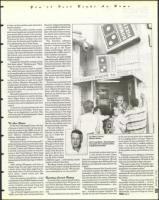
Top: When in Tel Aviv,
Domino's delivers.
Left: Dr. Eyal Naveh: "Americanization
turns culture into a consumer product,
a capitalistic commodity."
for the fatal accident last year at
a rock concert in Arad, where
teen-agers crushed each other in
their mad rush for the entrance. He told
Israeli newspapers that McDonald's and
Madonna are indirectly responsible for the
tragedy.
Yehoshua stressed that Israelis must
work hard to minimize the effects of Amer-
icanization. A thinker who over the years
has moderated his political voice, shifting
from the far left to the center, Yehoshua
Reort- tea, ecomeat Wateney
In recent years, several Israeli leaders, says Israelis have two powerful weapons
including President Ezer Weizman, for- to defend themselves against the negative
mer Prime Minister Shimon Peres and consequences of Americanization — edu-
Yehoshua, the author, have called on Is- cation and history.
"We must keep our education system in
raelis to resist the forces of Americaniza-
tact — it builds our system of identity. We
tion.
Weizman blamed American pop culture should not privatize Channel 1 [as some
in the new government have suggested].
It is a unifying factor," he says. "And we
must begin having a dialogue with our
past. We can do that by reading religious
texts — or, like the Europeans, we can
make movies about our history. We must
invest public money and initiative into
this."
Yehoshua is now working on a novel set
in a Jewish community in Europe at the
end of the last millennium. He hopes it will
help connect Israelis to their rich past.
`The past is a part of us," YehoShua says.
"Being connected to it will give us the right
perspective on current events."
But young authors and creators see the
present as far more relevant than the past,
noted Keret, one of Israel's most success-
ful writers.
"People criticize the young writers for
supposedly losing our identity — as if we
are writing American books and movies,"
Mr. Keret says. "But when I am writing
about a Yemenite women who works in
McDonald's, I am not writing an Ameri-
ISRAEL page 62