
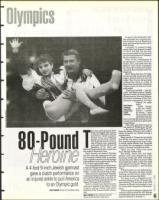

A 4-foot 9-inch Jewish gymnast
gave a clutch performance on
an injured ankle to pull America
to an Olympic gold.
TOM TUGEND SPECIAL TO THE JEWISH NEWS
he press called gymnast Kerri
Strug "the biggest little woman
in America"; President Clinton
phoned her; Time magazine
put her on the cover; and the
22,000-strong Jewish commu-
nity of Tucson, Ariz., expressed
quiet pride that the 18-year-old
daughter of Dr. Burt and
Melanie Strug had literally vaulted into
the ranks of America's icons.
Kerri became an instant Olympic
heroine when she suppressed the pain
of a severely twisted ankle to success-
fully complete a second vault she thought
was needed to cinch a gold medal for the
U.S. women's gymnastic team.
Time described the feat as "Kerri's hero-
ic leap into Olympic history," and planned
to put her smiling face — and the gold
medal — on the cover of its Aug. 5 issue.
After the bomb explosion at Atlanta's
Centennial Olympic Park, Time split the
cover between Strug and an injured vic-
tim of the bombing, accompanied by the
legend "Courage and Cowardice."
Kerri's intensity and determination
came as no surprise to her father, a heart
surgeon, and her mother, both active
members of the Tucson Jewish commu-
nity.
Steve Lipman of the Atlanta Jewish
Times contributed to this story.
At age 12, the diminutive ath-
lete convinced her reluctant par-
ents to let her move to Houston, to
train with famed gymnastics coach
Bela Karolyi.
A straight "A" student in high
school, Kerri had planned to enroll
at UCLA this fall, but she may
now be persuaded to turn pro and
join her teammates in a lucrative,
30-city exhibition tour.
None of the worshippers at
Congregation Anshei Israel in
Tucson, Ariz., last week knew the
Hebrew name of the congregant
for whom the mishebarach prayer
was said. But everyone knew her
diagnosis.
Kerri Strug had torn two liga-
ments and had sustained a third-
degree lateral sprain in her left
ankle. The 18-year-old gymnast
suffered the injury in a pair of
leaps that insured the American
women's team its first-ever team
gold medal.
"People are excited — very ex-
cited," said Rabbi Arthur Oleisky,
spiritual leader of Anshei Israel.
Strug's parents, Burt and Melanie,
have been members of the Con-
servative congregation, the city's
largest, for eight
years.
Kern Strug is
Rabbi Oleisky
carried by
made the mishe-
Coach Bela
barach — a prayer
Karolyi to the
for health — after
medal
ceremony.
Strug suffered the
injury that kept her
from entering the subsequent all-
around and individual gymnastic
competitions.
The rabbi said the blessing in
the name of "HaBachura Strug"
— the young woman Strug. No one
knew the name of Strug or her mother,
which normally are recited during a
mishebarach.
Many people in Tucson are not aware
that Strug, who spent most of her last
five years training away from home,
is Jewish, Rabbi Oleisky said. Strug did
not attend the synagogue's religious
school or become bat mitzvah there.
"She's too busy. There was never
time," Strug's mother said.
But Strug, whose face and high-
pitched voice were ubiquitous in the
American media last week, told inter-
viewers that she offered a prayer after
she twisted her ankle on her first vault
and waited for her second. "Please, God,"
she said, "let me do this —just one more
time."
If Kerri's feat was one defining mo-
ment of the Olympics, the other was the
bombing, and the horror of that explo-
sion had one curious side-effect.
For days on end, a delegation corn-
posed of relatives of the 11 Israeli ath-
letes killed by PLO terrorists at the 1972
Olympics in Munich had pleaded in vain
for some public recognition of that mas-
sacre.
Following the bombing in Atlanta, the
national media recalled the 1972 killings
and linked the chain of terrorism stretch-
ing from Munich to Atlanta. ❑