

Familiar Tune
Israeli and
Palestinian
security
methods are
disturbingly
similar for
Arab human-
rights
campaigner.
assem Eid says
he used to be a
human rights ac-
tivist. Now he's
going to be a hu-
man rights fight-
er.
After seven
years as field co-
ordinator for the
Israeli human
rights group,
B'tselem, he is
leaving to found his
own Palestinian Human Rights
Information Committee. B'tse-
lem, the scourge of errant Is-
raeli soldiers, settlers and
interrogators, has decided to
stay out of the territories under
Palestinian self-rule.
Mr. Eid, who lives in east
Jerusalem's Shuafat refugee
camp, still under Israeli sover-
eignty, insists that his Pales-
tinian brothers need him now
more than ever. Unlike other
CL
CCI
ERIC SILVER
ISRAEL CORRESPONDENT
Palestinian campaigners, who
have been harassed into silence,
he vows never to be intimidat-
ed.
'What is going on under the
Palestinian National Authori-
ty," the 38-year-old father of
eight complains, "is terrible. It
seems that our future is going
to be very dark. I still see my-
self as a candle. I have to light
the darkness. But today you
have to be a fighter just to get
the information."
Mr. Eid accuses the Pales-
tinian security forces of arbi-
trarily detaining political
opponents and of torturing pris-
oners. Six prisoners have died
under interrogation since the
Palestinian leader, Yassir
Arafat, returned to Gaza and
the West Bank two years ago.
"The torture methods used
by the Palestinian interroga-
tors are very similar to the Is-
raeli methods," Mr. Eid says
with a wry smile. "Why? Be-
cause the current interrogators
were previously the victims of
the Israelis."
Palestinian police, he alleges,
routinely beat and humiliate.
They open fire without legal
justification. "When they come
to arrest somebody and people
gather," he says, "they start
shooting to disperse the crowd.
Sometimes people get killed or
wounded."
As an example, he cites a po-
lice raid on Bido village, near
the West Bank town of Ramal-
lah, on June 6. "They arrived to
solve a family quarrel that got
out of hand. The police start-
ed shooting, killing a 20-year-
old man and wounding five.
They arrested another five,
then left the village without re-
solving the quarrel."
According to Mr. Eid, the
main problem is the lack of cen-
tral control. "When the securi-
ty forces are
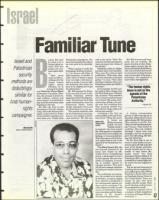
Bassem Eid:
Human rights killing or injuring
people," he says,
activist.
"nobody comes to
investigate why they opened
fire. They appoint a committee,
but then they never publish any
findings or recommendations.
What this means is that the hu-
man rights issue is not on the
agenda of the Palestinian Au-
thority."
The affable Bassem Eid, who
was himself detained for 25
hours last winter by Mr.
Arafat's Force 17 presidential
guard, is determined to put it
on that agenda. His new com-
mittee, he explains, is not go-
ing to publish reports or
organize protests. "Our main
job will be to research violations
and bring our results to the me-
dia."
His credentials are impres-
sive. He worked on 40 reports
for B'tselem, on topics ranging
from collective punishment to
law enforcement against set-
tlers and the rampages of Is-
raeli undercover units, as well
as two on Palestinian collabo-
rator executions and the depre-
dations of Mr. Arafat's
Preventive Security Force.
Mr. Eid is brave and tena-
cious, but not reckless. He
knows the fate of other Pales-
tinian rights activists, like the
Gaza psychiatrist Eyad Sarraj,
who was arrested last month
on trumped-up drug charges
and was accused of injuring a
policeman, who appeared in
court with a bandaged fist.
"The human rights
issue is not on the
agenda of the
Palestinian
Authority."
— Bassem Eid
A visiting correspondent
phoned a legal action group in
Ramallah asking about human
rights abuses, Mr. Eid recounts.
They told him to call Mr. Eid.
`They are like handicapped peo-
ple," he says, "they cannot do
-anything. They got Arafat's
message. I know what that
message is, but rm not going to
get it. rm still acting, still hik-
ing, still criticizing."
So his first task is not so
much to raise funds as to pro-
tect his back. He will make the
most of his Israeli umbrella,
though he believes it is only a
matter of time before Mr.
Arafat moves into East
Jerusalem. He has talked to 15
Palestinian MPs, urging them
to establish a human rights lob-
by within the new legislative
council.
But for the best insurance he
is looking abroad, targeting hu-
man rights gurus like Nelson
Mandela in South Africa and
ex-President Jimmy Carter in
the United States. These are
people, he says, who carry
weight with Mr. Arafat. Their
moral blessing could give him
the protection he needs.
A positive response will be
a measure of their consistency
as much as of Bassem Eid's per-
severance. ❑
CID
CI,
CT)
C
47