

Opposite page:
Top; Kangaroo (1979): The pouch represents
"the establishment" — the people are
jumping out of the pouch, running away from
the strict regulation imposed upon them by
society.
Middle: Suitors (1976): John believed every
man hides behind a mask when he speaks to
a woman — flowers and fine words can only
get a man so far. The woman must remove
the mask and determine which suitor will
make the best mate.
Bottom: Aisumasen — I'm Sony (1979):
John and Yoko sit back to back; they bare
their souls to one another and to us — two
people who are able to love and wise
enough to know when to say "I'm sorry."
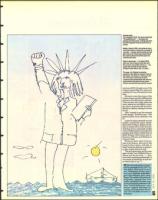
This page, left: Making its exclusive
premiere in Ann Arbor is Lennon's Power to
the People. The sketch is a reference to the
1971 Ann Arbor concert/rally at which
Lennon and Ono performed to free left-wing
author/activist John Sinclair from prison.
Sinclair was freed 55 hours after the concert.
minimum $500, though some of the
original, signed Bag One pieces are
reselling for tens of thousands these
days.
Schwartz notes that many of the
Lennon buyers would not fall into the
category of traditional art collector.
They are fans who might otherwise
never attend an art exhibit, or peo-
ple who've previously felt too intim-
idated by a gallery setting to browse
for art.
Yoko "wanted to get the artwork
to the people," Schwartz says. "The
general public wasn't getting to see
it."
Lennon's modus operandi was the
simple, unadorned quick sketch.
Some of the works on display are doo-
dles he tossed off in mere seconds.
And they have a cartoonish quality
which Clifford believes presages the
popular style of later artists such as
Keith Haring. Others have seen in-
fluences of Picasso and Matisse in
Lennon's style.
Whatever their value to the an-
nals of art history, they are by the
hand of John Lennon. And that, in
itself, lends the sketches a poignan-
cy they might otherwise lack.
`The joy it gives them and the mes-
sage it sends," says Clifford of the au-
dience and the artwork, " — that,
more than anything aesthetically, is
why people purchase the art and nev-
er want to give it up." ❑
`The Artwork ofJohn Lennon"
will be presented July 24-27 in
Ann Arbor. Hours are 9 a.m.-9
p.m. Wednesday-Friday and 9
pan Saturday in the Michi-
gan Union Ballroom, 530 S. State
Street. The exhibit will include 45
serigraphs, original Bag One
works, a portfolio of Lennon song
lyrics and original production eels
from "Yellow Submarine," plus
several original drawings by
Lennon, never previously shown.
Call (707) 526-8991 for more in-
formation.