

A Centennial Love Stor y
To placate American
and world opinion,
the Nazi sport authorities
organized training camps
for Jews.
Marty Glickman, were replaced in the 4-by-100-me-
ter relays with two African-American athletes, Jesse
Owens and Ralph Metcalfe. Mr. Glickman contin-
ues to believe an anti-Semitic coach was behind the
switch.
Another tragic anecdote involves the Polish fencer
Roman Kantor, who had taken part in the 1936
Games, and the Nazi general Reinhard Heydrich,
an avid fencing aficionado. The feared head of the
Gestapo provided Kantor with money and travel pa-
pers after the Jewish athlete fled from the Soviet oc-
cupation zone in 1939. His story ends, like so many of
his contemporaries, in the Majdanek Nazi concen-
tration camp.
Mark of excellence
It is easy to see that of all the Olympic events, fenc-
ing might be considered the ultimate Jewish sport. It
is not an exaggeration to say that Jews won more
medals in Olympic fencing — based on their repre-
sentation in the general population — in the first half
of the 20th century than any other ethnic group. Hun-
garian Jewish fencers were especially dominant in the
Olympics. Ivan Osiier, the leader of
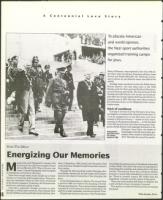
Rising tension:
Copenhagen's Jewish community, gar-
Adolf Hitler enters
nered a silver medal in Stockholm in
the Olympic
1912. He holds the record for partici-
stadium in 1936.
From The Editor
Energizing Our Memories
ention the word "Olympics" in tandem with
Israel and the collective thought of most
Jews is Munich, 1972. That, of course, was
when 11 Israeli Olympians were murdered
(i)
by Palestinian terrorists in Germany.
Each time we get ready to get caught up in these
1- Games, our memories leaf through history. Some of us
cc can even remember where we were when we learned
1.- of the Munich massacre. To this day, the Olympic torch
LU
= serves as a yahrtzeit candle of sorts.
Just like a yahrtzeit, though, we learn to gain
strength, to rebuild and to move on. That's exactly what
Jewish athletes, and in particular Israeli athletes, have
ci)
LU
1 4
done. In Barcelona, 1992, Israeli judo Olympians Yael
Arad and Oren Smadja brought home their nation's
first medals.
Through the 100 years of the modem Olympics, Jew-
ish athletes, coaches and, for that matter, all of us have
had our own share of memories of the triumphs, the
glory.
As the Olympiad opens in Atlanta, The Jewish News
is proud to offer our readers this sampling of Jewish
Olympic participation. This commemorative keepsake
was part of a more extensive section produced by the
staff of our sister publication, the Atlanta Jewish Times.
Of particular interest is the story of the Paralympics,
chronicling the achievements of wheelchair tennis play-
er Marc Nadel. Yes, there will always be important ar-
ticles listing the medalists and ranking them with their
records. The internal flame that carries an athlete,
however, is never fully embodied by a time or a num-
ber. There is, instead, a spirit. Mr. Nadel, from his
wheelchair, reminds us of the reality of that spirit.
When the torch reaches full flame in Atlanta, the
world will feel its heat, its energy of renewal.
This section is a taste of what should be an exciting
Olympiad.
Phil Jacobs, Editor