

A Moho Awl Iwo Oars
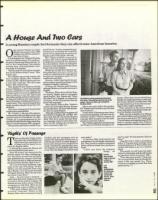
A young Russian couple feel fortunate they can afford some American luxuries.
lga and Ilya Veksler can easily
identify the guests at their 1988
wedding who still live in the for-
mer Soviet Union.
In a photograph, the Vekslers' 65 guests
stand on a marble stairway. The young cou-
ple point to friends and family and say, "Is-
rael" or "the United States," the countries
to which many of the individuals or fam-
ilies chose to immigrate.
"Half the people in that picture no longer
live [in the former Soviet Union]," Mrs.
Veksler said.
The Vekslers came to this country with
their daughter, Masha, Mrs. Veksler's
mother and Mr. Veksler's parents just over
a year and a half ago. "We still count
halves," Mrs. Veksler said.
They decided to join relatives already
living in Michigan, a state they perceived
to have a relatively low cost of living. The
Vekslers said it was not too difficult for
them to adjust to a new life. They found
jobs rather quickly and never had any ma-
jor financial problems, they said, despite a
lack of American working experience or a
credit history. They received support from
family members already living in the Unit-
ed States.
Both have subsequently found better
employment opportunities.
Mr. Veksler, a 28-year-old engineer,
switched jobs within his field and now does
contract work for Ford Motor Co. Mrs.
Veksler, 26, is a paraprofessional for the
Southfield Public Schools' high-school Eng-
lish-as-a-second-language (ESL) program.
Her previous job was at Jewish Voca-
0
tional Service. "I took a receptionist posi-
tion because it was the first one I could find,
and it was an opportunity to practice my
English and be with people," she said.
Mrs. Veksler found her current job by
accident. She went to register Masha for
kindergarten and learned of an opening in
the school district, which was looking for
someone to help students from the former
Soviet Union learn English.
Masha had a harder time than her par-
ents adjusting to the move. At first, she
could not understand the language her
teachers and classmates spoke. For two
months she cried daily.
However, it didn't take long for her par-
ents to notice a tremendous change in their
daughter's English vocabulary.
At home, the Vekslers speak Russian,
although Masha now tends to converse in
English.
"It's funny. When she is with her Russ-
ian friends, Masha and her playmates
speak English," Mrs. Veksler said. "When
she talks to us in English, we answer her
in Russian. We feel it's important that she
know both languages."
When Masha talks to Mrs. Veksler's
mother, she must speak Russian because
her grandmother, who lives with the fam-
ily, does not speak English.
Although confident their daughter will
be proficient in English, Mr. and Mrs. Vek-
sler worry that she will lose her Russian
skills. They know people who hire Russ-
ian-language tutors to school their chil-
dren, but the Vekslers do not believe a
tutor is necessary right now.
The Vekslers recently purchased a Bloomfield
Hills home. They park their two Ford cars in the
garage. They are on their way to living their
American dream.
After a year and a half in this country,
Mr. Veksler said it is hard to say if he feels
more American.
"I don't know if [becoming more Amer-
icanized] is happening, but that's not my
intention," he said. "I want to improve my
language skills and gain more of a back-
ground on American culture."
The Vekslers appreciate classical music
and frequent the Detroit Symphony Or-
chestra. When they are not entertaining
friends, the couple spend time at other peo-
ple's homes. Summer provides them with
an opportunity to go to the lake and par-
take in other outdoor activities.
Their summers in the former Soviet
Union were spent in the family's rustic cab-
in in the Russian countryside.
"Here you can maintain your lifestyle
and cultural habits, and you are free to live
in a way you want to live," Mr. Veksler said.
"Your education and experience pay off. Its
hard to convince people from Western
backgrounds that in Russia engineering is
iltigAts' Of Passage
T
hree months after Greg Lamdan
arrived in the United States, he
talked about his yearning to vis-
it Israel and his desire to im-
prove his English skills.
In the last four years, the 18-year-old
has accomplished much more.
Since his arrival, he's been given the
Hebrew name Tzvi after undergoing a
brit. His family moved from its North-
gate apartment into a home in Oak Park.
He was bar mitzvah in 1993 and recently
graduated from Berkley High School.
"In a way I feel more American, espe-
cially in my ways of thinking," he said.
"Before, my only memories were of my
life in Russia. I now have past memories
of living in America. Still, I try not to for-
get where I came from."
Greg — his real name is Grigoriy —
said he also feels more religious now that
he it able to freely practice Judaism. He
attends services at the various Orthodox
synagogues in Oak Park. When he has
an opportunity to put on tefillin, he does.
"I feel more religious and I feel clos-
er to God," Greg said. "Before we left
Russia, there was a movement toward
freedom and the synagogue was re-
opened. We had people coming from Is-
rael trying to teach us about religion. I
knew some things from childhood be-
cause I watched my grandmother prac-
tice Judaism, but they didn't make sense
to me. Now, the things I remember make
more sense."
In January 1994, Greg's family lost
everything in the Northgate Apartments
fire. They moved to another apartment
before relatives helped them purchase a
house.
"I don't care about the monetary
things we
Far left:
Greg Lamdan
hopes to become
a citizen in
January 1997.
Left:
Greg,
photographed
four years ago,
came to this
country with
dreams. Some
have been
fulfilled.
lost," he said. "It's the pictures I feel bad
about."
Greg did well in school, graduating
with a 3.75 grade-point average. He is
studying pharmacy at Wayne State Uni-
versity and hopes to go on to medical
school.
This month, he will make his appli-
cation for citizenship and should become
an American citizen in January 1997.
"Time here goes so fast," Greg said.
"It's so much faster than [in Russia] be-
cause of the way people live. There,
everyone is working so much that time
passes slowly."
❑