
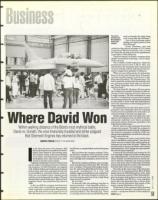

PHOTO BY ISRAEL SUN
The Lavie's
demise led to
the company's
decline and
rebound.
/--
Where David Won
Within walking distance of the Bible's most mythical battle,
David vs. Goliath, the once financially troubled and strike-plagued
Beit Shemesh Engines has returned to the black.
JENNIFER FRIEDLIN SPECIAL TO THE JEWISH NEWS
I
n the first 24 years of its history, Beit
Shemesh Engines exemplified the stereo-
typical, labor intensive, loss-accruing, state-
run company which, as the main employer
of an angry, disenfranchised, blue-collar
development town, often loomed as a mon-
ument to Israel's social malaise.
Originally designated to become Israel's lead-
ing jet-engine manufacturing and overhaul-
ing company, the Beit Shemesh was plagued
with wildcat strikes and continual government
bailout plans which time and again proved cost-
ly and ineffective. Canceled projects, most no-
tably the Lavie fighter plane, crippled morale
and drove into the ground the dream of French
industrialist Joseph Shicllowsky, Shimon Peres'
longtime friend, who established the plant in
1968.
In fact, by 1992 the company had deteriorat-
ed so badly that it seemed the government,
which originally envisioned Beit Shemesh En-
gines as the motor that would propel the city of
Beit Shemesh into a solid middle-class area,
would have to concede defeat and shut the plant
down.
But just before the company crashed, Yehu-
da Bronicki, president of the privately owned
Ormat group, which has interests in power sys-
tems and high-tech companies, came to the res-
cue.
Beyond its complex problems, poor manage-
ment and glaring misdirection, Mr. Bronicki
saw a company with good technological poten-
tial. By redirecting Beit Shemesh from a mili-
tary-goods manufacturer to a civil- and
military-engine manufacturer with a global ori-
entation, Mr. Bronicki thought he could over-
haul the company and turn it into a high-flying
international competitor.
He was right.
'In the early '80s, the challenge was how to
take government — and especially military —
companies, and try to convert them for as much
civilian use as possible while making them eco-
nomically effective," Mr. Bronicki says. "There
is a synergy between Ormat and Beit Shemesh,
and we thought the right thing
to do was to take the challenge."
Part of that challenge meant
finding the right person to lead
Beit Shemesh.
Avner Shacham, who had
worked as the general manager of U.S.-based
Connecticut Machine Products, went to work
for Ormat for one year prior to his appointment
as president of Beit Shemesh.
Upon his arrival, he found a company that,
despite its excellent technology, was ill-adapt-
ed for survival.
The workforce of 420 employees, which the
government had cut from 1,400 in 1987, was
still bloated, the standards and requirements
were low and the workers' attitudes toward cus-
tomers ranged from apathetic to offensive.
'When you are selling parts, the philosophy
here is not only does the part have to be good,
you have to talk properly to the buyer on the
other side of the phone," Mr. Shacham says. "We
had to teach the workers that if somebody calls
you, you have to return their calls, you can't just
say, I know what they want, so rm not going to
call them back."
The first thing Mr. Shacham did was reduce
the workforce by another 30 percent to 290 em-
ployees, further reducing the city's reliance on
a single company. He then embarked on what
he calls a "re-education" process which entailed
encouraging teamwork, retraining employees
to take pride in their work and explaining to
them the importance of developing good cus-
tomer relations.
He implemented an open-door policy and ex-
plained to his employees that the company
would never be successful if it continued to op-
erate according to the previous approach.
At first, employees were wary of the new man-
agement and hesitant to be cut off from the gov-
ernmental umbilical cord which promised
paychecks and pay increases regardless of an
individual's performance.
Slowly, however, the employees found that
change can be good. Through the company's
newly established profit-sharing mechanism,
the recently expanded workforce of 350 em-
ployees has reaped direct rewards from the com-
pany's restructuring.
"The company is much, much better than
what it was before it went private," says one em-
ployee who has worked in the engine-testing de-
partment for more than 20 years. "Before, the
company had no money and there were always
demonstrations. Now, things are calm and sta-
ble, and we are prospering."
Located off the winding road joining the Tel
Aviv-Jerusalem Highway and the working-class
city of Beit Shemesh, a stone's throw away from
where Goliath was struck down by David, his-
tory's ultimate underdog, the company today
sits on 100 acres, where rosebushes and finely
manicured grounds have been cultivated from
formerly litter-strewn surroundings.
One mile up the road, many of the city's pop-
ulation lives in housing projects. Most of these
people travel out of Beit Shemesh for work, while
an overwhelming majority of Beit Shemesh En-
gine's managers and engineers arrive each day
from Jerusalem and Tel Aviv. Local residents
tend to fill in the lower-level jobs, a mirror of the
kinds of social grievances that much of the
town's original inhabitants still harbor.
Within each of the company's three divisions
— overhaul and assembly, manufacturing, and
casting — employees dressed in blue jumpsuits
DAVID page 52