

Rocky
First Steps
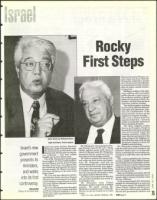
Above: David Levy: Balking for Sharon.
Right: Ariel Sharon: Time for payback.
Israel's new
government
presents its
ministers,
and walks
into its first
controversy.
ERIC SILVER
SPECIAL TO THE JEWISH NEWS
srael's new prime minister, Binyamin
Netanyahu, broke all records last week.
He presented his government to the
Knesset only 18 days after his election
was confirmed — and then walked
straight into his first cabinet crisis.
Two of Mr. Netanyahu's Likud party
heavyweights, the former Defense Minis-
ter Ariel Sharon and the former Foreign
Minister David Levy, were absent from
the Cabinet list and boycotted the special
Knesset session. Mr. Sharon was report-
ed to have withdrawn to his ranch in the
Negev desert.
Mr. Levy had been offered his old For-
eign Ministry berth, but threw Knesset
members and commentators into disar-
ray by refusing to accept the post until the
new prime minister allocated a senior port-
folio to Mr. Sharon.
Mr. Levy told reporters later that night:
"The government must represent all those
forces who worked to establish it. It is in-
conceivable to form a government without
Ariel Sharon."
I
Mr. Netanyahu was keeping the For-
eign Ministry open for Mr. Levy, whose
Gesher splinter group holds seven of
Likud's 32 Knesset seats. Mr. Netanyahu
announced that he would serve for the
time being as acting foreign minister.
Mr. Sharon's omission from the top Cab-
inet ranks was both clumsy and ungra-
cious. Mr. Netanyahu owed him an
overwhelming debt. It was the burly old
warrior who persuaded Mr. Levy and an-
other right-wing maverick, Rafael Eitan,
to withdraw from the prime ministerial
race, thus leaving Mr. Netanyahu a clear
run against Labor's Shimon Peres.
Mr. Sharon also brokered the deal that
won the Likud candidate the crucial ul-
tra-Orthodox vote.
Mr. Netanyahu chose Yitzhak
Mordechai, another ex-general, as defense
minister. The stolid, popular Mr.
Mordechai is a political novice. Unlike Mr.
Sharon, he can be trusted not to make
waves.
Once he was denied Defense, Mr.
Sharon demanded Finance, an-
other china shop from which Mr.
Netanyahu preferred to exclude
him. The job went to Dan Meridor,
an urbane former justice minister,
after an earlier, equally unseem-
ly tug-of-war.
Building a coalition of six right-
wing, religious, ethnic and center
parties proved a crash course in
the combative realities of Israeli
politics for the 46-year-old Mr. Ne-
tanyahu, who had never served as
more than a deputy minister.
The coalition parties, including
his own Likud, still have their sep-
arate egos and aspirations, inter-
ests and constituencies. If the
prime minister wants to get his
legislative program through —
and to win a second term four
years down the line — he has to
satisfy an irreducible minimum of
their competing demands.
The three religious parties
drove a hard bargain, though in
the end they were more concerned
with down-to-earth issues like
housing, education, welfare for
large families and control of the
purse strings of the Religious Af-
fairs Ministry than with forcing
the secular majority to keep the
Sabbath and eat kosher.
Mr. Netanyahu resisted attempts to
turn the clock back on all changes in the
hallowed "status quo," or to post rab-
binical watchdogs at archeological ex-
cavations in case they turn up Jewish
bones.
The coalition guidelines do, however,
include a pledge to deny official recogni-
tion to Reform and Conservative conver-
sions carried out in Israel. This reverses
a Supreme Court ruling of last November
requiring the Interior Ministry to register
such converts as Jews.
But non-Orthodox conversion abroad
will still give potential immigrants an au-
tomatic right to Israeli citizenship under
the Law of Return.
In his inaugural speech, Mr. Netanyahu
pledged his administration to persevere
with the peace process. He appealed to the
rulers of Syria, Lebanon and Saudi Ara-
bia to negotiate without prior conditions.
But the new government's platform was
STEPS page 76