
ence
SUZANNE CHESSLER
SPECIAL TO THE JEWISH NEWS
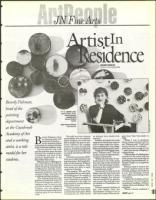
F:1-14, 1995/96, photo-
based collage, acrylic,
resin on plywood,
exhibited at the
Susanne Hilberry
Gallery.
PHOTO BY DAN IEL LIPPITT
Beverly Fishman,
head of the
painting
department
at the Cranbrook
Academy ofArt
and a working
artist, is a role
model for her
students.
Right: Beverly Fishman:
The cell as art.
B
everly Fishman colors
her painting career with
two kinds of palettes —
one for personal projects
and another for student activities
at the Cranbrook Academy of Art.
This has been her way of life
over the past four years, the time
Fishman has worked as artist-
in-residence and head of the
painting department at the
Bloomfield Hills school.
Fishman came to Michigan by
way of the Maryland Institute,
where she was an instructor; the
College of New Rochelle Gradu-
ate Art School, where she was an
associate professor; and Con-
necticut College, where she was
a visiting assistant professor.
"The exciting thing about the
position at Cranbrook is that I'm
first and foremost an artist-in-
residence, and rm here to mod-
el what an artist is," explained
Fishman, who uses images of
cells from the human body as the
starting point for her abstract
work.
"We build very close, intimate
relationships with our master's
degree students, who work next
door in studios. My goal is to pos-
itively influence the younger
artists who come through this
program, hopefully giving them
the courage and knowledge to go
out and do something with their
talents."
Individual and group exhibi-
tions have added shades to her
painting career. Represented lo-
cally by the Susanne Hilberry
Gallery in Birmingham, Fish-
man traces her style to early
questions of identity.
`The question, Who am I?' be-
came physical for me, and I start-
ed thinking about the outside of
the body," Fishman recalled. "I
wasn't interested in the figure; I
was interested in the body, its
fragmentation and the different
associations it had.
"I kept peeling away layers,
trying to find some closer truth,
a process that took years. When
I reached the cell, I felt I found
an abstract form loaded with
meaning."
Fishman structures her work
using photo-based laser copies of
cells as seen under the micro-
scope, melding them into collage
forms and applying acrylic paint.
"I hope the work triggers ques-
tions," Fishman said. "The cell
touches issues of regeneration,
mutation and division.
"Within the last year, I've in-
cluded stars in my work, going
from the cells as the innermost
point in the microscopic world to
the stars as the outermost point
in the telescopic world."
Fishman got her first set of oil
paints when she was 4 years old
and began using them to make
abstract designs. Her interest
was encouraged by her parents
and an aunt, who took her to see
art exhibits in Philadelphia, her
hometown.
Fishman earned a bachelor of
fine arts degree from the
Philadelphia College of Art in
1977 and a master of fine arts de-
gree from Yale University in
1980.
"When I was in graduate
school, things started to gel for
me," Fishman said. "I had a real
strong interest in material —
paint was never enough for me
— and I was always collaging or
adding things.
"That process of collaging has
stayed over the years, and my
work always has some edge of
something representational, al-
though it might not be apparent
what it is."
Fishman likes to work on her
personal projects early in the
morning, getting to the studio by
6 a.m. and finishing around
noon. Afternoons belong to her
15 students.
"I select the students and de-
vise an entire two-year program
consisting of readings, critiques,
visiting artists and dialogue," she
explained.
'When I choose students, I
ARTIST page 107
Scanned image of the page. Keyboard directions: use + to zoom in, - to zoom out, arrow keys to pan inside the viewer.
June 28, 1996 - Image 105
- Resource type:
- Text
- Publication:
- The Detroit Jewish News, 1996-06-28
Disclaimer: Computer generated plain text may have errors. Read more about this.