

WHAT IF?
it's healthy that people feel detached. Raucous rallies
were never conducive to serious decision-making."
Not The Old Days
Nevertheless, until now — and especially since the
early 1980s -- Israeli election campaigns have gener-
ally been colorful, frenetic and, above all, strident. So
why the change?
"Public apathy would imply the expectation of a low
turnout at the polls, and that is not the case at all," cau-
tions Professor Dan Bar-On, a psychologist at Ben-Gu-
rion University of the Negev. 'What we're seeing in the
street and on the roads isn't a lack of interest in the elec-
tions but a change in style, a different way of doing
things."
Dr. Bar-On agrees that most people already have de-
cided how they will vote and are therefore bored by the
campaign; that the two main parties have deliberately
blurred the differences between them, which acts
against generating excitement; and that the campaign
is essentially a single-issue affair (the peace process) —
and a worn issue, at that.
issue will define the Israeli election,"
said a source close to the Labor leader-
ship. 'Washington can't help with the
question of the character of these two
men, but it can make a difference in
terms of security. Israelis need to be re-
assured that Washington will be there
as their country takes chances for peace;
they need to know that their leader has
the pull in Washington to keep the high-
tech equipment and the military aid
coming."
The timing of the U.S.-Israeli defense
agreements may have been motivated
by politics, but the combination of high-
level symbolism and tangible results,
including new weapons that may be able
to knock down Katyusha rockets, was a
potent combination in Israel, according
to analysts there.
And the Clinton-Peres orgy of mutu-
al praise, which included a remarkable
exchange of endorsements in front of an
enthusiastic crowd at the recent policy
conference of the American Israel Pub-
lic Affairs Committee (producing cries
of foul from Israeli opposition leaders),
is unlikely to generate a significant po-
litical backlash on May 29, according to
William Quandt, a former National Se-
curity Council official and now a pro-
fessor at the University of Virginia.
"Some Israelis will react negatively
because the endorsement is so blatant,
although not exactly unprecedented,"
he said. "Others feel reassured that
strong support from Washington im-
proves Israel's security and makes it eas-
ier for them to face the future.
"Peres has been a full co-conspirator
in this; he wouldn't be courting obvious
American support if he didn't believe
it would help in the election."
'The campaign is ignoring most of the 'personal,' long-
range issues facing Israeli society, be they economic, so-
cial, or religious," says Dr. Bar-On. "No one is talking
about the issues that will have to be faced afterward —
the gap between rich and poor, the relationship between
religion and state, etc."
Others say that the candidates themselves have
changed the elections.
"It's true that the campaign looks sterile if you com-
pare it with the days when Menachem Begin could draw
tens of thousands of enthusiastic supporters to rallies
in the main squares," says Professor Dan Bar-Tal, a po-
litical psychologist at Tel Aviv University. "Shimon
Peres is the uncontested leader of his party, but he is
not a charismatic politician. [Binyamin] Netanyahu
lacks even the unqualified support of everyone in his
party. And neither candidate knows how to work up a
crowd."
Above all, however, Dr. Bar-Tal says that the climate
of restraint is a direct effect of the Rabin assassination.
"The impact of the assassination has been greater than
many of us — who stressed the public's tendency to-
ward forgetfulness — originally assessed," he reflects.
A more significant problem could
arise if Mr. Peres loses. Some Mideast
observers worry about a chill in U.S.-Is-
raeli relations if the man spurned by the
U.S. administration — Likud leader
Binyamin Netanyahu — prevails.
"Netanyahu would undoubtedly have
some partners in his government who
are not favorites in this town," Mr.
Quandt said. "Conceivably, [Gen. Ariel]
Sharon would be in the government. If
he ends up as defense minister, there
are people here who would be genuine-
ly horrified. American policy in that
event would be difficult."
But Mr. Netanyahu's political histo-
ry suggests that he would move quick-
ly to patch up relations with a Clinton
administration that has been over-
whelmingly pro-Israel, most analysts
believe — or with an incoming Dole ad-
ministration.
"Netanyahu would have every in-
centive to get off to a good start in rela-
tions with Washington," Mr. Quandt
said. "It's not in his interests to bear a
grudge over this, if he wins."
"Bibi is very smooth; he understands
how things work in Washington," added
Morris Amitay, treasurer of the Wash-
ington PAC, a pro-Israel political action
committee. "But a lot depends on what
happens on the ground over there."
A turn away from the peace process
policies of the Rabin/Peres governments,
he said, could produce strong new pres-
sure from "Arabists" at the State De-
partment even if President Clinton is
re-elected.
Others worry that the administra-
tion's strong endorsement of Mr. Peres
creates a dangerous precedent that could
come back to haunt Israel.
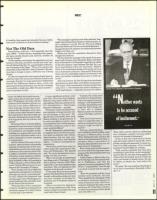
Shimon Peres addresses a joint session of Congress.
"Anybody who really cares
about the U.S.-Israeli relation-
ship in the long term has to be
unhappy," said Douglas Feith,
a member of presidential chal-
lenger Bob Dole's foreign poli-
cy team and a longtime
Mideast analyst who has been
critical of the Rabin and Peres
policies.
"This kind of intervention,
which you might like today, is
setting a precedent for some-
thing you might not like to-
morrow."
Previous administrations
have meddled in Israeli politics under
the guise of Mideast policy, he said.
"What distinguishes this case from the
others is the shamelessness of the in-
tervention. What it comes down to is
that this administration isn't even ris-
ing to the level of hypocrisy."
Even strong peace process support-
ers worry about the long-term conse-
quences of the administration's bear hug
for Mr. Peres.
Judith Kipper, a fellow at the Cen-
ter for Strategic and International Stud-
ies in Washington, said that the
apparent American endorsement of Mr.
Peres is "inappropriate," even though
it is aimed at preserving the negotia-
tions.
"Both the president and the prime
minister went overboard," she said.
`They crossed the line of propriety. Peres'
re-election is extremely important in
terms of American policy. But it's im-
portant to emphasize the policy, not the
politicians; the United States will clear-
ly accept any government that's elected
and work with it." LI
—Dan Bar-Tal
"Both Labor and the Likud are calibrating
their strategies carefully, because neither
wants to be accused of incitement."
So far, in fact, the Likud election broad-
casts have been careful to attack Mr. Peres'
policies, not the man personally (in sharp con-
trast to its 1992 campaign, which virtually
portrayed Yitzhak Rabin as a drunk).
"Both parties evidently feel they have
something to gain from a quiet campaign,"
says Dr. Bar-On, who also warns against the
illusion that the present mood of civility sig-
nals a sea change in Israeli society. He sees
it, rather, as merely the "calm before the
storm."
He quips: "No one need fear that Israel is
on its way to becoming a Denmark or Swe-
den." CI
C,
ti
61