

created a better understanding among the leader-
ship of each other's problems."
And it has created an atmosphere in which Mr.
Perlmutter's group finally can embark on the first
concrete project of its existence: the establishment
of a model industrial zone on one of the borders be-
tween Israel and the Palestinian Authority. If it is a
success, the zone will bring thousands of new jobs to
Palestinians and bring them desperately needed tax
dollars, which will allow the creation of effective so-
cial welfare programs. This will, according to Mr.
Perlmutter, "facilitate the real implementation of the
peace process to no insignificant degree." Which will
make Mr. Perlmutter a key behind-the-scenes play-
er in the architecture of the new Middle East. It is
not a role he would have ever imagined for himself.
"The congress was very feisty, and was willing to
be more adventuresome in terms of incurring the
wrath of the mainstream Jewish community than
other related organizations," says Mr. Perlmutter.
"Very early on, in the 1980s, we began meeting with
Arab leaders."
This policy led to some, well, interesting situations
— the first of which involved a mid-1980s meeting
in Amman with King Hussein.
he's our avowed enemy, we can have nothing to do
with legitimizing him. In the end we decided not to
do it."
They did, however, decide to go to Saudi Arabia in
1990, the first Jewish organization to meet with King
Fand.
By that time, other organizations started catching
up to the AJC's policies, recognizing the fact that for
Israel to be an occupying power was inconsistent with
A Watershed Event
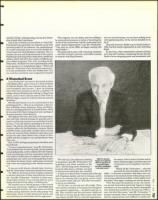
Louis Perlmutter was born in the Jewish enclave
of Brookline, Mass., just an hour or so from the heart
of Catholic Boston. His was a Conservative, obser-
vant household, and, he says, "I grew up thinking
Jews were not a minority at all, but a majority." A
college stint at Brandeis did nothing to dispel this
notion, and it wasn't until he came to New York in
1961 to begin a career as a lawyer that he realized
its fallacy.
For the next decade or so, he concentrated on his
professional life — first as an associate at the law
firm of Phillips, Nizer, Benjamin, Krim and Ballon,
then as a managing director at Lazard Freres, where
he was one of the firm's rising stars and a protege of
its senior partner, Felix Rohatyn.
Throughout this time, like many of his generation
who took their cultural heritage for granted and fo-
cused on achieving success in an assimilated world,
he says, "I was not active in anything to do with Ju-
daism." He and his wife, Barbara, the vice president
of public affairs for the Manhattan company Marsh
and McLennan, had joined a temple upon arriving
in the city more for their children's sake (they have
two grown sons; their eldest owns a store on Nan-
tucket and the youngest is an actor/producer) than
their own.
But, in 1975, he began preparing for his eldest son's
bar mitzvah.
"It was a watershed event," says Mr. Perlmutter.
"I remembered my own bar mitzvah, and my parents
and grandparents, and I suddenly felt this intense
sense of continuity and that somewhere inside me
was 2,000 or 3,000 years of tradition, and how im-
portant that was. And it was at that point that I start-
ed to follow the issues closely, and become conversant
with what was happening in the Jewish communi-
ty."
It was not until almost a decade later, however,
that Mr. Perlmutter's interest translated into action.
"In 1984 the American Jewish Congress asked me
to become chairman of their international commit-
tee," says Mr. Perlmutter. "And that is when every-
thing really started. I was a strong believer and a
strong advocate for the policy of reaching out."
He reached out to Jewish groups, to the Jewish
community and Israel's neighbors in the Middle East
— an unheard of policy at a time when prevailing
wisdom among American Jewish lobby groups was,
essentially, Israel is under permanent attack, and
we should have no interaction with its aggressors.
"What I'm basically
its nature, both in terms of values and in
'We were at a late afternoon meeting
trying to do is apply the
terms of human rights, and that some sort
in the palace," says Mr. Perlmutter ("we"
skills I've gained as an
of resolution and recognition was inevi-
including a few other members of the
investment banker
table.
AJC), "and the king starts whispering — and make a contribution
in the public sphere."
Which led Mr. Perlmutter — who had
he never talks above a whisper, you have
assumed the chairmanship of the AJC in
to lean forward and listen very carefully
— 'I want you to know that I've spent most of the day 1988 — to his next conclusion: that there was a re-
with Chairman Arafat, and he's in Amman, and he dundancy in the myriad Jewish lobby groups and it
knows I'm meeting with your group, and he wants was having a detrimental effect on their ability to af-
very much to meet with you.' Now that was certain- fect policy. Once again, reaching out was his answer.
"Over the years the positions of, say, the Ameri-
ly not on our schedule.
"At this time, no one had met with Arafat. There can Jewish Committee had really begun to merge
were certain members of our group who thought it and blend, so it was actually very hard to distinguish
was a historic opportunity — too good to pass up, re- one's stance from another's on not just one of the is-
ally. They wanted to get this guy across a table and sues, but all of the issues," says Mr. Perlmutter. "I
look him in the eye and go man to man. But there became convinced, when I was chairman, that these
were others who felt: This is a. terrorist organization, discrete organizations were difficult to justify and