
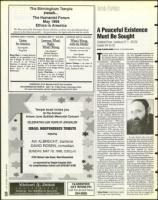

The Birmingham Temple
The Humanist Forum
May 1996
Ethics in America
The May series of the Humanist Forum will focus on three areas of profound ethical
concern to the American public — the government, the legal profession and the media.
MONDAY, MAY 6 • 8:30 P.M.
MONDAY, MAY 13 • 8:30 P.M.
MONDAY, MAY 20 • 8:30 P.M.
Vision
for America
What's Wrong
with the Media?
Guest Speaker
Lawyers: What's
Right,
What's Wrong
THE MICKEY AND ROBERT SHORR
Doug Ross
Guest Speakers
MEMORIAL LECTURE 1996
Doug Ross is a leading Democratic
candidate for the governorship of the
state of Michigan. He served as both
the Director of the Michigan
Department of Commerce and as an
Assistant Secretary of Labor under
Robert Reich in the Clinton
Administration.
Michael Schwartz
and Larry Charfoos
Michael Schwartz is a partner
in the firm Fieger, Fieger and Schwartz
and a leading defender of Dr. Jack
Kevorkian. He is the former Grievance
Administrator of the Michigan Attorney
Grievance Commission.
Larry Charfoos, is a leading
trial lawyer in the state of Michigan
and the author of several bestselling
books of medieval law.
Guest Speaker
James Fallows, Washington Bureau
Chief for the Atlantic Monthly
James Fallows is the author of
the new bestselling book about the
media, Breaking the News.
ADMISSION: $5.00 Members $6.00 Non-members
THE BIRMINGHAM TEMPLE • 28611 W. 12 Mile Road, Farmington Hills
For more information call the Temple Office at 810-477-1410
Temple Israel invites you
to the Annual
Arlene June Gottlieb Memorial Concert
CELEBRATING 3,000 YEARS OF JERUSALEM
ISRAEL INDEPENDENCE TRIBUTE
featuring
AVI ALBRECHT, baritone
DAVID ROSEN, comedian
SUNDAY, MAY 19, 1996, 3:30 p.m.
TH E D E TRO T J E WI S H N EWS
5725 Walnut Lake Road, West Bloomfield
28
co-sponsored by Temple Couples Club
for complimentary tickets call (810) 661-5700
Michael A. Jonas
P•H•O• T•0•G•R•A• P•1-1•1'
Weddings • Bar / Bat Mitzvah Specialist
"The DIFFERENCE Makes The Difference!"
(810) 647-5060
CLASSIFIED
GET RESULTS!
Call The Jewish News
354-5959
A Peaceful Existence
Must Be Sought
Shabbat Emor: Leviticus 21:1- 24:23;
Ezekiel 44:15-31.
RABBI ELIEZER COHEN SPECIAL TO THE JEWISH NEWS
T
he first half of this week's ual Jew was so great that he not
sedrah, Emor, deals with only felt himself unworthy to
the special duties, regula- judge his fellow man, but he sin-
tions and responsibilities of cerely saw only the good in every-
one and truly interpreted their
the Kohanim — the priests.
Aaron and his descendants behavior in a positive light.
The Mishnah in Tractate Avos
were designated for this special
role; and although the sacrificial (1:12) tells us that "Hillel used to
service no longer exists, the re- say: 'Be of the students of Aaron
strictions that apply to Kohanim — love peace and pursue peace,
are still in force. The Kohain did love humankind and bring them
more than simply facilitate the close to the Torah."' Maimonides
offering of sacrifices. The Torah in explaining the Mishnah says:
tells us that the high priest "bore `They said of Aaron that when he
the judgement of the Jewish peo- felt that a person was evil or that
ple upon his heart" (Exodus he had had a bad reputation or
28:29) and "bore their names be- that he was a sinner, he would
fore God as a remembrance upon initiate a greeting to him and
would befriend him and would
his shoulders" (Exodus 28:12).
The priest was the intermedi- engage him in conversation ..."
ary — the connection — between To Aaron, every Jew was beloved,
God and the Jewish people and by him and by God.
between the Jewish people and
God. And this relationship, in
both directions, as personalized
by the priest, was one of uncon-
ditional love.
When, even today, the priests
bless the nation (outside of Israel
this is done according to tradition
on the biblical festivals, the
"Duchanin" of the Musaf service)
the preliminary blessing they re-
cite is to the One "... Who com-
manded the priests to bless His
nation with love." And the fact
the Mogayn Avrohom — the au-
thoritative 17th century corn-
mentary on the code of Jewish
law — states: "Any priest that
does not love the congregation or
It was Aaron who not only
the congregation does not love
him should not bless the people." loved every Jew, but also sought
The priest represents the love_ to engender that love between all
God has for His nation and their Jews and to end dispute and to
reciprocation — the nexus being bring peace. It is certainly ap-
propriate that the priestly bless-
the sacrificial service.
It seems to me that this spe- ing first uttered by Aaron
cial function of the Kohanim was culminates with the divine bless-
exemplified throughout the ing that is the basis of all bless-
Torah by the behavior of Aaron ings, namely that of peace.
It has always seemed ironic to
himself.
Aaron loved the Jewish people me that the final blessing in the
to the point of being unable to Amidah — the silent devotion
view them and their behavior in that we say three times a day —
an objective, critical light — even is the blessing of peace wherein
to their request for the Golden we thank God and bless Him for
Calf. In fact, there is the very granting peace to His nation.
How is it that we Jews — the
telling Midrash that contrasts the
behavior of Moses, the leader, most persecuted nation in his-
with that of Aaron, the priest... tory who have been expelled from
"Moses would judge the people practically every nation on earth,
with a true judgement and he who have rarely known a gener-
chastised them, but Aaron nev- ation without suffering — should
er told a man or woman 'you be- thank God for granting us peace?
On the other hand, perhaps if
haved improperly."'
Aaron's love for each individ- we cannot truly love one anoth-
er and be at peace with our fel-
low Jew, how can we expect this
Eliezer Cohen is the former rabbi
from the rest of the world? ❑
of Young Israel Oak-Woods.
• c=/
\
C_