

Community Views
Editor's Notebook
Chernobyl Threats
Ten Years Later
The Lessons Of War,
And Of Making Peace
BORIS KARASIN SPECIAL TO THE JEWISH NEWS
ALAN HITSKY ASSOCIATE EDITOR
I
he accident that took the
Three-Mile Island Unit 2
power plant out of service
inMarch 1979, less than
three months after its commer-
cial operation began, was a com-
plex one. Many factors, both
human and mechanical, con-
tributed to its seriousness.
People soon understood that
there was a great environmental
problem. The total cost to clean
up and dispose of the radioactive
materials exceeded $1 billion.
About 2.1 million gallons of wa-
ter were contaminated with ra-
dioactive materials during
clean-up operations. The plant is
still shut down.
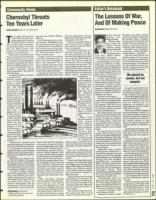
On April 26, 1986, an accident
occurred at the
nuclear power
plant in Cher-
nobyl, a .small
north Ukrainian
city. The N4
Reactor Core
overheated; an
explosion and
meltdown oc-
curred with the
chance of a chain
reaction. The So-
viet government
announced the
accident three
days later. It
happened on a
Friday and for
two days, people
in Kiev, the next
big town to Cher-
nobyl, did not
know about the
dangers of the
contamination.
The 3 million
residents of Kiev
used the Dnieper
River water for
swimming and
fishing.
Scandinavian scientists used
sensitive equipment to determine
the extent of the threat. Quanti-
ties of radioactive material es-
caped from the reactor building,
drifting with atmospheric circu-
lation over Scandinavia and East-
ern Europe.
After some days, Moscow Ra-
dio and the official newspaper
Pravda gave some information.
The official report was: 31 deaths;
203 hospitalized for acute radia-
tion sickness; 135,000 evacuated.
On April 30, 1986, a radioac-
tive cloud reached Kiev. During
May, most children were evacu-
ated by parents to other places in
the former Soviet Union. The en-
tire north of the Ukraine, the
south of Byelorussia and the
western part of Russia were pol-
luted. Eastern and northern Eu-
Boris Karasin is a former
resident of Kiev who now lives
in West Bloomfield.
rope were also affected. Millions after the catastrophe in the pol-
luted zone. There were only "So-
felt fear.
In a 30-kilometer zone, noth- viet people," not "Jews."
These same people refuse to
ing was alive. Firefighters, doc-
tors and chemists were allowed see a future in the new, indepen-
to enter the area. The soldiers of dent countries, where anti-Semi-
the Soviet army and the police tism is not popular.
Chernobyl continues to be a
were on the front lines of the "bat-
tle." Who knows how many of fear factor for many. The gov-
ernment of Ukraine can't shut
them are alive today?
Prypiat, where the nuclear down the Chernobyl power plant
power plant employees lived, is a the way Three- Mile Island was
ghost town now. Hundreds of closed. The Ukraine needs its
farms were destroyed. For 10 own electric power; oil and gas
years, nobody took care of the from Russia cost too much. The
fields or agricultural sites. A red- young country needs help, espe-
brown pine forest became the cially from European neighbors.
Chernobyl showed that air and
symbol of this global disaster.
Long ago in this part of the water pollution and radioactive
Russian empire, there were many fallout ignore international
boundaries.
About $5 bil-
lion is needed for
clean-up and re-
building a new
cover under reac-
tor N4. It's a
huge price, even
for industrial
Western Euro-
pean countries.
Four nuclear
power plants give
Ukraine power.
Unstable eco-
nomic conditions
do not permit
them to refuse
using nuclear en-
ergy.
Some Third
World countries
want nuclear
power. They at-
tract scientists
from the former
Soviet Union.
The new, inde-
pendent govern-
ments do not
have the money
to compete for
shtetls. After the 1917 revolution, great projects, and the entire
some people emigrated; others world could become the hostage
moved to larger cities where they of maniacs who have atomic pow-
changed their lifestyles and be- er.
How can we guarantee our
came officers, teachers, doctors,
lawyers. Neither pogroms, wars safety when only poorly educat-
or farm collectivization lessened ed workers and technicians will
the Jewish spirit. Only the Holo- be at work at the nuclear power
caust proved a "final solution" to plants?
I was in the Chernobyl zone 10
the Jewish presence there. Now
Jewish people live only in the big years ago. I saw the empty cities
cities. Bratzlav, Lubavitch and and villages; I saw the eyes of the
Chernobyl were sites from which people whose destiny was broken.
Chasidim spread their ideas of Without war, without revolution
Judaism. Today, the Lubavitch or riot, without natural catastro-
are well-known, but no one re- phe, they became refugees in
members the Chernobyl Cha- their own land.
Some families from the cont-
sidim.
After Chernobyl, Russian aminated zone live among us. For
Nazis recalled the Jewish pres- them, all life has two parts: be-
ence at the site. They tied the fore Chernobyl and after. They
cause of the disaster to a world will never forget the "official lie"
Jewish plot. Chernobyl, they said, and the help received from un-
was the result of Zionist activity known people.
We must not forget the date.
in the Slavic lands. It did not mat-
ter that Jewish doctors, nurses, The nuclear age tells us to be
chemists and scientists worked careful. Our planet is so small. El
You've seen the
pictures hun-
dreds of times.
Mothers weep-
ing amid the
rubble. Rescue
workers taking
away the injured
with blood
streaming down
their faces. Bodies strewn
grotesquely in the streets.
No matter how many times
we see the images in the news-
paper or on television, we stop,
we shudder, we privately thank
God that, aside from Oklahoma
City and the World Trade Cen-
ter, it hasn't happened here. And
then we go on with our lives, as
if it hasn't happened at all.
It could be Jerusalem, Tel
Aviv, Kiryat Shemonah or the
Buenos Aires Jewish Commu-
nity Center. It could be a Unit-
ed Nations refugee camp in
Lebanon or Beirut itself. It could
be Cairo, or Northern Ireland, or
Bosnia. It could be Auschwitz-
Birkenau or Dachau.
We recoil, and we go on.
Sometimes we protest. We'll
march in front of a federal build-
ing, or write our representatives
in Congress. We'll talk to our
friends and neighbors, express
our sadness, attend memorial
services, and life goes on.
But it doesn't go on, not in the
same way, for the families of the
victims. For them, no words, no
prayers, no letters of consolation
will bring back a loved one
wrenched from life by a bullet, a
Katyusha rocket, an artillery
shell, a mortar round, a suicide
bomb.
We can grieve, but it won't
matter. The victims won't be
back. Not the Bitar children from
Dearborn killed last Thursday
in Lebanon by Israeli shells. Nor
the Israeli children in Purim cos-
tumes who were scythed away
by a Palestinian "martyr" on a
Tel Aviv street.
Remember those popular
words from the Vietnam era —
what if they started a war and
nobody came? rve often thought
that would be the most effective
strategy when the neo-Nazis
preach their hate —just let them
talk to an empty street corner.
Of course, that's what the neo-
Nazis did over the weekend in
Huntington Woods. They
strewed their hatred through the
city in the dark and then disap-
peared back to their holes.
Unfortunately, most wars
these days don't start that way.
It's not a question of nobody corn-
ing, or only soldiers getting hurt.
Bombs and shells are not as se-
lective as we wanted to believe
— during the Gulf War in 1991
or in Lebanon in 1996.
Remember Lebanon in 1982.
Fourteen years later, nothing
much has changed. Syria pulls
the strings, while a helpless
Lebanese government sits and
watches. Syrian-supplied ter-
rorists set up shop in schools,
hospitals, cities, refugee camps.
You start a war, and people,
real people — soldiers, civilians,
women, babies — get killed.
And then their friends and
families scream in the newspa-
pers, cry before the cameras, fly
or bus to Washington for protest
demonstrations, and demand
the other side be censured, boy-
cotted, sanctioned and cut off
from the world community.
We should be
moved, but not
swayed.
It's sad. It's sad that there are
any victims. It is sad that a pub-
lic-relations campaign with po-
litical overtones is the response.
It is sad that peoplethink they
can show the pictures of the bod-
ies and the rubble, and that will
sway our senators, our con-
gressmen, our president, our
public opinion. It will be sadder
still if they are right.
Have we so quickly forgotten
the bus bombings in Israel? Or
that Israel's bloody mistakes in
Lebanon are just that, mistakes?
Can the Arabs say the same for
the suicide attacks or the
Katyusha rockets crashing into
civilian hamlets in northern Is-
rael?
Israel's foes have become more
sophisticated in the public-rela-
tions game. Have we and our
leachers become more sophisti-
cated?
Israel for 50 years has offered
to negotiate with its neighbors.
Only a few have taken up that
offer, at the risk of their lives.
But in return, the region has
achieved a modest peace and
hope for a future of tranquility.
Israel, the Arabs, the United
States, the United Nations—we
have a choice. At each juncture,
we can head down the road to
peace or the road to war. Many
have hoped that the fragile peace
achieved since the Camp David
Accords in 1979 can be broad-
ened. Each unsteady step down
the peace path makes it harder
to step down the opposite path.
Can Israel stay the course in
the face of Katyusha rockets?
Can we?
Will the terrorists, and their
sympathizers, ever learn that
the bloody reality is not the same
as the television screen — bul-
lets, and bombs and war don't
just reach the bad guys, whoev-
er they are. CI