

AP/YONATAN SHAUL
Tragic
Benefits
4.<
The headlines have gone,
but suicide bomb victims are
finding where the government
can and cannot help.
INA FRIEDMAN
ISRAEL CORRESPONDENT
t first they spent their
days and nights on the
couches in Hadassah Hos-
pital's lobby, afraid to
leave their loved ones for even a
few hours. Parents abandoned
their jobs; children missed school.
Their relatives and friends
brought changes of clothing,
burgers from McDonald's, roast
chicken for Shabbat. Reporters
descended on them; employers
lent them cell phones; social
workers read them their rights.
And above all they helped one
another, bonded together by the
sudden tragedy that had set their
lives askew.
But now, while the rest of the
country has returned to business
as usual, the families of the sur-
viving victims of last month's four
terror bombings are just begin-
ning to face the long haul toward
recuperation. And some of them
feel they've been left to cope with
a myriad of details practically on
their own.
For some families, the loss of
intense attention hasn't been all
bad. "I think it's actually a relief
that the masses of well-wishers
have stopped coming now," says
Elana Shimshon, the mother of
21-year-old Dana Shimshon, a
policewoman who was critically
wounded in Jerusalem's bus
bombing on Feb. 25 and is suf-
fering from damage to her lungs,
intestines, sight, hearing, and se-
vere burns that will require her
to undergo countless skin grafts.
Among the victims of earlier
terror attacks who came to en-
courage Dana was Avigdor Ka-
halani, the leader of the Third
Way Party, who spent years re-
covering from the burns he in-
curred during the Six-Day War.
JE WI SH NEWS
A
CD
LJ_J
}--
61
A complete stranger named
Malakai still visits her regularly
and has kept her room — a spe-
cially sterile "fish tank" — deco-
rated with messages of
encouragement.
Dana's colleagues in the Bor-
der Police man the night shift at
her side, giving her family an op-
portunity to rest. And the
Shimshons have nothing but
praise for the care and attention
their daughter receives at the
Burns Unit of Hadassah Hospi-
tal.
But the family still bears the
brunt of the turmoil. 'Because
Dana is a policewoman, she falls
under the aegis of the Defense
Ministry," says Elana, "and to
this day no one has come to ex-
plain precisely what we're enti-
tled to receive from the state."
The Shimshons know that Dana
will continue to receive her salary
from the police, but no one can
say for how long. Meanwhile,
Elana is using up vacation days
from her own job to be at her
daughter's side.
"But they won't last forever,"
she notes, "and we're having a
dispute with the ministry over
compensation for the loss of fam-
ily income."
The Shimshons face other
practical problems. "I have three
other children at home, and what
I really need is help there, be-
cause the household has ceased
to function," Elana continues. She
also speaks of her 15-year-old
son's fear of riding on a bus, yet
if there's such a thing as support
groups for the families of terror
victims, she hasn't heard about
them.
"On the one hand, there's been
great outpouring of caring and
?.
c-\
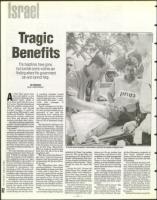
An Israeli woman wounded in a bomb attack is carried to the hospital emergency room.
attention for Dana," her mother phone yet. So my mother has
sums up. "But on the other, the been given a cell phone by her
bureaucracy isn't doing what it employers, but that arrangement
should. Unfortunately, this coun- is about to end," she relates.
try has already had plenty of ex- Keren is also concerned about
perience with terrorism. There getting up to the third-floor apart-
should be rules for cases like ment, since she can't walk the
ours."
stairs and doesn't know who will
Across the hall, 19-year-old get her there.
Keren Siman-Tov, a pretty, soft-
As a soldier, Keren also falls
spoken soldier who suffered in- under the aegis of the Defense
jury to her lungs, stomach, legs, Ministry and also reveals that no
and hearing in the same bomb- one has informed her of what en-
ing, has been making a remark- titlements she will receive. How
able recovery and is already being is she dealing with these uncer-
allowed home on "leave.
tainties?
Yet, that welcome event has
"I think I need a lawyer," she
aroused uncertainties about says just above a whisper.
meeting her basic needs. "We just
That same conclusion has
moved into a new apartment, and been reached by Susan Wein-
there's no installation for a tele- stein, whose husband, 52-year-
old Ira Weinstein (originally of
New York), suffered severe
burns and has been in respira-
tory intensive care since the Feb.
25 bombing.
"Ira is getting the best med-
ical care in the world," Susan
says with remarkable poise af-
ter a month of relentless anxiety.
"Our friends have cared for us
like family. The social worker as-
signed to us has been wonder-11j.
But the system," she says of the
National Insurance Institute —
Israel's central social-welfare
agency, which handles every-
thing from allotments for new-
borns to social-security payments
— "is rigid and stingy about in-
formation."
National Insurance covers Su-