

E terra
JENNIFER FINER
STAFF WRITER
PHIL JACOBS
EDITOR
uick! Name five
current Detroit
Tigers.
OK, name
two.
Tuesday, you
know, was
opening day
down at the cor-
ner of Michigan
and Trumbull. In
recent memory,
there have been
reasons to look
forward to a
raw, cold April day in the spring. Who can
argue with 1984 and 1968 and even other
banner years?
For old-timers, though, for those who
can remember counting the days until
spring training was over and the home
team returned north, the Tigers had a dif-
ferent meaning. And for Jews as well as
other immigrants to Detroit, this team had
a player like none other.
Hank Greenberg's last spring as a De-
troit Tiger came 50 years ago.
He was the object of the Detroit Jewish
community's total dedication. Indeed, in
the first-ever published Jewish News is
a photograph of Army Sgt. Hank Green-
berg. His baseball career was interrupted
by World War II. Detroiters have memo-
ries of waiting to see him walk the steps
at the old Shaarey Zedek on Chicago
Boulevard during the High Holidays.
Many more remember the joy he
brought them just by hearing his name
come over the radio in a game broadcast.
Stories are legend of how Jewish
refugees who were resettled in Detroit
knew little English but would sit in the
stands in their wool suits and yell the
name of Hank Greenberg.
No, most of us probably cannot name
five of the 1996 Tigers, who are picked by
most "experts" to finish at the bottom of
the American League East Division. When
Hank Greenberg played, none of the cur-
rent Tiger roster had even been born. Some
of the players' parents probably weren't
around either. The Seattle Mariners, the
team the Tigers opened with on Tuesday,
weren't a franchise yet. But neither
were the Baltimore Orioles, New York
g
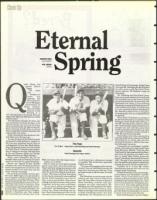
This Page:
The "G Men" - Goose Goslin, Hank Greenberg and Charlie Gehringer.
Opposite:
Hank Greenberg in his Tigers' uniform.
Mets and many other big-league teams.
Listen, it is a stretch.
But we want you to sit back and read
about a man and a time that made the
Tigers and early spring synonymous with
opening the door for Elijah at the Passover
seder for most of the Detroit Jewish com-
munity. The impact of Hank Greenberg
on this Jewish community was something
special. Hank Greenberg was a hero to
men, women and children. Many knew
nothing more than his name when it came
to baseball. As his day went, so did theirs.
"Do you know what's missing in the
world today?" said Bob Steinberg. "Heroes.
I had a hero. Hank Greenberg was my
hero. Hank Greenberg was a hero in the
true sense of the word. He was someone
we all looked up to, idolized and wanted
to emulate. The Jewish boys especially
looked up to him.
"I was one of his people and he was one
of mine. Sure we had biblical heroes, but
here was a live hero you could see. If you
got close enough to call his name, he would
wave."
Bob Steinberg waves the past into the
present with ease when he talks of his
hero. His Troy office is almost a shrine to
Hank Greenberg, complete with pho-
tographs and other memorabilia. Mr.
Steinberg, one of the founders of the Michi-
gan Jewish Sports Hall of Fame, estab-
lished an oncology fund at Sinai Hospital
in Hank Greenberg's honor. But most
importantly, Mr. Steinberg was a close
Detroit friend of Greenberg's. Indeed, those
E who meet Mr. Steinberg for the first time
are often given a gift: New York Times
sports reporter Ira Berkow's book on
Greenberg.
Mr. Steinberg said that Hank Green-
berg was not just watched at the ball park
/ • ,' but watched over by the Detroit Jewish
community during his 10 years here. Mr.
Steinberg's late uncles, Louis and Irving
Blumberg, introduced Greenberg into De-
troit's Jewish social circles. It was his uncle
Lou who introduced Hank Greenberg to
Mr. Steinberg when he was a young boy.
Greenberg gave him an autographed ball
he still has.
When Hank Greenberg was chosen to
be the first honored as a member of the
Michigan Jewish Sports Hall of Fame, it
was Mr. Steinberg who called to inform
him. Unfortunately, Hank Greenberg was
already very sick with the cancer that
would eventually take his life, just three
years after having his number retired in
1983. He was 75 when he died.
Irwin Cohen, who wrote a column for a
baseball publication, interviewed Hank
Greenberg for an article when the star
returned to Detroit in 1983 for the num-
ber-retirement ceremony.
"I remember our conversation," said Mr.
Cohen, who went on to work in the Tiger
front office from 1984-92. "I told him that
I had heard he had experienced anti-Semi-
tism from the pitchers who didn't want
him to break Babe Ruth's home-run
record." Greenberg slammed 58 homers in
1935. "He said it was absolutely not the
case. He said the other players wanted him
to break the record. He just couldn't do it."
"Couldn't do it" is how Mr. Cohen
describes the chances that we'll ever see
another Hank Greenberg.
"If Hank Greenberg were around today,
he'd probably play basketball," said Mr.
Cohen. "It's so much easier not to play
baseball as Michael Jordan proved. To hit
a baseball is the hardest thing to do. I don't
know if Jewish kids have the patience any-
more to do it. Also, today, getting Jewish
players in the minors usually means get-
ting someone who has no pride in his reli-
gion like Hank Greenberg did. I've met six
or seven in the minors just like that.
"Hank Greenberg grew up with religion