

With TNT's "Moses,"
producer Gerald Rafshoon
finds his own path to the
Promised Land.
SUSAN BERNSTEIN SPECIAL TO THE JEWISH NEWS
fourth in the Bible Story series with
LUBE, an Italian/German production
company. Instead of the typical screen
treatments of the Bible — inaccurate,
glamorous — these films attempt au-
thenticity.
But the Torah doesn't always provide
enough dialogue and stage direction for
a four-hour drama, Rafshoon admits.
Scriptwriters flesh out the text with
the help of a consortium of historians and
clergymen, who pore over different in-
terpretations. "Our experts tell us if we're
out of line," he says.
"Moses" only strays from the original
text a few times, and manages to con-
dense four books of the Torah smooth-
ly. The characters also seem less
glamorized — Ben Kingsley's shy Moses
stammers (the Torah says he is slow of
speech), unlike the hunky Heston in Ce-
cil B. DeMille's The Ten Commandments.
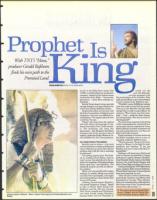
Filmed on location in Morocco, "Moses" features Frank Langella as the Pharaoh Mernefta, son of
Ramses.
NO SEQUINED PYRAMIDS
Realism has its virtues — but most
viewers hold that overblown Hollywood
vision of Exodus as sacred. How did the
producer deal with the risk in selecting
his deliverer?
"It's casting against type. We decid-
ed, in reading about Moses, that he
wasn't a man who started out in the po-
sition of a superhero. He had greatness
thrust upon him," says Rafshoon. "He
stuttered, he grew up with an inferior-
ity complex."
That's a bit of post-biblical Freudian
analysis, he admits. Moses was pulled
out of the river and adopted, so he might
have been treated as a lesser prince than
the son of Pharaoh.
Academy Award-winner Kingsley,
who played Potiphar in "Joseph," agreed
to take on Moses while dining with
Rafshoon and his wife one evening.
With Frank Langella and Christopher
Lee (both former screen Draculas)
playing father and son Pharaohs to
round out the
cast, the filmmak-
ers then grappled with
the presentation of the miracles. They
used special effects to give extraordinary
events a natural look, Rafshoon says.
"We didn't want a DeMille-ite miracle
when the waters of the Red Sea parted.
They go to the Red Sea and the tides
change (there is still a tunnel effect)," he
explains. "The miracle was that some-
body — God — made the tides change.
It's interpretation. Who knows what re-
ally happened?"
The most clever sequence is the giving
of the commandments, portrayed as a
communal osmosis experience where
Moses, Miriam and other characters call
out each commandment, as if they are
filled with God's presence.
Fresh retoolings of ancient stories let
the Bible's messages come to a new, of-
ten jaded, audience, Rafshoon says.
`They're relevant. There's a lot of res-
onance in 'Moses,' in the fight for inde-
pendence and freedom. If you get
freedom, you have to take individual re-
sponsibility."
Rafshoon will shred more Hollywood
icons in "Samson And Delilah," to begin
production in April in Morocco. Model/ac-
tress Elizabeth Hurley takes on the Hedy
Lamarr role, with Dennis Hopper and
Dame Diana Rigg rounding out the cast.
Until producing the TNT Bible Story
series, Judaism didn't interest Rafshoon.
These biblical characters' metamorphoses
have been inspiring, he says.
"They all have a certain restlessness,
particularly Abraham and Moses, that
interested me," he says. "They all knew
there was something else, although they
didn't know what it was. rve always been
interested in the journey." 0
ow Executive producer Gerald Raf-
shoon's "Moses" airs on Turner Net-
work Television at 8 p.m. April 7,8.