

THE GOD SQUAD
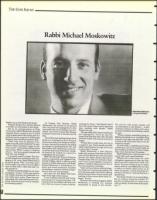
Rabbi Michael Moskowitz
Rabbi Michael Moskowitz
of Temple Shir Shalom
Rabbis run in the Moskowitz family.
Michael Moskowitz's brother Steven
is a rabbi, as is his sister-in-law Susie.
But as • an undergraduate at Duke
University, Rabbi Moskowitz thought
seriously about a career in law. It wasn't
until he spent part of his junior year in a
political science program in Edinburgh,
Scotland, that his future became clear.
"There was such an absence of Ju-
daism in my life, and I noticed it," he says.
"That's when I decided to apply to rab-
binic school. I remember calling home
and saying, 'When I apply to rabbinic
school...,' and my parents jumped and
said, 'Oh, you decided."
It obviously wasn't a shock. The fam-
ily had always been involved in their syn-
agogue in St. Louis, Rabbi Moskowitz in
its youth group. Plus, "my mom said I
first brought it up when I was 10, after I
LU
z went to class with a rabbi and said I re-
= ally enjoyed it.
ci)
-
"We had wonderful rabbis at our home
synagogue," he says. "I had very positive
1— role models and saw the rabbinate as a
— very viable career option. These were nor-
cc mal people who were teaching and coun-
ty
dedicating their lives to Judaism
° but teaching people."
LU
At Temple Shir Shalom, Rabbi
Moskowitz, 28, started on the ground
floor. He joined the congregation in July,
just before the new building was com-
pleted. And while Temple Shir Shalom
is almost 8 years old, it is brand-new for
him.
"One of the most exciting things about
being in a congregation that's young is
there are so many new things to create,"
he says. Among the programs he helped
to initiate is a youth group for 7th- and
8th-graders that emphasizes communi-
ty service and social interaction. Anoth-
er program he worked on is geared to
congregants 35 and under.
NET (Not Enough Time) is being op-
erated in conjunction with Oakland Com-
munity College, which is offering credit
classes by Rabbi Moskowitz and Rabbi
Dannel Schwartz in introductory Ju-
daism and Jewish mysticism. He plans
on teaching a course on Jewish perspec-
tives on love, sex and marriage.
And then he and Rabbi Schwartz
team-teach high school classes.
"I love working with kids and having
them grasp new concepts and ideas. I al-
ways try to do new things with them and
try to find new ways to make Judaism
exciting for them. I feel blessed that I
have this career where I get to spend my
time working with people," Rabbi
Moskowitz says.
His age really didn't mean anything to
the congregation, which he says em-
braced him from the start. His call-back
interview ended with hugs all around, he
laughs.
"People like to make jokes, but not in
a negative way. Some people are defi-
nitely surprised about my age, but it's not
an issue here," he says.
Rabbi Moskowitz, a Teen Mission
leader this summer, is far from his home-
town, but he feels lucky to be near good
friends, like Rabbi Joshua Bennett of
Temple Israel. The two worked at Gold-
man Union Camp together, roomed to-
gether in rabbinic school and now live in
the same apartment building.
"Josh and I are always sharing ideas,
the things we're trying and creating. We
have the same goals, and that's making
people feel good about being Jewish and
wanting to learn more about their Ju-
daism," he says.
When he's not at the synagogue, Rabbi
Moskowitz is working out, playing
racquetball or going to the movies.
He and his wife Leslie usually end
up meeting for a late dinner — a phe-
nomenon common to rabbis and to pret-
ty much everybody else starting a career,
he says.
"There's always something going on.
Making boundaries is an important thing,
because it can take over your life. I want
to have a life with Leslie that is not ab-
sorbed in temple."
He and Leslie, a marketing and events
coordinator, met in Cincinnati while he
was studying at Hebrew Union College.
They were married last November.
Rabbi Moskowitz is determined to be
a good rabbi and a good husband.
"Maybe we've seen from our older
colleagues' experience of what can hap-
pen if you don't spend time with your
family. You have to learn to say `no' some-
times, which is very difficult for me. But
it makes us better rabbis when we do
what we preach. I teach about the im-
portance of family, making Shabbat a
special time.
"One thing I teach is to re-create Shab-
bat, to create a ritual for oneself. If I
say that, and Saturdays I'm never home
with my family, it loses some of its mean-
ing." Cl