

3 ■ WINTER 1996 ISSUE ■ SINAI HOSPITAL
HealthNews
Sinai Women's Health Breast Care Center
continued from page 1
"Sinai Women's Health Breast
Care Center is a seamless system to
provide continuity of comprehensive
care for women with any breast dis-
ease, beginning with screening,
'-c11--3ing diagnostic services, and
concluding with follow-up treat-
ment," states Elizabeth Schmitt,
MD, ImagingDirector of the Center
and member of Sinai's Diagnostic
Imaging/Radiology Department.
Thus, a more convenient, patient-
friendly, efficient approach to breast
care is available to patients
with or without a referral from
another doctor.
There is a team of specialists, in-
cluding a radiologist specializing in
breast disease, general surgeons,
medical oncologists, radiotherapists,
plastic surgeons, a cancer counselor
for emotional support, pathologists,
cancer specialist nurses and the
patient's primary care physician
(family practitioner, gynecologist
or internist). The team meets to
evaluate the results of clinical
examination and test results, deter-
mine a diagnosis and make treat-
ment recommendations.
"A woman will come to a single lo-
cation; we bring the doctors to her;
she doesn't have to go to different
offices or facilities," according to
Dr. Phillips. The visit may begin
and end with a screening mammo-
gram and breast examination. If the
breast tissue X-ray is normal, with
no suspicion of disease, she's on
her way.
If the mammogram results are ab-
normal or disease is suspected, more
detailed tests can be done on-site.
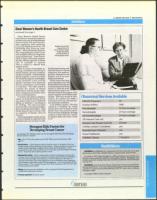
11111111 W1.
Elizabeth Schmitt, MD,
Imaging Director of
Sinai's Women's Health
Breast Care Center,
counsels a patient on
mammography results.
Sophisticated testing with
minimal invasion include
ultrasound, fine needle as-
piration, stereotactic core
biopsies, and X-ray local-
ization procedures.
Within days of her diag-
nosis, the patient has had
the benefit of learning and
understanding what breast
cancer is, what the avail-
able treatment options are
and has received the support of the
cancer counselor and the team of spe-
cialists. With this wealth of infor-
mation, the patient can make a
reasonable and truly informed deci-
sion about her treatment.
In Dr. Phillips' opinion, "The time
required to complete the entire
process from start to finish is much
shorter than most patients expect.
From the time of diagnosis, through
surgery, to returning home, typical-
ly requires little more than a week
or so."
Strongest Risk Factors for
Developing Breast Cancer
Neonatologists
OB Intensive Care Unit
ilwaF
lad
Certified Lactation Consultants
;OM
According to Dr. Phillips, these are the strongest risk factors for developing
breast cancer in women:
• Age - 50 to 70 are the peak years of risk. Risk actually diminishes after
age 70
• Family history - A first degree relative [mother, sister or daughter] who has
• Reproductive factors - Early menstruation and late menopause increase the
number of years the breast is exposed to estrogen stimulation and therefore
increases the possibility of developing a breast malignancy. The age of a
woman at the time of her first pregnancy is also considered when assessing
risk (estrogen stimulation stops during pregnancy - thus lowering the risk of
breast cancer). The younger the age at the first pregnancy, the lower the risk
of developing breast cancer
• History of pre-cancerous conditions, such as atypical ductile hyperplasia or
proliferative fibrocystic disease
• Previous experience of breast cancer
Healthfiews is published as a community service to provide up-to-date
information about Sinai Health System, its physicians and services.
Founded in 1953, Sinai Hospital is a 598-bed tertiary care facility on a
36-acre campus centrally located in metropolitan Detroit. Michigarfs only
Jewish-sporisored hospital, Sinai Iia.s numerous satellite locations through-
out the area
HealthNews is produced by Sinai's Corporate Communications/Mar-
keting Department For more information, please write Sinai Hospital
Corporate Communications/Marketing, 6767 W. Outer Drive, Detroit,
Michigan 48235.
Copyright 1996 by Sinai Hospital.
s
PECIAL ADVERTIS EM N
breast cancer will increase the risk for others. Premenopausal occurrence of
breast cancers indicates a higher risk for other family members. A pre
menopausal onset, with involvement in both sides, puts first degree relatives
at 8.5 - 9 percent risk of getting breast cancer