

SIN Entertainment
41 1101 14r--.1
"ktr-
A stroll down
sitcom lane.
ALICE BURDICK SCHWEIGER SPECIAL TO THE JEWISH NEWS
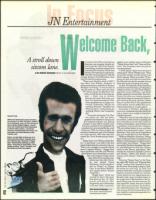
Opposite Page:
Middle left: Gabe Kaplan played a Brooklyn-
born teacher in an inner-city school "headed"
by the Sweathogs: Juan Luis Pedro Phillipo de
Huevos Epstein (Robert Hedges), a Puerto-
Rican Jew; Freddie Boom Boom Washington
(Lawrence-Hilton Jacobs), a hip African-
American; Arnold Horshack (Ron Palillo), the
class dunce; and Vinnie Barbarino (John
Travolta), stud.
Bottom, far right: Male bonding was at its
finest at Arnold's Drive-In, down the street
from Jefferson High. The teens of "Happy
Days" featured Anson Williams as Potsie
Weber, Donny Most as Ralph Malph, Henry
Winkler as Arthur "Fonzie" Fonzarelli, and
Ron Howard as Richie Cunningham.
82
elcome Back,
I
t was the mid-1970s and American
television was changing. Socially rel-
evant hits like "All In the Family"
were fading, and there seemed to be
a yearning for innocence. Prime-time
sitcoms were gaining in popularity,
and ABC was running away with the
ratings, thanks to Fred Silverman, then
head of network programming.
"Those were the glory days of ABC,"
says Mary Ann Watson, professor of
telecommunication and film at Eastern
Michigan University. "It was the last of
the pre-cable era. There were not many
TV choices except the Big Three net-
works, and all the shows had mass ap-
peal — there was no division
between the races. But today, you
have very separate audiences. Tele-
vision programs are no longer uni-
versally understood. Whites are
watching "Friends," "Seinfeld" and
"Melrose Place," while blacks are
watching "Martin" and "Living Sin-
gle."
It was also during the '70s, Wat-
son points out, that the demo-
graphics had started to change; and
the targeted audience was getting
younger. In fact, ABC's coveted week-
ly lineup consisted of very profitable hit
comedies that were tailored for the youth
of America. With the shows written for
and about adolescents, and with Clearasil
as a major sponsor, ABC was even nick-
named the "Acne Broadcasting Compa-
ny."
"Happy Days" and 'Welcome Back Kot-
ter," in particular, were ABC's hits that
clearly helped push the network to the top.
"There was a nostalgic core to both of those
shows," explains Watson. " 'Happy Days'
was a throwback to the '50s, and Welcome
Back Kotter' was a throwback to come-
dian Gabe Kaplan's high-school
days. Both shows created a pop-
culture teen idol. John Travol-
ta, who played Vinnie
Barbarino, was the breakout
star on `Kotter'; on 'Happy
Days' it was Henry Winkler,
who played Arthur `Fonzie'
Fonzarelli."
"Happy Days," which was
created by Garry Marshall,
first aired on Jan. 15, 1974,
and ran until July 12, 1984.
Supposedly set in Milwaukee
in the late 1950s, it painted a
Alice Burdick Schweiger is an
Ann Arbor-based freelance
entertainment writer.
slightly more realistic picture of life than
"Father Knows Best" and "Ozzie and Har-
riett." The characters were not quite as
one-dimensional.
"I think family values were the show's
calling card," Henry Winkler says. "That,
along with casting, was the secret to the
show's success. There were other TV pro-
grams at that time that borrowed from
the '50s and went by the wayside, but our
show kept going and going and going."
At first, the majority of the storylines
revolved around the trials and tribuistions
of Richie and his two pals, Potsie Webber,
played by Anson Williams, and Ralph
Malph, played by Donnie Most. But then,
Fonzie, the ultra-cool, leather-jacketed,
high school-dropout motorcycle rider be-
gan receiving the most attention. Before
long, it was the "Fonz" who sparked the
most interest; and he shifted from an oc-
casional character to a major player.
According to Winkler, although he
wound up overshadowing the rest of the
cast, it never put a wedge between him
and Ron Howard.
"While Ron was the star of the show, all
of a sudden, unbeknownst to anybody, the
Fonz character just took off; it never af-
fected our friendship," says Winkler, who
is godfather to Howard's four children.
"We only talked about it once, and then
neither of us mentioned it again. I never
flaunted it. Ron is the most magnificent
guy, and we are still very close friends."
"Without Winkler's character, 'Happy
Days' would have been too saccharine, and
Richie's wholesomeness would have been
hard to take," says Watson. " 'Happy Days'
was exactly the kind of program the coun-
try was looking for at that time. And be-
cause of the show's popularity, ABC
created the successful spinoffs 'Laverne
and Shirley,'Mork and Mindy,' and
Voanie Loves Chachi,' which also rated
high."
Following "Happy Days" on the Tues-
day night ABC lineup was 'Welcome Back
Kotter," another sitcom geared for the un-
der-30 crowd. First airing on Sept. 9, 1975,
the series ran until Aug. 10, 1979. The
premise of the show was based on Gabriel
Kaplan's stand-up comedy act, reminis-
cences about his own experiences as a
Brooklyn high-school remedial student in
the tough area of Bensonhurst. But in-
stead of being one of the slow learners, Ka-
plan played Mr. Kotter, the savvy teacher
with a keen sense of humor. His students,
who called themselves the "Sweathogs,"
were a group of streetwise hoodlums who
were unable to make passing grades in a
normal classroom.
C_ \