

Timid No
Mor e
Of the 60,000 Ethiopian immigrants who've come to Is-
rael since the 1980s, some 600 families and 900 single peo-
ple still live in Israel's infamous trailer parks. Built in
1990 and 1991 as temporary housing for immigrants and
destitute Israelis, many remain standing in the peripheral areas of the
country. They are bleak places, little better than shantytowns. The tiny,
two-room trailers are lined up like storage containers. The "grounds" are
junk-covered gravel and junk-covered sand. They have become known as
centers for crime, drugs, prostitution and tension between Ethiopians, Rus-
sians and veteran Israelis.
"My room stinks," says Avraham Darba, who came to Israel from Gondar
Province in 1989. "When it rains, it gets wet inside. I sleep in a mattress on
the floor, between the holes that I've boarded over."
For the last three years, he's been.living in the Be'erotayim trailer park
east of Netanya, on the Green Line separating Isra e l proper from the West
Bank. He lives alone — his mother and daughter are still in Gondar. On a
salary of less than $600 a month, he has no idea how he'll ever be able to
afford an apartment and get out of Be'erotayim. "Sometimes I think about
hanging myself," he says.
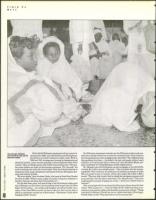
Two years ago, Ethiopians
demonstrated in Israel over the
slow pace of aliyah.
LLI
LLI
CD
CC
LLI
LJ_I
40
But Ethiopian immigrant activists say the Ethiopian trailer park resi-
dents have mainly themselves to blame for remaining there. They could buy
low-cost apartments on easy mortgage terms, but refuse. "The weakest among
the population live there — the elderly, the sick, and people without much
initiative. It's hard to get them to .move out," says Jonathan Miran, pro-
jects coordinator for United Ethiopian Jewish Organizations.
Mr. Messale notes that Ethiopians can get mortgages of up to $120,000,
of which $111,000 is an outright grant — they pay back only the remain-
ing $9,000. They could buy an apartment on monthly payments of under
$50, but prefer to stay in trailers, where rent ranges about $10 to $50 a
month. "They say they're sick, they're afraid the mortgage payments will
go up and they won't be able to meet them," Mr. Messale says. "They don't
understand the concept of taking out a loan — there's no word for 'loan' in
Amharic."
Still, most people who live in places like Be'erotayim blame Israel for their
misery. "This country is s—," says Uri Talla, 22. Mr. Talla lives alone, is un-
employed, and receives welfare and disability payments for asthma. "Things
were good in Ethiopia. If Israel put me on a plane back there, I'd be happy.
Nobody helps us here. They just send you to live in some box."