
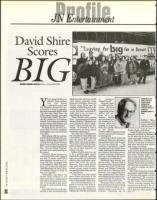

David Shir
Scores
BRENDA ABRAMS JOSEPHS SPECIAL TO THE JEWISH NEWS
C./)
LL,
Cr)
LU
CD
1-
LU
Lu
88
ou've scored 40 films, re-
ceived a Tony nomina-
tion, four Emmy
nominations and won
two Grammy Awards for con-
tributions to what is arguably
the most renowned album of the
`70s, Saturday Night Fever. As
if this weren't enough, your song
"It Goes Like It Goes," from Nor-
ma Rae, netted you an Academy
Award. You've been recorded by
everyone from Billy Preston and
Syreeta to Barbra Streisand.
So what do you do for an en-
core? Well, if you're composer
David Shire, your next move has
to be BIG.
Shire along with his partner,
lyricist Richard Maltby (the two
began collaborating at Yale Uni-
versity during their freshman
year), have written the score for
BIG, a new musical premiering
Feb. 13 at the Fisher Theatre,
en route to an April opening on
Broadway.
Initially, Shire became in-
volved with BIG at the urging of
his wife (it seems some blind
dates actually do work out), ac-
tress Didi Conn. He began work
on the project in 1989. Two years
later, just as they did with their
1985 Broadway hit, Baby, Shire
and Maltby began to work on
the score together.
"Generally", says Shire, "we
decide while working in the
same room what a song is about
and where it's going to go. Usu-
ally, if we can get a title, that's
enough to send me back to my
piano."
As a rule, the two work sep-
arately in the morning and get
together in the afternoon to edit
each other's material. Some
songs are rewritten; others are
thrown away. Shire uses the
analogy of altering a suit to de-
scribe the process: "You design
a suit, but when somebody fi-
nally tries it on, you have to
start fixing the sleeves."
Shire further cites a quote
from choreographer/director
Jerome Robbins: "Musicals are
never finished; they're aban-
doned." Shire smiles and con-
tinues. "A musical is such a
collaborative art form, you're
constantly adjusting it."
But what kind of adjustments
are necessary to turn a film into
a Broadway musical? Having
seen the movie BIG early on,
Shire chose not to see it again.
"You have to deal with the char-
acters as they're currently evolv-
ing, not as they appeared on
screen," he says.
Indeed, the film may turn out
to be a double-edged sword;
much of the audience, including
some who might not ordinarily
attend a play, could show up be-
cause they loved the movie.
However, those same people
may come with a lot of precon-
ceived notions, ready to make
comparisons faster than you can
say Tom Hanks.
"I feel that if we don't make
them forget the movie in the
first couple minutes of the show,
we're in real trouble," Shire says.
But if the extraordinary re-
action at several New York re-
hearsals is any indication,
Shire's sense is that "people are
willing to go with the story based
on
whatever
terms it's told."
Of course, there
is a difference be-
tween showing
the musical to a
supportive group
within the con-
fines of a re-
hearsal studio
and previewing it
for audiences in
Detroit. Shire is
hoping to learn
from the crowds
at the Fisher
whether BIG is keeping people
moved, excited and consistent-
ly entertained.
According to Shire, there are
things one discovers through a
live audience that can't be spot-
ted during rehearsal — "the
rustling of programs, people
reading the bios instead of ac-
tually watching the performance
and whether the laughs actual-
ly exist. A preview audience al-
lows one to see clearly the show's
strengths and weaknesses."
Feedback from family also
can be useful. "Because Didi is
an actress (baby boomers know
her from You Light Up My Life,
Grease, and "Benson"; their kids
know her from "Shining Time
Station"), her suggestions are
very constructive," says Shire,
who admits that she doesn't hes-
itate to tell him if a song isn't up
to the level of his best work.
The person Shire credits with
first teaching him about doing
his best work is his father, an or-
chestra leader and piano in-
structor. "Growing up in
David Shire will
look to Detroit's
theater-going
audience for
feedback on his
B!Gscore before it
makes its
Broadway debut in
April.
Buffalo," Shire
reminisces, "the
house was filled
with the music of
Gershwin,
Porter, Rogers and Kern."
Lately though, he has been in-
fluenced musically by Matthew, K \
his 20-year-old son from a pre-
vious marriage to actress Talia
Shire. Matthew, a student at
Emory University in Atlanta,
has been hired as the show's
pop-music consultant.
In addition to music, Judaism
plays a role in Shire's life. David
and Didi enjoy celebrating Shab- -\
bat every Friday night with
their 3-year-old son, Daniel, and
they recently attended David's
Sunday school class reunion at
Temple Beth Zion in Buffalo.
Family is his top priority but, for
the next few weeks, the play's
the thing.
Shire describes his feelings<
about next week's Fisher debut
as "nervous and excited, worried
and expectant." He compares
the opening of BIG to anticipat-
ing the births of his children:
"You're worried, hoping that
everything is going to be all
right, but, at the same time, you
can't wait for that curtain to c(
rise." Li