
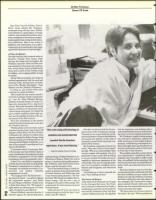

Debbie Friedman-
Queen Of Souls
V"-
D ET R OI T J EW I SH NE W S
Says Peter Yarrow of Peter, Paul &
Mary, whose albums Ms. Friedman
strummed along with as a teen: "Debbie
is the inheritor of a great legacy. I've sung
with her and watched her perform many
times, sometimes in the wee hours at spon-
taneous gatherings during Jewish educa-
tion conferences. Hers is the music of
jubilation and confirmation. It is a call to
community and commonality that rages
against the darkness and spreads light."
LLJ
31
A Place In History
Through teaching and cantorial stints in
Houston, Chicago, New Jersey, Palm
Springs, San Diego and Los Angeles, Ms.
Friedman spent the 1970s and '80s writ-
ing cantatas for Chanukah and confirma-
tion, choral works, dozens of infectiously
funny and tuneful Jewish holiday songs
for children, and a bulging portfolio of songs
for adults.
Almost without exception, her songs are
matched appropriately with the mood and
meaning of text. Among them are rendi-
tions of the "Birchat Havdalah," "Oseh
Shalom" and the "Kaddish D'Rabanah."
In doing so, she earned what some
would say is a place in history.
"She's really the first woman contribu-
tor of note to popular Jewish musical litur-
gy," says Dr. Marc Michael Epstein,
professor ofJewish Studies at Vassar Col-
lege and a descendant from a long line of
cantors. "She broke the barrier of the staid,
hymnic renditions of Chanukah music,
without being avant-garde. It's neither the
grave, solemn renditions of the 19th cen-
tury nor the childish melodies of the ear-
lier portion of the 20th century."
Even her competitors in the limited
world ofJewish contemporary music give
Ms. Friedman her due.
"Debbie pretty much invented a style of
American Jewish music," says Cantor Jeff
Klepper of Beth Emet, the Free Temple,
in Evanston, Ill., who has co-written many
popular melodies for Reform liturgy. Along
with his singing and writing partner, the
aforementioned Rabbi Freelander, he is
part of the successful recording and tour-
ing duo Kol B'Seder.
"I remember about 15 years ago, Rab-
bi Freelander said that Debbie's style of
music would become the predominant style
for Reform congregations. He was vilified
for saying so, but it was a prophetic vision."
Indeed, it's a rare Reform congregation
in North America that does not include Ms.
Friedman's compositions in worship. In-
creasingly, her melodies are heard in Con-
servative and modern Orthodox
congregations, as well.
"The singing of her `Mi Shebeirach' —
the prayer for the ill — has all but replaced
the prayerbook version," says Rabbi
Howard Shapiro of Reform Temple Israel
in West Palm Beach, Fla. "We include it
right before our silent prayer on Friday
night. It's plaintive and effective."
Howard Gelberd, executive director of
Detroit's Agency for Jewish Education,
"She came along with blendings of
One does not have to look far for can-
torial critics of Ms. Friedman's catalog.
They believe her music lacks the rooted-
melodies and Jewish texts that
ness and grandeur of hymns that followed
Jews across the Atlantic, or the work of
sounded like the American
classically trained North American com-
posers of this century.
experience. It was mind-blowing."
Ms. Friedman responds evenly to her
critics. "Why does it have to be an issue?"
she asks. "Who is my music hurting? I don't
— Rabbi Dan Freelander of the duo Kol B'Seder
want to compete with anybody. I'm not a
great lover of organ music. How is writing
spoke glowingly of Debbie Friedman's con-
in our own musical vernacular not an ac-
tributions to Maayin Tifiloh (the well of
ceptable or legitimate expression of our
prayer), a teacher-training pilot program.
culture?
My music may be uniquely Amer-
Ms. Friedman visits Detroit three to four
ican, but it is rooted in a tradition that is
times a year for her part in this.
Russian and Hungarian, and influenced
"One of the hardest things in Jewish ed-
by
Israel."
ucation is opening up the minds and hearts
As if holding up a mirror to herself, she
of Jewish teachers, and Debbie has such
a way of emancipating teachers, " Mr. Gel- says, "I'm a melting pot here."
berd said. "She brings out insights. She re-
leases energy. And she has a way of The Power Of Prayer
bringing out the spirit within people. She A day before final rehearsals are to begin
understands the links between text and for the Carnegie Hall show, Ms. Fried-
man's attention is distracted by Farfel, a
God and prayer.
rambunctious mixed breed who made the
"After she has left town, her music is
trek with Ms. Friedman to New York from
ringing through my body for days. I can't
southern California last July. The dog bolts
sleep," says Mr. Gelberd.
into the apartment, eyes bulging, after a
walk along West End Avenue, with its blar-
ing taxis and quick-stepping pedestrians.
Ms. Friedman, happily tossing squeeze
toys around the apartment, appears full
of life, showing no outward signs of dysau-
tonomia, a debilitating neurological con-
dition that eight years ago threatened not
only her performing career but the quali-
ty of her day-to-day existence.
The condition arose from a series of med-
ical complications. Awakening after a
headache, she was unable to walk; a week
later, she suffered further paralysis. Her
recovery has been slow and marked by set-
backs, which can render her limp and con-
fused.
She had a relapse so severe at Yom Kip-
pur last year that she could barely rise from
bed. But, huddled by an open window with
Farfel at her side, Ms. Friedman could hear
Kol Nidre wafting from the main chapel of
her synagogue, the Conservative Congre-
gation Anschei Chesed, a block away. She
believes she was sustained by the power of
communal prayer that night.
"We always ask why we daven (pray) in
the plural," she says. "Well, sometimes we