
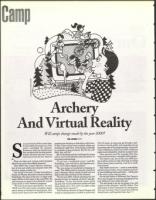

ILLU STRATI ON BY ANDREE CH EVRIER
Archery
And 'Virtual Re
Will camps change much by the year 2000?
S
PHIL JACOBS EDITOR
un rays bounce off the crystal lake.
A blue-scaled fish jumps out of the
water, unsettling the serenity.
Breezes so mild you hardly know
they are there help the pine branch-
es sway. It's all so very real. You can
reach and touch the sun. And you
do.
Then you take your virtual reality headset
off and run out to the softball diamond.
Year 2000? Yep. Camp? Maybe a combina-
tion of arts and crafts and computer tech. But
for some camps, maybe not.
One thing is for sure, at least according to
Fresh Air Society Executive Director Harvey
Finkelberg. The days of the four- to eight-week
camp will be on the wane in the year 2000. He
said campers are going to be looking for a series
of one-week or even weekend programs.
"We'll be much more specialized," he said.
`We'll have fine arts camps, computer camps,
sports camps or whatever is the interest. Also,
camps know that in the year 2000 the demo-
graphics are showing us that there will be few-
er kids. There will be more available college-age
students for staff. Now, were seeing a shortage
in available college students. But by the year
2000, this will flip."
Mr. Finkelberg said the challenge for camps
Will be more diversification and attractive, in-
teresting programming.
"If you run a traditional camp," said Mr.
Finkelberg, "you won't be in the business any-
more. Or it will be highly doubtful."
The way camps are marketed is changing al-
ready. The 1990s model is typically a brochure
and a videotape. Many camps, he said, are now
listed with their services on the Internet.
"By the year 2000, we'll be operating very dif-
ferently in how we conduct our lives," said Mr.
Finkelberg. "I know that family camps will be
big and year-round conference centers will also
keep camps alive. You can't run eight weeks
and close down anymore."
Sid Friedman, director of Camp Tanuga, said
trends in camping seem to follow a cycle every
10 to 15 years. A camp may go through a peri-
od where virtual reality and computers are an
important part of the programming, along with
trips to Mackinac Island and other programs
pretty much dictated by what the campers want.
Then parents send the message that they
want more structure, a campfire and a guitar.
"It's hard to say, but in the year 2000 peo
ple could be so fed up with what kids are doing
after school, there could be a call for a tradi-
tional camp."
And what's novel now — such as waterslides,
parachuting, jet skis, circus trapezes and oth-
er non-traditional camp activities — will be part
of the norm in the years to come.
For Arnold Fisher of Willoway Day Camp in
Novi, the thought of anything changing for the
year 2000 isn't part of the formula.
"It's still going to be the fun place to be, still
a place to come and play," said Mr. Fisher. "Our
philosophy is that if campers are having fun,
they are learning. Other camps feel children
should learn, and hopefully have fun." 0