
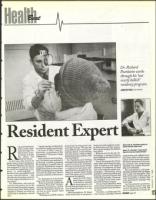
Dr. Richard
Pearlstein works
through his "not
overly hellish"
residency program.
JENNIFER FINER STAFF WRITER
Resident Expe
ichard Pearlstein
had to walk a half-
mile through two
feet of snow, in ten-
nis shoes, to make
the phone call
bout his future.
At the time, this soon-to-be
doctor was in Israel, studying at
Hadassah Hospital. The day he
was supposed to find out where
he would be completing a resi-
dency in otolaryngology —
known to the non-medical world
as ear, nose and throat — was
a1so the day Jerusalem received
its only major snowstorm in re-
cent years.
Dr. Pearlstein, who says he
was the only person out on the
snow-covered Jerusalem streets,
would soon learn Henry Ford
Hospital in Detroit, one of his top
choices for a residency, wanted
him.
Ra
"I spent one day in Detroit for
my interview before moving here
(in June of 1992)," says Dr.
Pearlstein, a graduate of the
University of Cincinnati College
of Medicine.
After medical-school gradua-
tion, all doctors are required to
go through a residency program
for training in a specific area of
medicine. Residencies range in
length from three to seven years.
They are designed to equip doc-
tors with the skills they need to
practice medicine autonomous-
ly.
Dr. Pearlstein is in the fourth
year of his five-year residency.
While notoriously dubbed the
programs "from hell," residen-
cies are demanding but, accord-
ing to Dr. Pearlstein, they're not
as bad as some people make
them out to be.
`Working as an ENT resident
is hard, but I'm doing what I set
out to do," he says. "For me, the
most difficult part was the ini-
tial time factor. I was working
100-plus hours a week so sleep
deprivation was a problem. But
you live with it."
Dr. Pearlstein said working
the long hours enhances the ed-
ucation process for residents.
However, several recent articles
in medical journals have indi-
cated that it is unhealthy for res-
idents to execute their duties
with little sleep, and it could be
dangerous for patients.
lmost all of Dr. Pearl-
stein's time is current-
ly devoted to research
on cancer genetics, but
he will soon get back into a rou-
tine of seeing patients on a reg-
ular basis.
After his residency, Dr. Pearl-
stein would like to complete a
A
head and neck surgical oncolo-
gy fellowship and then special-
ize in cancer surgery for children
and adults.
When he isn't in the lab, Dr.
Pearlstein is seeing patients,
thus fulfilling the clinical part of
his residency.
One of the aspects Dr. Pearl-
stein likes most about his spe-
cialty is treating a wide range of
ailments. He performs all head
and neck surgeries except neu-
rosurgery. Alleviating sinus
problems, removing tonsils and
treating cancerous tumors fall
within his specialty. However,
as a resident, he is never unsu-
pervised during a surgery.
On one recent afternoon, three
of the doctor's patients returned
to the hospital's clinic for follow-
up visits.
The first, a middle-aged De-
troit woman, had fallen several
Above Left: Dr. Pearlstein checks his
patient with the broken nose.
Above: Dr. Pearlstein "works harder
than all of his non-medical friends."
weeks before and suffered a bro-
ken nose. After a brief exami-
nation of her nose and mouth,
the doctor determined the heal-
ing process was progressing
smoothly and surgery was prob-
ably not necessary.
His next patient, a 20-year-
old male, arrived with his father
and 1-year-old daughter. The
side of the man's face and lip
were pierced by a bullet. The
only permanent damage was
nerve loss.
As this patient's physician,
Dr. Pearlstein doesn't ask why
or how the injury occurred. His
job is to address the wounds, de-
RESIDENT page 128
127
Scanned image of the page. Keyboard directions: use + to zoom in, - to zoom out, arrow keys to pan inside the viewer.
January 19, 1996 - Image 179
- Resource type:
- Text
- Publication:
- The Detroit Jewish News, 1996-01-19
Disclaimer: Computer generated plain text may have errors. Read more about this.