

Close Op
REBIRTH page 37
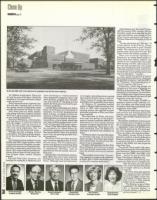
By the year 2000, Sinai's city campus will be expanded to look like this artist's rendering.
THE D ETR OIT JEWI SH NE WS
Dr. Sabbota would agree: "Sinai (lat-
er) saw the error of its ways. I think the
hospital is a lot more attuned to physi-
cians' issues now."
Solid communication between doc-
tors and other hospital staff, as well as
the speedy return of laboratory tests,
are two plus-points for Sinai, he says.
Still, every once in a while, commu-
nity gossip calls into question whether
Sinai isn't again 4osing its physicians
to non-Jewish institutions.
Raymond Weitzman, a rheumatolo-
gist and doctor of internal medicine
with the DMC, says he was once at
Sinai. So were many of his colleagues
who now work elsewhere. But, he
points out,-the tide flows both ways.
"People are just jumping around
everywhere. The grass is always green-
er on the other side of the fence," he
says.
Job-hopping seems epidemic in the
health-care field. Large systems, which
incorporate several hospitals, are gen-
erally more immune to financial trou-
bles than independent institutions like
Sinai. But some medical profession-
als say the red tape of vast conglomer-
ates propels them toward smaller
arenas.
Big and little alike, however, are
bracing for cutbacks in Medicaid and
38
Phillip Schaengold:
President and CEO
Mervyn Manning:
Board Chair
more shrinkage in reimbursements
from insurance companies. Sinai, like
other facilities, grapples with cost-shift-
ing, the process of charging private
payers for what goes uncovered by gov-
ernment programs.
Amidst these challenges and others,
Sinai nevertheless has attempted to
maintain its Jewish programming.
Each summer, it supplies medical as-
sistance to Fresh Air Society camps.
Administrators and doctors recently re-
turned from a trip to Israel, where they
met with medical professionals in De-
troit's Partnership 2000 sister region.
Sinai's West Bloomfield Day Hospi-
tal, directed by Dr. Albert Bayer, es-
tablished a. program for the mentally
disoriented elderly. Most of its patients
come from the growing geriatric Jew-
ish population.
The Sinai Guild provides services
and volunteer opportunities to Jews,
old and young. The Foundation pro-
motes and sponsors everything from
the annual Heritage Ball fund-raiser
to educational activities, such as
speeches by Jewish health-care pro-
fessionals.
Among other commitments, the hos-
pital offers free care to near-destitute
immigrants from the former Soviet
Union. Although local anti-Semitism
Samuel Indenbaum:
Chief of Staff
Ambivalence isn't the word 75-year-
old Farmington Hills resident Shirley
Korobkin would use to describe her feel-
ings toward Sinai, even though all four
of her Jewish specialists are based at
William Beaumont Hospital in Royal
Oak.
"You go where they go," she says. "If
I had a choice, I'd go to Sinai. Jewish
hospitals cater more to your (Jewish)
needs. The others say if you want a
kosher meal, they'll give it to you. But
I don't know how kosher it really is."
Near a set of central elevators at
Beaumont, an ashen-faced couple ex-
plains that their elderly relative was
rushed to the hospital late that night
after having a stroke. Like many peo-
ple who face emergencies, this couple
says that heading toward a specifical-
ly Jewish hospital in times of crisis isn't
as important as just getting their loved
one to a safe place — quickly.
"I don't think the quality of care at
Sinai has deteriorated any. I think the
big problem is location," said the DMC's
Dr. Weitzman. "It's perceived as an in-
ner-city hospital, like Grace."
Nationally, watch-dog groups are
struggling to find ways of gauging sat-
isfaction with patient care. The Illinois
based Joint Commission On Accredita-
tion Of Healthcare Organizations comes
is no longer a prevailing concern among closest with its biennial surveys of 5,300
the majority of metro Jews, it still pro- hospitals across the country.
vides a reason for people like Alexan-
The three-to-five-day JCAHO in-
dra Riabova to be,grateful Sinai exists.- spections monitor staff, infection con-
Dr. Riabova, 27, completed medical trol, fire safety and other broad areas
school in Moscow before moving to Ann of concern. Sinai has maintained its ac-
Arbor in 1992. After passing her li- creditation since 1969.
censing exams, she applied to post-
"We want to make sure that hospi-
graduate programs at Sinai and other tals not only are writing policies for
area hospitals.
quality care, but also implementing
The interview at Sinai, she says, them," says JCAHO spokeswoman Al-
went well and doctors in the depart- ice Brown.
ment of internal medicine offered her
But patient satisfaction (versus qual-
admittance to a four-month training ity of patient care) is tougher to evalu-
program designed specifically for im- ate on anything but an anecdotal basis
migrant physicians. Then came a one- — especially within the 96,000-mem-
year internship. Now, Dr. Riabova is ber Jewish community. For each per-
working on her three-year residency at son who complains about a hospital,
Sinai.
there are others who sing its praises.
"In Russia, there was anti-Semitism
One elderly woman living in metro
on all levels," she says. "It was pretty Detroit's southern suburbs referred to
scary, actually. Jews didn't get accept- Sinai's nursing care as mediocre. Oth-
ed to schools they wanted. It was dan- er patients say that it indeed had fal-
gerous to go to synagogue."
tered in the 1980s, but has improved
President Schaengold stresses that since that time.
Sinai Hospital will continue to reach
The Jewish News spoke with mem-
out to the Jewish community, but it's bers of the.community who prefer Sinai
time the Jewish community reaches over Beaumont, Beaumont over Sinai,
back.
Sinai over the DMC, the DMC over
"The medical community," he says, Sinai ... and so on and so forth with
"has regained its respect and confidence Grace, Providence, Botsford, etc.
in Sinai. (But) I think the Jewish com-
Some members of the Jewish com-
munity still remains ambivalent."
munity say they know of people who
fear the inner city and others
who resent the that Sinai
no longer caters to a Jewish
majority.
However, Jews also seem far
from passive in their attitudes
toward Michigan's only Jew-
ish hospital. They say they are
glad to have it. They express
relief over its comeback.
"The feeling you get at Sinai
is palpable," Dr. Sabbota says.
"It's a heimish feeling. A
friendly feeling. A feeling that
you're at home." 1=1
Pola Friedman:
Sandy Schwartz:
Richard Roth:
Foundation Chair
Foundation Director
Guild President