
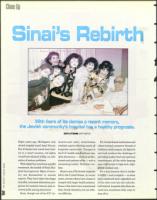

With fears of its demise a recent memory,
the Jewish community's hoppital had a healthy prognosis.
RUTH LITTMANN STAFF WRITER
30
Eight years ago, Michigan's only
Jewish hospital wasn't dead. Not yet.
But if doctors had wired their facil-
ity to a heart monitor, red lights
would have flashed wildly, an indi-
cation of serious problems.
With adept but sometimes painful
treatment, the health of Sinai Hos-
pital has improved. Signs of recov-
ery are documented in annual
reports. They have taken the shape
of profits, increased admissions, pro-
grams for medical interns and re-
newed pride among physicians.
Sinai, though out of the ICU (in-
tensive-care unit), nevertheless
combats a germ infecting nearly all
hospitals nationwide. Changes in
the U.S. health-care field have nee-
dled Americans — medical profes-
sionals and patients alit e — with a
nauseating reality: Nothing's cer-
tain.
Sinai is one of 22 Jewish hospitals
left in the United. States. In recent
years, several others have closed or
merged with larger health systems.
Some of the latter have maintained
their Jewish identities, but not with-
out difficulty.
For Jewish-based institutions and
others trying to preserve threads of
tradition amid mergers, the fight for
survival involves the challenge of
providing kosher food and spiritual
nourishment, all the while keeping
pace witli trends in high-tech, high-
prieed medical care.
It's a dual mission that is harder
to fulfill — and to explain — as Jews
have continued their migration out
of the cities and into the suburbs.
Left behind, hospitals like Sinai de-
vised new, sometimes risky ways to
stay alive.