
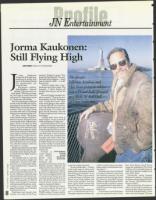

Jorma I
Still Flying Hi
GARY GRAFF SPECIAL TO THE JEWISH NEWS
orma
Kaukonen
bought his first high-pow-
ered electric guitar with
some of the Israel Bonds
his grandmother put
away for him.
His parents — particu-
2rly his father — were not
pleased. "They gave me con-
stant (grief). 'Why are you wast-
ing your time on music that will
never last? It's disgusting,' and so
on," Kaukonen remembers.
But when Kaukonen called last
month to tell his folks he was be-
ing inducted into the Rock 'N' Roll
Hall of Fame, his father dryly re-
marked, "Aren't you glad I made
you stick with rock 'n' roll instead
of going into engineering like me?"
All jokes aside, Kaukonen
hasn't questioned his musical ca-
reer for a minute. He's best-known
as lead guitarist for Jefferson Air-
plane, which will enter the Hall
of Fame in January. But his eight
years in that crew represent only
a fraction of his endeavors, which
also include backing the legendary
Janis Joplin; forming a second
band, Hot Tuna, that's been to-
gether on-and-off for 25 years; and
recording a handful of solo albums
that include the new Land of He-
roes , the first release under his
own name in 11 years.
Simply put, Kaukonen has Hall
of Fame credentials aplenty. But
he hardly minds sharing the glo-
ry with his former flight mates in
the Airplane.
"I'm thrilled with it," says the
54-year-old musician, singer and
songwriter, who lives on a 200-
acre farm in southeastern Ohio.
"I like stuff like that. I think it's
pretty cool."
The honor weighs a bit differ-
ently on his other band mates. Af-
ter all, Jefferson Airplane sang
about revolution and counter-cul-
ture utopia; it's not a group that
should land quietly in a Hall of
Fame, even though it's already
well-represented by photos, mem-
orabilia and the fringed outfit
singer Grace Slick wore at the first
Woodstock festival.
Kaukonen says bassist Jack
Casady, who's also his Hot Tuna
J1
Cr)
LU
U)
LU
I--
CD
CC
LU
I=1
LLJ
H-
86
partner, "thinks it's great." But
guitarist Paul Kantner, the nom-
inal head of the Airplane — which
last reunited in 1989 — is a dif-
ferent story.
"Paul is cooler than I am,"
Kaukonen says with a laugh. "But
honestly, I think they're all
thrilled. How can you not be? It's
great."
And will it lead to another Air-
plane reunion? 'That is the obvi-
ous question, isn't it?" Kaukonen
says. "I really don't know. Obvi-
ously we're going to play togeth-
er for the Hall of Fame induction,
and I like that because it's a no-
pressure thing. It's not like 'OK,
guys, let's do a reunion. Let's see
if we can make as much money as
the Eagles.'
"I really don't know what it
might lead to. I've got a bunch of
other stuff going on right now."
Chief among them is The Land
of Heroes, an acoustic-oriented al-
bum that's something of a double-
back through Kaukonen's roots
— and not just the musical ones.
The title track, in fact, is drawn
from stories his grandparents
brought with them when they
came to America during the ear-
ly 1900s. Kaukonen was inspired
to write it after re-reading the
Kalevala, the Finnish epic about
ancient Scandi-
navian life.
Finland is Jorma Kaukonen:
A Finnish
where Kauko-
heritage
nen's father's
with Russian-
family came
Jewish roots.
from, but the
musician has
equally fond memories about the
Russian-Jewish influences he
picked up from his mother's side.
Kaukonen says he was actual-
ly raised "as absolutely nothing.
We weren't a religious family; one
of my sources of misery as a kid
was that my dad wouldn't let me
go to the Scouts father-and-son
church dinner because he was
against organized religion."
So most of Kaukonen's experi-
ences were cultural. He grew up
in northern Virginia ("a very
WASPy culture," he says), and de-
scribes an Avalon picture of visits
to see his mother's parents.
"It was just like that — we'd go
to the beach and eat chicken and
potato salad, with granny and her
pals sitting in lawn chairs," he re-
members. "When I'd go to one of
my friends' homes in Virginia, and
they'd serve fried chicken and
potato salad, it didn't taste the
same. I'd say 'What's wrong with
this stuff?' and the mothers would
all be (angry) at me.
"So I picked up a lot of that cul-
ture in a subliminal kind of way.
I thought everyone was that way;
I didn't realize there was some-
thing unique to that Russian-Jew-
ish culture."
Kaukonen isn't sure what kind
of musical influences came from
his relatives, however. He had
garage bands during high school,
but when he attended Antioch
College in Ohio, Kaukonen fell for
blues and folk, tutored by a group
of sympathetic hall mates that in-
cluded future blues legend John
Hammond.
A roommate turned Kaukonen
onto the spiritual music of the
Rev. Gary Davis, two of whose
songs are included on The Land
of Heroes. He eventually hung out
with Davis during a college co-op
job in New York.
Eventually, music became
Kaukonen's passion. "I quit going
to classes and just played the gui-
tar," he says. "So I did learn some-
thing at school."
He moved to San Francisco in
1962 and decided he needed an (
electric guitar when he joined a
band that included Joplin. "Janis
was a very loud singer," he says