

The Metamorphosis
of Yitzhak Rabin
y
itzhak Rabin was the least predictable of
peacemakers, an old soldier with an in-
stinctive distrust of the kind of bright young
intellectuals who contrived the Oslo break-
through with the Palestine Liberation Or-
ganization. He visibly cringed when
President Bill Clinton coaxed him to shake hands with
Yassir Arafat on the White House lawn in September
1993.
As prime minister for the first time from 1974 to 1977,
Mr. Rabin could hardly steel himself to utter the word
"Palestinian." He and his defense minister, Shimon Peres,
allowed, however reluctantly, the establishment of the
first Jewish settlements among Arab towns and villages
in the West Bank. As defense minister in the 1984-90 Na-
tional Unity Government, Mr. Rabin ordered his troops
to break the intifada uprising "with might, power and
beatings."
Yet on the night of his death at the hands of a lone Is-
raeli gunman, Mr. Rabin was singing "Shir Hashalom,"
the Hebrew hymn of peace, with 100,000 supporters of
Peace Now. It was, Mr. Peres said afterward, probably
the first time in his life that the croaky-voiced Mr. Rabin
had sung in public.
His farewell message had a ring of Martin Luther
King's "I Have a Dream." His government, he said, had
decided to give peace a chance. "I was a military man for
27 years. I waged war as long as there was no chance for
Eric Silver is a senior writer for the Jerusalem Report.
An uncanny
transformation
from soldier
to global statesman.
ERIC SILVER SPECIAL TO THE JEWISH NEWS
peace. I believe there is now a chance for peace, a great
chance, and we must make the most of it."
What wrought the transformation was the realization
that Israel could not batter the children and mothers of
the intifada, Palestinian uprising, into submission with-
out compromising its own humanity and alienating the
civilized world with which Israel identified itself
As early as the 1988 election campaign, Mr. Rabin and
Mr. Peres argued that Israel could not go on ruling a large
and hostile Arab minority if it wanted to remain a Jew-
ish and a democratic state. The only alternative was sep-
aration, a line on the ground with Israelis on one side and
Palestinians on the other (though to the last Mr. Rabin
refused to acknowledge that his policy might spawn a
Palestinian state).
The 1988 electoral stalemate denied the two Labor
leaders an opportunity to put "territory for peace" to the
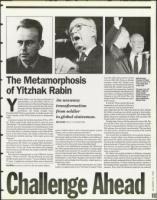
test. But after their narrow victory Opposite page:
in June 1992, Mr. Peres, as foreign The body of Yitzhak
minister under Mr. Rabin's pre- Rabin is carried to its
resting place
miership, convinced himself and his final
on Mt. Herzl.
chief that Mr. Arafat was ready for
a symmetrical compromise. Isolated This page, from left:
and impoverished by the historic mis- Rabin in 1966; the
prime minister
calculation of siding with Saddam speaks
out for peace;
Hussein in the 1991 Gulf War, the with his partner in
leader of the PLO had become a part- peace negotiations,
Shimon Peres.
ner for peace.
It was Mr. Peres, always the more
imaginative and restless of the two,
who selected and backed the free-
lance diplomats for the Oslo back channel. But without
Mr. Rabin, checking every detail, reining in their enthu-
siasm, a deal would never have gelled. And without Mr.
Rabin, elected on a platform of "peace with security," the
Israeli public would not have acquiesced.
Despite their history of bitter personal rivalry, Mr. Ra-
bin and Mr. Peres were an extraordinary team. In their
70s, they recognized that a solution to a century-old con-
flict between Jew and Arab was attainable. This was their
own last chance, and they were not going to let mutual
recrimination get in the way.
Nor would they be deflected by the enemies of peace,
Arab or Jewish. After every Islamic suicide bombing, a
grim-faced Mr. Rabin announced to the television cam-
eras that the negotiations would continue. Echoing a cel-
ebrated phrase of Israel's first prime minister, David
Ben-Gurion, he said he would "fight the terrorists as if
there were no peace process, and fight for peace as if there
were no teiTorism."
Mr. Rabin was equally stubborn in defying a campaign
of unprecedented vilification by the Israeli right and its
Jewish fan clubs abroad. They branded him a "traitor"
and an alcoholic, portrayed him in Nazi uniform or Arafat
kafiyeh headdress. To their enduring shame, leaders of
the parliamentary opposition were slow to disown these
excesses. Even when his Knesset majority was reduced
C h al lenge Abea