
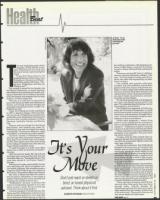

PHOTO BY GLENN TRI EST
Jill Davis: "It's all
about going inside
and feeling how
you move."
Ill
he most challenging aspect of this
program, which calls for a com-
plete rethinking of one's body and
the way it moves, is pronouncing the
name.
"If you don't know about it, it's
probably because of the name," says
Feldenkrais therapist and Bloom-
field Hills resident Jill Davis. "Peo-
ple hear `Feldenkrais' and they say
`Feldenwhat'?"
The method is named for its founder, the
late Moshe Feldenkrais, an Israeli physicist
who believed one's physical and mental well-
being is dependent on his ability to be aware
of his movements and recognize that his body
works as a whole, single unit.
"The aim is a body that is organized to
move with minimum effort and maximum ef-
ficiency, not through muscular strength, but
increased consciousness of how it works," Dr.
Feldenkrais said.
Today, the Feldenkrais Guild, established
in 1977, is based in Oregon. There are liter-
ally thousands of Feldenkrais practitioners
worldwide, and a Feldenkrais Guild board of
directors that includes members in Paris,
Germany, Australia, Sweden and Kansas
City.
Famous patrons include the late David
Ben-Gurion, who himself was under Dr.
Feldenkrais' care and who labeled the results
"remarkable." Smithsonian Magazine ca lled
the method, "a revolution in human health."
Jill Davis' interest in Feldenkrais began
10 years ago after her parents became ill.
They spent most of their time in the hospi-
tal; Ms. Davis spent much of her time sitting
in the waiting or hospital room. Soon she, too,
began feeling constantly weary.
"It made me begin to wonder what effect
illness has on body movements and health,"
she says.
After her parents' death, Ms. Davis found
her hands were numb and her neck was sore
more often than not. "Everybody told me, 'You
must have injured it,' but I knew I hadn't,"
she says.
Determined to take responsibility for her
own well-being, Ms. Davis considered vari-
ous health programs. She stumbled across a
magazine ad for Feldenkrais, then signed up
for a course. The positive effects were instant.
She went to Nepal and hiked for miles in
the mountains. Sometimes, it was simply a
matter of knowing how to use her body and
knowing she had the power to do it.
"Feldenkrais," she says, "is all about the
power of re-educating yourself. It is an edu-
cation on how to move. We move every day
of our lives, but we don't study it."
A former president of Temple Kol Ami, Ms.
Davis used the Feldenkrais method on her-
self, her husband and her two sons. And while
no one advocates Feldenkrais as an alterna-
flue:, tn rpcnilar rnenieina Mg navig whn nf-
Don't just reach or stretch or
bend, an Israeli physicist
advised. Think about it first.
ELIZABETH APPLEBAUM ASSOCIATE EDITOR
ten works in conjunction with physicians, be-
lieves it offers help to everyone, from those
in pain to those with perfectly maintained
bodies.
"Everyone can benefit from it: athletes,
dancers, physical therapists, children," she
says. "I've had positive results with all pa-
tients who take self-responsibility to learn
how to re-learn.
"I've worked with patients with back,
shoulder and neck problems, and all have
greater reduction of pain and greater mo-
bility. I've also worked with cardiac patients
who have lowered their blood pressure and
reduced their stress. Business profession-
als report better concentration, more pro-
ductivity and less fatigue.
"It's all about going inside and feeling how
you move and experiencing yourself," she
says. "It's understanding the feeling, not just
the mechanics, of movement."
The Feldenkrais approach includes two
steps: the Functional Integration, in which
practitioners guide students through body
movement, and Awareness Through Move-
ment, a series of movements taught in class-
rooms or in one-on-one lessons.
Unlike other programs — where if you
want to really understand the concept you
have to spend $40,000 for six years of con-
sultation — Feldenkrais requires a minimal
amount of work between teacher and client.
(Those interested in becoming Feldenkrais
therapists must complete a four-year train-
ing course, however.)
It begins with the fully clothed client re-
laxing on his back. He concentrates on breath-
ing while the practitioner lightly touches his
neck, legs, shoulders.
During the treatment, the Feldenkrais
therapist will sense areas of movement the
student may to need consider: perhaps he's
o much weight on one
continua
""ll
aybe he's using his back
bends, or maybe its an
at work (is the comput-
to constantl y bend his
1?).
sessment, the practition-
series of gentle exercises
aft of the process) with the
„
roc.,4ss involves not only muscles
c
but e'sreri al' nervous system and, of course,
the braintpoint is not to become as fit as
Jane Fonda,'1itit to become cognizant of the
way one uses the body so as to avoid pain and
increase flexibility and functionality.
Clients also learn to become aware of mus-
cles and other body parts they may have,
through habit, virtually ignored. Dr.
Feldenkrais believed that pain and tension
often resulted from the misuse, or lack of use,
of the entire body. The result is that one not
only moves better but feels better.
YOUR MOVE page 70
C)
0,
CNJ
CNJ
CC
w
CC1
2
Lu
cL
Cr)
nn