

MIPMSWOM.M. ::,,WaMMEM>:;MVX%M.MUMMSMSaW;M=MVAWNMSW.M.K , .V.V4SOMV90==...V...
. m,:n.waysmmaa• vmmawma
M^:, 4 .20MUSMMONV2MWASOA,VOIMMSMSMS:=MSWOMMAUMSNWMP
AYMZWOOMMUMMIMM33
OW.
That Looks Like It
What happens when
post-nasal drip sets in?
ost young people are
able to munch on
snacks during graph-
ic episodes of the TV
hospital drama "ER",
but they get a little
woozy at the thought
of piercing body parts
other than their ears.
Body piercing, the trend for 20-some-
things and teen-agers these days, has be-
come almost as popular as perms.
"My dad said, 'I don't want you to, but
I know you are going to.' My mom said,
hope you don't mind if I hate it.' Now,
she thinks it's cute," says Jan Dijkers-Ja-
cob, a 17-year-old who had her eyebrow
pierced last year.
Piercers impale their flesh for all sorts
of reasons, the most common being: "All
my friends do it." This prompts most par-
ents to utter the classic "bridge" question:
"And if all your friends jumped off the
Brooklyn Bridge, would you?"
Alas, kids will be kids, and what better
way to gross out adults than by pushing
a needle through your tongue?
Mike Jeffers, a body piercer at Royal
Oak Tattoo, believes naval piercing soon
will be as normal as ear piercing. He cred-
its the trend to models like Naomi Camp-
bell, who has a navel ring, yet is
Body piercing doesn't
jibe with Jewish law, but
some consider it a cool
mode of self-expression.
LINDA ROSENFELD
SPECIAL TO THE JEWISH NEWS
high-profile in society and well-accepted.
There is another motivation for body
piercing that goes beyond the need to jump
on the bandwagon of body-pierced peers.
While much about piercing is cosmetic,
the practice also has grown out of the de-
sire to mutilate one's own body, to cause
self-inflicted pain.
Doc Lowrey, owner of Royal Oak Tat-
too, is a trained piercer and tattoo artist.
He says the movement toward less con-
ventional piercing began with small
groups of individuals who engaged in
slave-owner relationships. They pierced
each other as marks of ownership. Much
of this happened on the West Coast. Then
the gay community began to catch onto
the idea, and soon the teen-agers on the
city streets popularized it as a hip way
to assert their "with-it-ness."
"Two years ago, piercing was beyond
fringe," Mr. Lowrey says. "Now it is a
fringe thing to do."
Mr. Lowrey, better known as "Doc," per-
forms three to six mouth piercings a
month. This includes both male and
female customers.
It can be addictive.
"It doesn't hurt. It's the anxiety before
that's a challenge," Doc says.
He
describes
piercing of any kind
as an empowering
experience because
the client has a
chance to overcome,
transcend anxiety.
"In that split sec-
ond, something opens
up. You drop into that
other consciousness.
You're blanking out,
shutting out the regu-
lar world. You are drop-
ping into a moment,
and when you are there,
it has depth. Once the
moment of pain has
passed, it's a high," he
says.
Furthermore, the per-
son has to care for his
wound, which requires nur-
turing. For two to three
months, the wound must be
washed twice a day with soap
and water. The soap must not
contain perfume, deodorant or
cold cream. Ivory and Neutro-
gena are good candidates, Doc
says.
"A lot of the cleansing gets to
be ritualistic. Due to the inten-
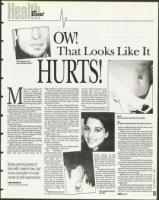
Above:
Navel piercing is becoming more popular.
Left:
Jan Dijkers-Jacob will pierce more after turning 18.
tional nature of the
wound, people develop
special attachments to it.
They want to maintain
the wound, so they have
to take special care," he
says.
Doc pierces the anato-
my of all types of people:
lawyers, Sunday school
teachers, psychothera-
pists and witches, he
says. Few come to him
for a Musafar-type out-
of-body experience, but
the journey to willing-
ly allow someone to
This customer received
an earful.
poke a needle through the skin above your
navel cannot be too far off.
What does Jewish law say about all
this? Even tame piercing is seen as self-
mutilation. It is associated with the will-
ful cutting of the body that Torah rejects.
Rabbi Daniel Nevins of Adat Shalom
Synagogue explains that Judaism gener-
ally condemns any bodily cutting except
for therapeutic purposes or for fulfilling a
mitzvah (circumcision, for instance).
Pierces for aesthetic reasons would be
contrary to Jewish law. However, Rabbi
Nevins acknowledges that many Jewish
women pierce their ears. It's still not nec-
essarily kosher.
"According to some biblical narrations,
one reason God forbade cuts was because
it was the practice of idolaters," he says.
Though the provision served as an at-
tempt to distance Jews from pagan prac-
tices, some Jewish female ancestors wore
earrings, even nose rings.
Rabbi Nevins says piercing "may cater
to the more vulgar elements in society.
Genital piercing is contrary to the theo-
ry that the body is sacred and is not to be
vulgarized."
Breaking the Jewish injunction on body
piercing, according to Jewish law, is some-
thing to be taken up with God, not soci-
ety. But, even modern-day society has a
HURTS page 56
51