

13
uilder Harold Turner's name isn't as well- known as that
of his colleague Frank Lloyd Wright, but Turner's hands
are the ones that crafted many of the famous architect's
designs.
The association of Harold Turner and Frank Lloyd Wright began
in 1937 when Turner built his first house designed by the architect
for Professor Paul Hanna at Stanford
University in Palo Alto, Calif. The
Hanna house was based on a unit
system, or modular plan, based on a
hexagonal shape. Although such a
shape stirred the imagination of
Wright, it was contrary to the
conventional standards of the building
profession that, like the ancient
Greeks, embraced the square as the
ideal shape for architectural enclosure.
The Hanna house became the acid
test for Turner's later success as an
independent builder.
In his book Frank Lloyd Wright's
Hanna House, Paul Hanna candidly
recounts the problems in building his
house: "On Monday the carpenters
appeared, and Turner and we (Paul
and Jean Hanna) spent time showing
them the blueprints and explaining
the hexagonal angle. We instructed
them to leave their large squares in
their tool boxes and handed them 120-
degree angle irons we had fabricated.
Skepticism was evident on the faces
of most of the new crew members...."
Finally, after an arduous trial-and-
error period with the workmen, seven
were found whom Hanna referred to
as cabinetmakers. This symbiotic
blending of building personalities
helped to lay the foundation for a
unique house which would hear
spiritual descendants.
Pleased with Turner's ability to
successfully construct the Hanna
house, Wright later hired him to build
others he designed — three of them
in Michigan: the Goetsch-Winkler
house, Okemos (1939); the Gregor
Affleck house, Bloomfield Hills (1941);
and the Carl Wall house, Plymouth
(1941).
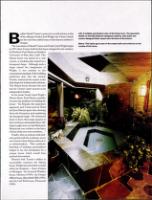
Left: A twilight and daytime view of the living room. The geometric
details on the Eliel Saarinen-designed credenza, side chairs and
custom-designed Stark carpet echo the lines of the interior.
Below: This hydro spa is part of the master bath and conforms to the
module of the home.